

Skip to Content
Mag

Canvas and Muse

For His Clothing Designer, Milos Raonic Is Both Canvas and Muse.

By Steven Kurutz

2:57 PM EDT on March 20, 2017

In 2012, Milos Raonic and Bob Smith met in a conference room at the Boston headquar- ters of New Balance, the athletic footwear and apparel company. At the time, Raonic was a rising tennis star, a 21-year-old Canadian whose 150-mile-per-hour serve had vaulted him into the Top 20 world rankings and earned him the nickname “Missile.” Smith was a 48-year-old rock drummer–turned–sportswear designer; he worked for Nike for 11 years before New Bal- ance hired him to help develop their tennis pro- gram. The company was considering signing Ra- onic to a big endorsement deal. But frst, Smith needed to ask a crucial question.
“I said to Milos, ‘Would you wear pink?’” Although designing tennis kits isn’t a
high-profle job in fashion, it can ofer an ap- parel brand a showcase like few other sports. Tournaments are played around the globe, and a player is on court for three hours wearing one non-team-afliated outft. The game’s stars are like serving, slicing, baseline-grinding billboards.
For New Balance, which is known for its anti-marketing approach—one of its enduring slogans is “Endorsed By No One”—outftting Raonic was a savvy way to up the brand’s profle internationally. Smith and his bosses wanted an up-and-coming player who would cause a sensa- tion, get people excited about the sport, and win singles titles—but, more important, make the clothes look great doing it. As Smith put it, “You want Andre, not Pete.”
Their collaborative relationship as designer and muse began ahead of the Australian Open, in 2013, and it ofers a window into the numer- ous considerations both practical and esoter- ic that go into making a tennis kit that pops. What’s the right balance between function and style? How can you stand out during all-white Wimbledon? Headband or no? And can any player ever look as cool as Borg in his ’70s Fila tracksuit and spread-collar, body-hugging tops?

For Raonic, the most important aspect of a kit is how
the clothes perform. “Out on court I want to give myself
the best opportunity to win,” he says. “I can’t have a shirt
that feels heavy if I sweat in it, or one that’s sticking to
your body if it’s humid.” The best thing, he says, is “to put
it on and it’s not something you ever think about again.”
Like a Paris couturier, Smith and his team create an
entire custom outft—a top, a short, and shoes—for every
Slam and big tournament, from the Australian Open in
January to the ATP World Tour Finals in November. New
Balance has a handful of lower-tier players signed to deals,
but Raonic is their fashion swan, the client who gets the
greatest consideration and most striking clothes, down to
accessories like socks and wristbands. “I hate when you
see a guy on court and his kit looks great but his ankle
supports are gray. As if they don’t matter,” Smith says.


Early on, the designer and player experimented with
diferent materials. Smith would tell Raonic, “Play in this,
now play in that, tell me how you feel about each one.”
When they got performance down, they focused on ft
and, fnally, their raison d’être. They had to come up with
a compelling story for why people should care about New
Balance tennis. “Nobody needs another clothing brand—
nobody,” Smith says with a laugh. With its northeastern
location and proximity to the International Tennis Hall of
Fame in Newport, Rhode Island, it was decided that New
Balance would be the New England tennis brand. That
image ft well with Raonic, who is 6’5” and stockbroker
handsome, with an understated personal style and maybe
the best hair in the game—a bushy mini-pompadour that
stays miraculously unmoving during play.


“I wanted something that would represent my per￾sonality, who I see myself and project myself to be,” Ra￾onic says. “We focused on simplicity. Designs and color schemes that are beautiful in a quiet way.”

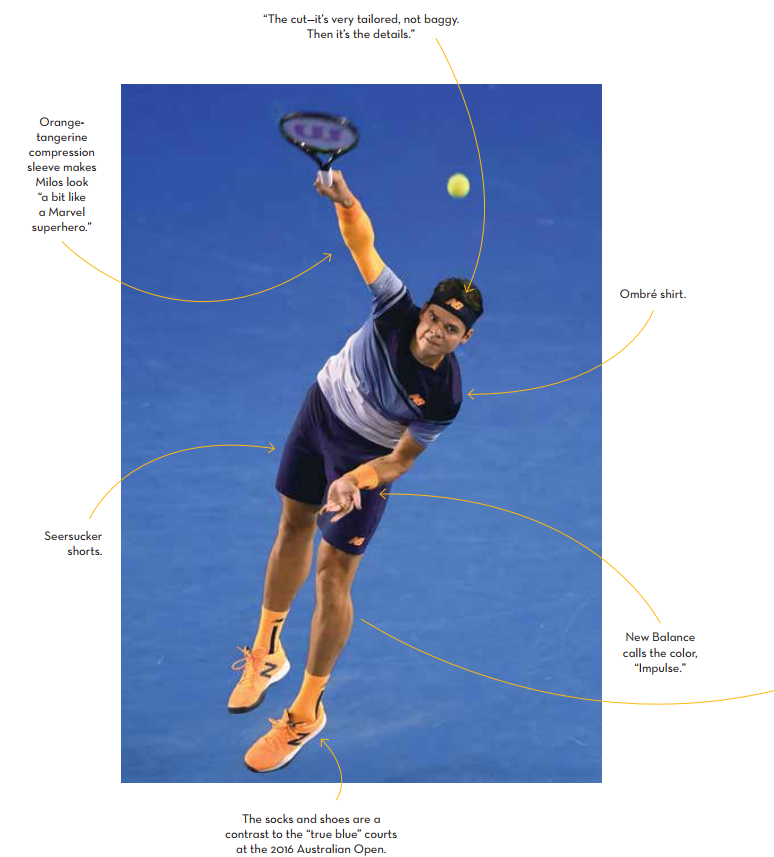
Smith says: “I’m not going to do paint splatter, right? I want him to look super, super crisp. There’s a stripe theme running through the kits. The cut—it’s very tailored, not baggy. Then it’s the details.”

Raonic sees Smith as the “eccentric creative type,” constantly sending him ideas, while his more analytical brain critiques what he likes and doesn’t. He likens himself to “the guy after the flm is shot, the editor—I’m very critical, let’s put it that way.”

Last year, for the Australian Open, Smith put Raonic in a technical-fabric seersucker short. At the 2014 Rogers Cup, held in Toronto, he added a white maple-leaf detail to his red top as a nod to Raonic’s heritage—an example of what he calls “designing in situ.” When Raonic plays this year’s Wimbledon, he’ll be wearing white, of course, but his polo shirt will have a jacquard weave of an English rose, a subtle way Smith can make him stand out.

Andre.

Smith never formally studied apparel design. Instead, he treats each season as a “big graphic-design project,” he explains, like back when he used to make his band’s gig posters. He’ll create a Slam template with the characteristics
of each tournament and the associations they conjure for him. The Australian means summer-bright skies, sizzling daytime temps up to 110 degrees, and fans who chant and jeer and paint their faces in national colors like soccer hooligans. Wimbledon is all strawberries and cream and the Queen. With its red clay courts and European playboys flling Roland-Garros, the French has a Mediterranean vibe, while the U.S. Open plays out just ahead of New York Fash￾ion Week. Smith and Raonic can be remarkably detail-oriented about each event, considering, for instance, the color of the court and sponsor boards at a stadium, and how an outft will play of of them. Raonic even thinks about how a kit will look when he’s photographed from a top-down bird’s-eye view. Everything is in service to standing out.

Milos.

That’s what happened spectacularly at the 2016 Aus￾tralian Open. Having seen in person the vibrant “true blue” court surface of Melbourne Park, Smith designed for Raonic a pair of dark blue seersucker shorts and an
ombré shirt of a lighter blue, then contrasted the primary color with shoes and socks of orange-tangerine. The combination was sublime, painterly, turning Raonic into a moving Matisse canvas in front of 10,000 fans and the international press.

Andre.

With his matching tangerine compression sleeve, Raonic also looked a bit like a Marvel superhero—and played like one, too, going deep into the tournament before losing to Andy Murray in the semis.
“Everything came together perfectly—the kit, the court color. He was on every page of the papers, he won best dressed [on an infuential fashion blog],” Smith says.


He laughs. “Sometimes I feel almost like I’m a stylist, knowing what he’s comfortable with. This season I wrote the brief for New Balance—literally, it was called ‘The Evolution of Milos.’”

Vilas.

The Australian kit, Raonic says, was perhaps the best-exe- cuted so far. What he loved was the way Smith used the bold orange for the accessories and the footwear, “to not be too loud, but speak in its own way.” (Raonic added that his fellow players are also fashion critics: “You’ll see players in a therapy room, watching the same TV, and it’s a third-set tiebreaker, a critical match, and you’ll hear people’s ideas: ‘That is a beau- tiful kit’ or ‘That is a horrendous kit.’”)
Raonic is generally open to Smith’s choices and the style trends of the game, like the sexier, mid-thigh shorts popular these days. But he has his sartorial limits, as when Smith re- cently suggested he take the court in knee-high striped socks, like those Guillermo Vilas rocked back in the early 80’s as one of the stars in ellesse’s stable. Raonic balked.

Borg.

When Vilas would get hot during matches, he’d roll his socks all the way down to his shoes. Smith sent Raonic a pho- to with a note that said, “Hey, here’s your socks for 2018.” The reply came back: “Maybe not.”
It wasn’t for fear of looking like a fool on court that Raonic said no, however. It was for a more particular reason, one that illustrates just how sensitive athletes are to what they wear during performance. “It would be having material where I’m not used to having materi- al,” he explains. “I’ve grown up having socks at a certain height.” Raonic laughs, then adds, “It would also leave weird tan lines. I’d have calves that were pale.”


Still, both men share an appreciation for ten- nis fashion from back in the ’70s and early ’80s, and what Smith called its “swashbuckling atti- tude.” Both cite Borg in his cream pinstripe Fila shirt and striped headband as the game’s ulti- mate style icon. Raonic also loves the way John McEnroe, his sometime coach, would wear his U.S. Davis Cup long-sleeve jacket to Wimbledon year after year. Unlike today’s players, who change kits after every event, those guys wore the same outft over sea- sons, an identifed uniform.
But every player is a creature of his time and how the game is played in that era. Ultimately, Smith says, he and Ra- onic have only one goal with regards to a kit: “Really, what I’m trying to do is make this guy look amazing. I want him to feel like Superman when he’s on court. I want people to gasp, ‘Oh, shit, he looks great.’”

Steven Kurutz is a features reporter for The New York Times and the author of Like a Rolling Stone: The Strange Life of a Tribute Band.

Featured in Racquet Issue No. 3

Stay in touch

Sign up for our free newsletter

More Stories

Can Green Clay Save the World?

Tennis has a complicated relationship with the climate, but new initiatives—including a switch to good ole Har-Tru—show it can be part of the solution.

July 23, 2026

Racquet’s Guide to Los Cabos

When you bring your racquet to Los Cabos, you discover a travel experience where tennis meets the sea, the desert and a vibrant Baja culture—a perfect blend that’s made the Mifel Tennis Open by Telcel Oppo an unmissable stop on the ATP Tour for ten years running.

July 20, 2026

Fit(s) For a Queen

The Serena Williams Fit-Dex is hands-down the best use of the internet.

July 16, 2026

Is it OK for a Player to Disappear?

The conversation around mental health has helped transform the sport, but as openness becomes the norm, another question is beginning to surface: Can vulnerability remain meaningful if athletes no longer feel free to withhold it?

July 14, 2026

Postcard from Wimbledon: Practice Is a Privilege

In this letter of recommendation, our correspondent reports from the All England's Aorangi Park, where the press can sit and absorb a sense of wonder and astonishment and porous, melancholy outsiderness. Where we are reminded, after all, that we are mere witnesses to these shapes and strokes of beauty, and not their arbiters.

July 6, 2026

How Wimbledon Stays Elite, but Not Elitist

Wimbledon Court is the All England Lawn Tennis Club’s effort to give New Yorkers the chance to play on a rare surface in the city’s backyard. It’s also part of a larger effort to ensure the tournament delivers on its promise of “the pinnacle of sport” and broadens the tennis fanbase to the next generation.

June 29, 2026