

Skip to Content
On Court

Elina Svitolina Doubles Down

[vc_empty_space height="5px"]

By Giri Nathan

[vc_empty_space height="15px"]Elina Svitolina, the top seed this week in Monterrey, announced on Monday that she wouldn’t play her first-round opponent unless specific conditions were met. She had drawn world No. 115 Anastasia Potapova, who competes under the Russian flag. In a statement marked with a yellow-and-blue fist and the word “Ukraine,” Svitolina urged the ATP, WTA, and ITF to adopt a new policy for Russian and Belarusian athletes: Present them neutrally, without symbols, colors, flags, or anthems. “I do not blame any of the Russian athletes,” she wrote. “They are not responsible for the invasion of our motherland.” She thanked those fellow players who’d spoken against war, especially those from Russia and Belarus.

The governing bodies of tennis obliged. Open the official world rankings and you’ll now see a blank space instead of a Belarusian flag next to world No. 3 Aryna Sabalenka, instead of a Russian flag next to (newly crowned) world No. 1 Daniil Medvedev. Players representing these two countries can still compete individually and neutrally, but the two tennis federations have been suspended and barred from international team competition. The ATP and WTA also suspended the Kremlin Cup, a combined event to be held in Moscow this October.  

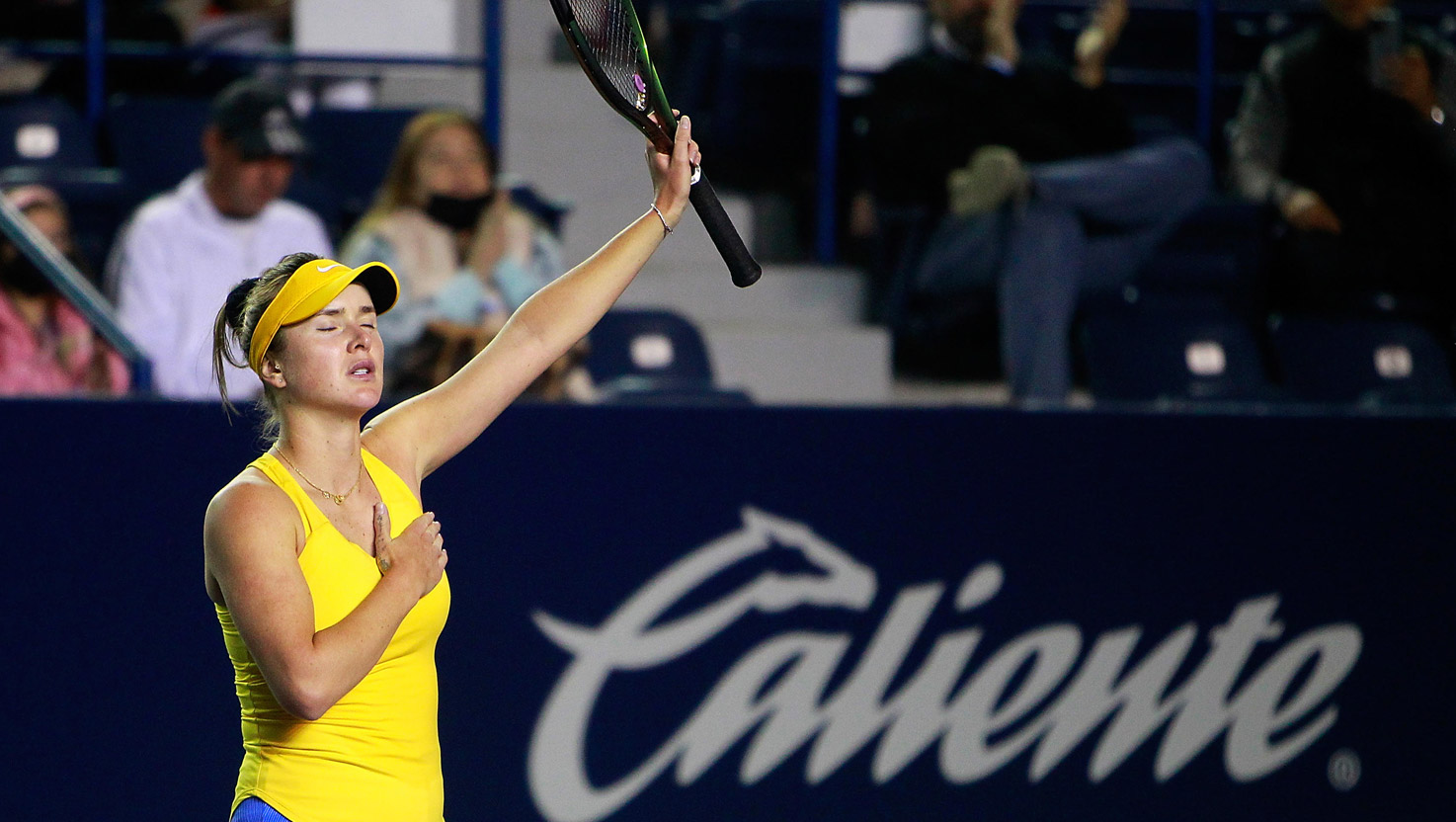
The 20-year-old Anastasia Potapova, who had written that athletes became “hostages of the current situation,” and that she was “against grief, tears, and war,” appeared on court in Monterrey, statelessly. Svitolina doubled down on her own state, arriving in a yellow top and blue skirt. She’s been in a slump since late last season: She ended 2021 outside the top 10 for the first time since 2016, and she hasn’t beaten any player ranked inside the top 50 since last October. She came to this one with intense purpose, edging ahead in a first set that was more tense than the scoreline suggests—Potapova chucked her racquet around—before rolling in the second to win 6–2, 6–1. “In general I was just focused. I was on a mission for my country,” she said on court after. She won her second-round match against Viktoriya Tomova on Thursday night, coming back from 0-2 down in the third set, and afterwards thanking a fan in the stands who held her flag and shouted “Ukrainians never give up.” She said she’ll be donating all her winnings in Monterrey to the Ukrainian army. 

Her countrywoman, world No. 140 Dayana Yastremska, heard the war firsthand. She recently beat world No. 3 Barbora Krejcikova in Dubai, and last week she was offered a wild card to play at the Lyon Open. She’d been visiting her parents in Odessa, preparing to head to the tournament, only to be “woken up by bombs” last Thursday. The family spent two nights sheltering in an underground parking garage, before Dayana and her sister headed to Romania by boat with their mother, as their father stayed back, since Ukrainian men of fighting age cannot leave the country under martial law. The sisters continued on to France, without either parent. The Lyon Open offered the two of them a doubles wild card, too.

This Tuesday, just four days after she fled Odessa, Dayana won her first-round singles match in Lyon against Ana Bogdan. It ran three hours, five minutes long, and saw her save a match point in each of the second- and third-set tiebreaks. “This win, compared to what’s going on in my country, is nothing. But I’m happy, at least, I’m also fighting for my country. I’m really proud of the Ukrainians and they’re really heroes,” she said. “I hope everything is going to finish soon.” She won her second-round match against Cristina Busca, 6–2, 6–3. The 21-year-old Yastremska, who’s been ranked as high as No. 21 in the world, said she’s now taking care of her 15-year-old sister, who is just starting her pro career, and that she’s proud of her.[vc_empty_space height="10px"]Above: Elina Svitolina after her first round match in Monterrey against Anastasia Potapova. (Getty) 

[vc_column width="1/6"][vc_tweetmeme share_via="racqetmagazine"][vc_column width="1/6"][vc_facebook type="button_count"][vc_column width="1/6"][vc_column width="1/6"][vc_column width="1/6"][vc_column width="1/6"][vc_empty_space height="45px"][vc_column width="1/4"][vc_column width="1/2"]

NOW AVAILABLE
Issue No. 18

racquet_issue-18

[vc_btn title="BUY NOW" style="outline" shape="square" color="success" size="lg" align="center" button_block="true" link="url:https%3A%2F%2Fracquetmag.com%2Fproduct%2Fissue-no-18%2F|title:GET%20IT%20NOW||"][vc_column width="1/4"]

Stay in touch

Sign up for our free newsletter

More from Racquet

Jannik Sinner Can’t Lose (Except at Content)

When Aryna Sabalenka’s on-court intensity translates into campy, self-congratulatory TikToks, harmony is felt and sense is made. But Jannik’s on-court persona, tightly controlled like an unseasoned chicken breast, respectfully, need not be repackaged for YouTube. Because where is the flavor?!?

April 13, 2026

Issue No. 28: Tennis is the Blueprint

“To create one’s own world takes courage.” —Georgia O’Keefe

April 13, 2026

The Disappearing American College Tennis Player

These days, American college tennis is barely that: American

April 3, 2026

The Elegant Order of the Court

Sure, game-play conditions may vary, and a maintained court is more enticing for actual play, but as purely aesthetic fascinations, the inherently satisfying rationality of court design endures. 

April 3, 2026

The Morte d’Arthur Was Greatly Exaggerated

Frenchman Arthur Fils—the charisma bomb—is back and looking better than ever.

March 30, 2026

An Open Letter To Daniil Medvedev: Are You “So Back?”

Racquet’s See You In Court is a regular column in which Melissa Kenny, a famously mediocre lifelong player, opines on pro tennis. She also writes Hard Hitting, a Substack about the thrills and frustrations of recreational tennis.

March 20, 2026
See all posts