

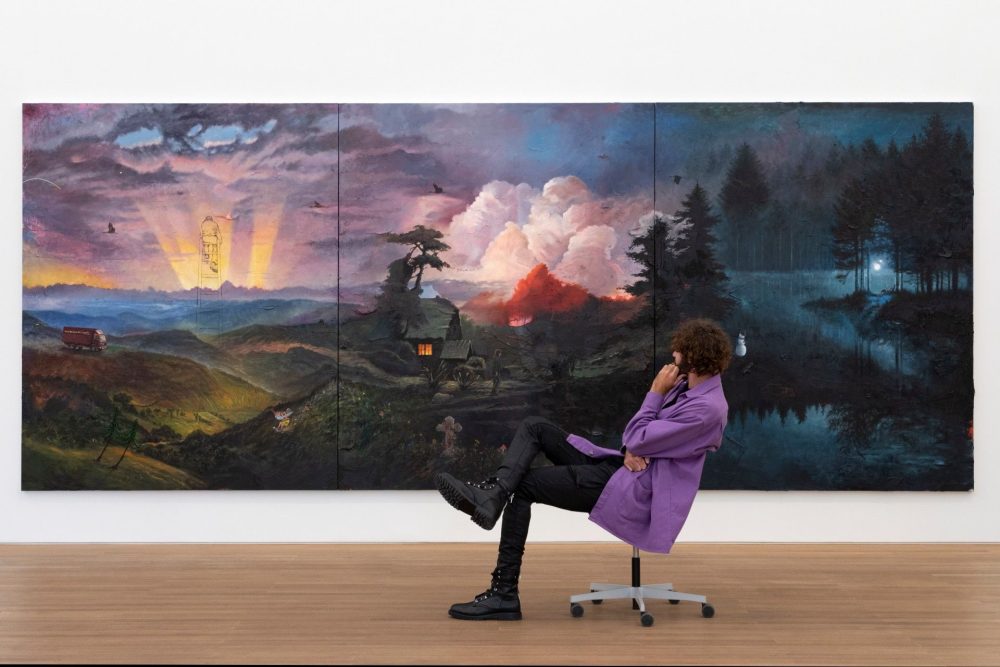
The TVLG ART x TENNIS CLUB has no dues or fees. It is a club with no clubhouse, no admissions committee, no code of conduct. ATP pro and art collector Reilly Opelka is one of two co-founders. The other is the Belgian gallerist Tim Van Laere, a former college player whose eponymous gallery (TVLG) sponsors Opelka. Friedrich Kunath and Rinus Van de Velde, artists whom Van Laere represents and Opelka collects, are passionate recreational players and core members. Venus Williams is in on it, too—a fellow art collector and close friend of Opelka, Venus is absolutely TVLG ART x TENNIS. TVLG ART x TENNIS is non-hierarchical, apolitical, a state of mind. “It’s something very cerebral,” Van Laere told me.
The club is in session whenever and wherever the worlds of art and tennis collide. When Hubert Hurkacz, on Opelka’s recommendation, visited Van Laere’s gallery in Antwerp, that was TVLG ART x TENNIS. In June 2022, when Van Laere, Kunath, and Van de Velde attended Wimbledon as guests of the 15-seed Opelka, that was TVLG ART x TENNIS x ALL ENGLAND CLUB. The Wimbledon situation, as recounted to me by Van Laere, is a funny one to imagine: Kunath, a melancholic East German whose paintings are held in collections at MoMA and LACMA, helping Opelka stretch out on a practice court; Van de Velde, who makes elaborate autofictional films and rarely leaves his Antwerp studio, watching from Opelka’s box as he beats Carlos Taberner in the first round; Opelka, at dinner after that victory, talking art history with Van Laere.
The TVLG ART x TENNIS gods move in mysterious ways. They arrange unlikely scenes and pairings. Kunath, who has also accompanied Opelka to the Laver Cup, the Japan Open, Indian Wells, and other Wimbledon tournaments—and has been credentialed as one of Opelka’s coaches—recognizes the appeal of his presence in the box and the locker room. He once had a particularly illuminating conversation with Opelka at Wimbledon, just before a match. They weren’t discussing strategy, or jointly manifesting a straight-sets sweep; they were talking about an artist. Kunath couldn’t recall exactly who, but he thinks it was probably Philip Guston, an Opelka obsession at the time. “I was like, is he serious? He’s going on court in 20 minutes. Why are we having this conversation? Then I thought about it, and I realized: it’s deflection.” Kunath, for his part, often looks to Opelka to provide similar relief at his art shows—he recently had a show at the Pace Gallery in New York, his debut exhibition with that august gallery, where Opelka was a welcome, singular presence. Here was someone he didn’t need to flatter, or fear, or lecture about his process. Here was someone he could talk tennis with.
The most memorable experiences at the intersection of art and tennis involve reciprocity. Artists want to talk and/or play tennis; tennis players want to talk and/ or see art; a balance is achieved. In December of last year, the 28-year-old Opelka traveled to Memphis to watch his 59-year-old friend Stephen Malkmus, the lead singer of the indie rock band Pavement, do a solo show at the Raised by Sound Music Festival. The two were introduced by Kunath, who became Malkmus’s hitting partner while Malkmus was rehearsing in Los Angeles for the 2022 Pavement reunion tour. Opelka described the Memphis trip as an “epic” weekend. There was a visit to the home of the legendary photographer William Eggleston, a Malkmus associate, and a meal at a soul food restaurant: fried chicken, collard greens, peach cobbler. On the day of the show, Opelka toured Graceland while Malkmus did soundcheck. Then there was the performance: Malkmus in jeans and a blazer, playing a red electric guitar, singing, among others, the Silver Jews song “Federal Dust,” which he co-wrote with his late friend David Berman (who also collaborated with Kunath on the 2013 book You Owe Me a Feeling). Opelka worships Berman and Silver Jews, of which Malkmus was an original member; he owns a copy of Berman’s acclaimed but little-known poetry collection, Actual Air. “That’s pretty niche,” Malkmus said. “For someone from tennis.”
In Memphis, Opelka and Malkmus also found time for an hour of tennis. Malkmus played high school tennis in the early 80s and got back into the sport just before the pandemic—“I bought a Babolat racquet and started brushing up on the ball and shit like that,” he told me. When they played, Malkmus insisted Opelka hit him some “real serves,” so long as Opelka told him where they’d land—Opelka’s first serve has been measured as fast as 149 MPH. “I stood back where Medvedev stands and tried to get a racquet on it,” Malkmus explained, laughing. He laughed a lot when telling me about Opelka; he seemed flattered, amused, energized by his friendship with a pro tennis player. “He’s kind of an old soul,” he said. “I don’t like to use that term so much, but he’s bright, he’s a smart kid. He’s not a kid. He’s giant.” (Opelka is 6’11”, tied with the retired Croatian Ivo Karlović as the tallest-ever ATP player.) The love is mutual. Opelka has long admired Pavement, and he hasn’t been disappointed by its playful, effortless frontman. “Talk about a pure artist,” Opelka said. “Sometimes I’m scared to meet artists. But Malkmus, his stock as an artist went through the roof after I met him.”
Opelka is a succinct and opinionated conversationalist. He likes to issue crisp pronouncements. One of the beliefs he shared with me is that there are two types of people in this world: artists and everyone else. I asked him to define the distinction. He replied obliquely that art has to choose you. Then he brought up the Pavement song “Stereo”—in which Malkmus quotes The Lone Ranger, recalls razing a demon settlement, and howls about how his baby gave him malaria—as evidence of an audacity not found in civilians. To sing that song, “you have to be so confident,” he told me. “Like, your parents are going to tell you, ‘What are you doing?’”
Opelka is an audacious person himself. He upends tennis’s genteel conventions, challenges its staid establishment. At the 2021 U.S. Open he was fined $10,000 for carrying a pink Tim Van Laere Gallery tote bag on court because the logo was too big— “I mean, what a joke on the U.S. Open to do that,” he later said. In 2025 he was fined for calling one umpire an “idiot” and another “the worst ump on tour.” He has advocated for the elimination of professional doubles, claiming doubles players receive a share of tour resources—practice courts, physios, prize money—disproportionate to their ticket sales and tennis skill. And alongside Nick Kyrgios, he was the highest-profile name attached to the Professional Tennis Players Association’s antitrust lawsuit brought against the ATP, WTA, ITF, and ITIA in March 2025. The suit described tour organizers and tournament operators as a “cartel” who enjoy “complete control over the players’ pay and working conditions.” (The PTPA has since removed the ITF and ITIA as targets of its legal actions and set its sights instead on the governing bodies of the grand slams, minus Tennis Australia, with whom they reached a settlement in December 2025. Opelka has not signed on to this new version of the suit.)
Both Van Laere and Kunath spoke to me about Opelka’s appetite for rebellious artists; Kunath suggested that he might look to these artists to better understand himself. One favorite is Lou Reed. Another, as noted, is Philip Guston. Guston was a celebrated abstract painter who eventually renounced abstract art as “a sham, a cover-up for a poverty of spirit.” His late-career embrace of representational painting—most notably his satires of Klansmen—caused a stir among critics and nearly destroyed his reputation. Opelka also collects work by the contemporary provocateur Jordan Wolfson. Wolfson once beat the shit out of a lifelike animatronic doll in a virtual-reality installation at the Whitney.
Opelka avoids “characters” in the art world—artists passing themselves off as more talented, committed, or visionary than they truly are. Instead, as he explained when I visited his art-filled South Florida home, he wants “serious” artists in his collection, which is headlined by names like Yoshitomo Nara, Paul McCarthy, and Carroll Dunham. One of Opelka’s prized possessions is a painting by the 32-year-old Belgian artist Bram Demunter. Opelka considers Demunter a serious artist for his ability to create surreal, fantastical landscapes, and he also respects that Demunter leads a modest lifestyle, living and working in Kortrijk, the small Flemish city where he was born. Another real one in Opelka’s collection is the German artist Jonathan Meese. In a conversation with GQ in 2022, Opelka said what legitimized Meese in his eyes was his advocacy for a “dictatorship of art;” as Meese declared in an address at Paris’s Centre Pompidou, in such a system art is “total power” and “stronger than religion, politics, and self-fulfillment." I saw one Meese painting during my tour of Opelka’s collection: a large rendering of a fetal figure suspended between a man and a woman, tethered to their outstretched hands by what appears to be an umbilical cord. The man is well built and has a prominent phallic bulge at his waist; the woman’s form is towering and maternal. “I see it as a beautiful painting of Meese’s interpretation of how to create life,” Opelka told me.
Opelka began visiting museums and galleries when he started touring Europe as a pro in the late 2010s. He likes those spaces because they provide the context necessary to discern quality; he can revel in a masterwork and then consider a piece in its shadow, and see if it holds up. “I like institutions like the Prado, MoMA, because you see who can hang. Matisse can hang with Picasso, Picasso can hang with Cy Twombly, Twombly can hang with Giacometti. But I’m also appreciative of the times when you go to a museum that’s not as much of an institution. Where you see an Albert Oehlen, and then you see another artist who’s not Albert Oehlen, and you learn quickly, there’s levels here.”
At the highest level of the art game, Opelka sees Picasso, De Kooning, Guston, and Francis Bacon. Of Americans working today, he thinks Kerry James Marshall, Ed Ruscha, and Paul McCarthy are the most significant. But these are just opinions, which he admits are circumscribed by his taste. He believes that “there’s no such thing as a bad artist”—even “characters” aren’t bad artists, just not for him. This deference to subjectivity is notable in a tennis player, whose class is determined by a points-driven ranking system. Opelka’s ranking as of the time of this writing is 63rd; his career high, achieved in 2022, is 17. His good friends Taylor Fritz (#9), Tommy Paul (#20), and Frances Tiafoe (#34), whom he has known since they were students together at the USTA training academy in Boca Raton, are all currently above him, and all have better career-highs.
If ATP rankings came with footnotes—or turgid artworld-style press releases—Opelka’s blurbs might explain the hip, wrist, and back ailments that have sidelined or hindered him for the majority of the last four seasons. They might extol the resilience he displays each time he brings his embattled body onto a tennis court— or imply that his mere return to the sport after so much time away stands as its own achievement. But Opelka is hostile to that sort of editorializing. In an interview with the Tennis Channel’s Steve Weissman in August 2025, he resisted Weissman’s suggestion that his ranking, then 73rd, would have been higher had he not been so beset by injury. After nearly two full years away, Opelka had been back on tour for a year, and he felt he was underperforming. “I’m at that ranking for a reason,” he said. “I’ve been losing a lot of second- and third-round [matches]. I haven’t gone on runs. I made a final the first week of the year, and a semi—these were at the 250-level—but I haven’t had a run at anything bigger than that. And that puts you at number 73.” Opelka appreciates that tennis is a meritocracy grounded in incontrovertible results; personal histories may contextualize the numbers on a scoreboard, but they won’t change them. “It doesn’t matter what you are, where you’re from, what you come from—if you’re good, you’re good, and you’ll beat the other person that day,” he told me.
Opelka spent his childhood in Palm Coast, Florida, a small city 70 miles south of Jacksonville, where his dad, George, led sales and marketing for a company that sold real estate appraisal software. He comes from athletic stock—George, 6’6”, briefly played basketball at Walker College in Alabama, and his mom, Lynne, has become a racquet sport enthusiast in her adulthood—but neither of his parents had any experience with tennis before he picked up a racquet at age five. His early development in the sport was facilitated by Tom Gullikson, the former U.S. men’s Olympic coach and Davis Cup captain, who retired in Palm Coast and befriended George at a bar. George mentioned offhandedly that his son liked tennis, and soon Gullikson was taking more than a neighborly interest in his development. Opelka remembers a day in his pre-adolescence when Gullikson pulled him out of school to hit with Kevin Kim, a visiting ATP pro. Asked if he could hang with Kim at that age, Opelka laughed: “Absolutely not.” But Gullikson, then in his 50s, kept up. Watching him, Opelka remembered thinking, “‘Oh my God. This guy’s unbelievable. This is the guy I get to hit with.’”
When Opelka was 12, he began attending weekend camps at the USTA academy in Boca, four hours south of Palm Coast. At 13, he was invited to attend the academy full time, an opportunity he and his family jumped at, though it led to their separation. George stayed and worked in Palm Coast while Opelka, Lynne, and Opelka’s older sister, Brenna, moved into a small apartment in Boca, where Brenna started at a new high school. George Opelka, who visited Boca regularly, was no Emmanuel Agassi—“he was a gentleman,” Opelka assured me—but he did impress upon his son the weight of the sacrifices made for his tennis dream. Still, George was humane about expectations. He wanted only for Reilly to commit wholeheartedly to the game; he wasn’t fixated on rankings or results. “My dad explained to me that winning doesn’t change this either. Winning doesn’t make this any cheaper. All of this is worth it only if I give my best.”
But with the advanced training he received from USTA coaches Jay Berger (who remains his coach to this day) and Diego Moyano, and the sports scientist Mark Kovacs, winning followed. At 15, Opelka was a finalist at the 2013 USTA Boys' National Clay Court Championship in the 16-and-under division, and was again a finalist in the next year’s 18-and-under division. In 2014, at 17, he beat future pro Michael Mmoh to win the Boys’ 18 Eddie Herr International Junior Championships; the tournament was hosted by IMG Academy in Bradenton, where Mmoh was a student and drew a large crowd; Opelka served 16 aces and won in straight sets. Winning Eddie Herr was a big deal, but the capstone of his junior career occurred the next summer, when he beat another future pro, Mikael Ymer, in the Wimbledon Boys’ Singles final. With his win at Wimbledon, Opelka joined an historic winner’s circle: Björn Borg, Ivan Lendl, Stefan Edberg, and Roger Federer had all also claimed the boys’ title there. He turned pro soon after—but not without reservations about his game. “I definitely knew there was a difference between the pros and the juniors,” he told me. “I knew I had weaknesses. At the junior slams, you’re often a practice partner with the pros, and they pick you apart. You beat the juniors, but then you go hit with a guy ranked 100, and he brings you down to the ground really quick.”
In the juniors, Opelka wasn’t as dominant and consistent with his tall-guy serve as he is now, which meant he was frequently broken, and therefore had to break his opponent more than once to win a set. “It was so easy, because guys weren’t really hitting big second serves yet. and I would run around and hit forehands on the second serve return all day,” he told me. But practicing with players like Jiri Vesely (career-high #35) and Denis Istomin (#33) as a junior introduced him to second serves he hadn’t seen before; their speed, spin, and angles were overwhelming. Understanding how hard it would be to break his new peers, Opelka committed himself to mastering his own serve, so as to keep himself in matches. By the end of 2019, he had the tour’s third-highest serve rating. In his healthy, non-COVID years since, he has finished second, third, and fifth in the category.
Opelka’s breakout year was 2019; he won his first tour title at the now-defunct ATP 250 New York Open, semi-finaled in Basel and Tokyo, and represented the U.S. at the Davis Cup Finals. He averaged 21.1 aces per match, second only to John Isner, who holds the men’s record for most-ever career aces. Opelka’s best year was 2022. He won tour titles in Houston and Dallas, finished second at the Delray Beach Open, and was a semifinalist at the Geneva Open. In late February of that year, he was 17th in the world and the highest-ranked American on tour. He kept a bushy beard and had grown out his curls in a style that recalled Jim Morrison. He was sponsored by Fila, Red Bull, Wilson, and, of course, the Tim Van Laere Gallery. He wore Thom Browne suits, owned expensive art, and had a few million dollars in tournament winnings to his name. He wasn’t quite at the top of the game, but he was only 24, and close.
Opelka lives in a quiet neighborhood of modest ranch homes and multi-family complexes. His house, wide and lowslung and roofed with terracotta, over- looks the Intracoastal Waterway, which laps placidly against a long, stilted dock, and carries a deep blue hue at night. When I visited Opelka in mid-December, he was joined at home by his girlfriend, the model and musician Soo Joo Park, who has walked runways for Chanel and appeared on the cover of Vogue Hong Kong, and her excitable Pomeranian, Aeon. Our meeting was slotted between a training session and a beard-trimming appointment. The next day Opelka and Park were attending a precursor event to Venus Williams’s wedding in Palm Beach.
In his entryway, Opelka showed me a Kunath painting, one of the first pieces of art he ever bought. Titled “I Am Easy to Find,” it is a neo-Romantic painting of a hyperbolic sunset over a grassy waterside bank; the waterbody of the canvas’s bottom quarter reflects the overhead scene’s yellow, orange, green, and blue, and its spotted clouds. At the center of the painting, on the edge of the bank, a coupe paneled in some of those same colors is open to the viewer’s vantage, but is sealed off on the other side by a large tree. Above the car in the sky the titular text can be read, and etched into the canvas, only legible upon close examination, are the words “soul and fire.” I knew that these text fragments were essential to Kunath’s style: the day before my trip to Florida, I visited his show at Pace, where I saw landscapes—a misty highway on the edge of a forest, a sunset over a breaking wave—marked by phrases like, “Someone’s Therapist Knows All About You,” “If It Comes, Let It; If It Goes, Let It,” “Winsome / Lonesome.”
Looking at “I Am Easy to Find,” named for the song by The National, I felt incongruously wistful: wasn’t this a straightforwardly, even aggressively, pleasant painting? A candy-colored sky, a view of one’s own? Before I could interrogate why and what I was projecting onto the work, I became distracted by the words, I AM EASY TO FIND, and it didn’t take very long to decode their connection to the coupe, and the tree, and the seven-foot man standing before me. When I’d completed this interpretive game, I felt undercut, like just as I was starting to fall into it, the painting had lost its mystery. Then I wondered if the text had been placed there to dupe smug literalists like me. I argued against myself: what if Kunath’s conspicuous hand didn’t undermine the work, but actually distinguished it in a knowing, postmodern way? As I deliberated, Opelka cut in, as if having read my thoughts. “There are some people who would love to have this painting with no text, no etching, just a beautiful sunset,” he said. “But that takes away the artist. That takes away his whole spirit. You’d lose me, for sure.”
For Kunath, landscapes have always been portals to feeling. As a child he was strongly affected by the work of the German Romantic Caspar David Friedrich. “I never saw landscapes in his work,” he told me. “I always just saw an emotional condition through the veneer of a landscape. I saw a sunset, or birds flying around, and I would feel this profound kind of longing.” Dislocation is a central theme of Kunath’s life; he grew up in East Germany, moved to West Berlin and then West Germany as a teenager, and has spent the last 18 years in Los Angeles. His art can feel similarly unmoored, especially his landscape work, into which he likes to insert discordant symbols and his signature text fragments. Kunath landscapes feature elements like the Oasis logo and lines pulled from cult folk rock albums; kitschy graphics like lounging cartoon animals and anthropomorphized fruit; and Romantic natural scenes, wherein suns set over oceans and mountains, and lone silhouettes stare down dramatic horizons. As idiosyncratic as he is, Kunath told me he makes art for an audience. “If I were alone in the world, or on an island, and I knew that no one would ever receive my work, I’m not sure I would do it,” he said.
No one receives Kunath’s work more attentively than Opelka. He has memorized many of the texts and etchings in Kunath’s paintings, and he often surprises Kunath by recalling lines even the artist doesn’t remember. In late 2025, Opelka visited Kunath’s studio in Los Angeles—afterwards, he sent a text reflecting on what he had seen. “I was like, ‘Holy shit, dude, this is like, curatorial observation level,’” Kunath told me. “He fully understands the emotional practice that I do, and he’s able to express it in a very serious and very profound way, without artspeak.” I asked him to be more specific: what did Opelka see, comment on? Kunath became more impassioned and only slightly less abstract. “He sees the work as not only the work itself, but he also understands the emotional value, or the emotional sculpture of the work. He understands the way my studio works as an emotional interior. We were talking about how even in the simplest way, the work can convey an emotional complexity…it’s a very philosophical conversation, because how much complexity is in a sentence like, ‘Fuck it, I love you,’ you know?” (Kunath has more than once inscribed those words onto paintings; Opelka owns one.)
I know from our conversations that Opelka appreciates Kunath’s sense of world-building, his ability to transport landscapes into singular fantastical realms. As Opelka put it to me, “Kunath will never imitate nature.” This is important to Opelka—he believes that any artist who tries to depict nature photorealistically is fighting a losing battle (“You’ll never win that war with nature”). And when an artist doesn’t try to imitate nature, they have the freedom to create utopias. In his bedroom he showed me a large painting by the Belgian artist Ben Sledsens, of a snowy, densely wooded forest. He pointed to a pond at the bottom of the canvas, nearly a perfect oval in shape, and an overturned tree that cut a sturdy path across it. “It’s important to me that his nature work is a total utopia,” he said with curious conviction.
In August 2022, five months after earning his career-high #17 ranking, Opelka underwent surgery to remove a benign tumor in his hip, fragments of which periodically became lodged in his hip joint and cut off his leg’s mobility. He returned to practice courts in December of that year, but in January 2023, training in advance of a comeback at the Dallas Open, he ran into a fence hitting a forehand and partially dislocated a tendon in his wrist. The injury required surgery, which resulted in an infection and required another surgery. The infected cultures gathered during surgery two were then lost. A trip to a New York infusion center ensued; the Chief of Infectious Diseases at the Hospital for Special Surgery was consulted. For eight months Opelka wore a cast and sling that kept his collarbone unnaturally extended and his right arm at a 90-degree angle across his chest. As a result he developed Thoracic Outlet Syndrome (TOS), which occurs when the nerves or blood vessels around the collarbone are compressed by an anatomical disruption. He felt sharp shooting pains any time he tried to lift his arm overhead, the motion on which his livelihood depended.
The whole thing was a mess. He saw specialists in Atlanta, Dallas, L.A., Belgium; no one could help him. He spent a week alone in Munich at the clinic of Dr. Hans-Wilhelm Müller-Wohlfahrt, a celebrity sports doctor who has treated Usain Bolt, Bode Miller, and Boris Becker, and served as the team doctor for Bayern Munich and the German national soccer team. Müller-Wohlfahrt, the man known as “Healing Hans,” couldn’t help him, either. He seriously considered retirement. Van Laere, who texts with him daily, helped discourage those thoughts. “When he talked like that,” Van Laere told me, “I told him, ‘We’re not going to talk like that. You’re going to come back.’” In the spring of 2024, more than a year after the initial injury, Opelka was seen by the Canadian chiropractor Mark Lindsay, who treated him at the Las Vegas home of NHL all-star Jack Eichel, one of Lindsay’s patients. Within an hour, Lindsay had restored feeling to Opelka’s fingers, which had been numb since the first wrist surgery. By the end of their second session the next day, Lindsay had essentially healed Opelka’s TOS by adjusting his misaligned first rib, which had been constricting a nerve. Without Lindsay’s intervention, Opelka may never have returned to tennis. But even when he did in the summer of 2024 (ranked 1188th), he did so with a wrist that will never be the same. “It’s like an achilles to a sprinter,” he said of the wrist’s importance to a tennis player.
The wrist is especially important to a player so reliant on his serve; as part of his recovery, Opelka had to adjust his service motion to take pressure off it. But the new motion brought pain to another mission-critical body part: his back. In January 2025, after beating Djokovic in two sets in the quarter-final at Brisbane, and Giovanni Mpetshi Perricard in the semi-final, Opelka retired in the first set of the final against Jiri Lehecka. The diagnosis: a bone bruise in his lower back. His first tour final in nearly three years was over in 12 minutes. “Thank you and sorry at the same time,” he told the crowd during the trophy ceremony.
In the spring of 2025, his back gave him trouble in both good wins and tough losses—against Rune in Miami (4-6, 6-3, 7-65), against Machac (6-71, 3-6) and Tien (4-6, 6-711) in Miami and Rome. Only post-U.S. Open, after making more adjustments to his serve with his physio, did he start to feel like his younger self; he felt especially healthy during his run to the quarter-finals in Basel in October. The question is whether the good feeling in his body will survive 2026. On New Year’s Day I called him in Brisbane, where he was preparing to redeem last year’s misfortune (he would lose in the second round). I asked him about his dad’s old wisdom about winning—it wasn’t everything then, but surely it must be now? Now that his income and professional ranking depend on it? Now that when he loses, angry sports gamblers leave comments on his Instagram like, “…the pain you made me feel tonight I lay it on you, you will feel x100 in all ramifications in this life and the next…”?
No. He told me he does not obsess about winning. “Winning comes with it,” he allowed, meaning proper conditioning, innovative training, disciplined gameplay—these tenets of athletic development are what motivate him. A final pronouncement from Opelka: “I just think about what I can do to become better.” It was tempting to dismiss this virtuous, media-friendly reply as mechanical, self-protective, the post-traumatic policy of someone still reeling from a concussive drop in ranking. But whether from the frankness of his tone, or the authoritative brevity of his expression, I believed him. He sounded to me almost like an artist—a pure artist, a serious artist—someone who pursues his craft with no eye toward its reception or rewards. Jonathan Meese, of “dictatorship of art” fame, calls himself a “servant of art.” In a 2011 interview with Christian Lund for the Louisiana Museum of Art, Meese explained, “I’m doing what art wants me to do. And then I’m dancing around, also screaming, talking with myself, always talking about that art should rule the world, that art is the strongest, that art is super and wonderful and great and how beautiful you are, art.” I asked Opelka if he considers himself a servant of tennis. He shrugged and said, “Yeah, servant of art, servant of tennis.” I wanted more. I said, “You, specifically, Reilly.” I reminded him how tall he is; I complimented his athleticism; I thought of Tom Gullikson and Mark Lindsay, the heroically competent men who started and saved his career. I asked if he feels chosen by tennis, the way music chose Malkmus, painting chose Kunath, on and on. He got the point. “If I was, I’m grateful,” he said. “Because I love tennis.”
Beau Dealy is a literary scout for film and television. His writing has appeared in The New Yorker's Shouts and Murmurs and InsideHook.


