

Montréal, the city New York could be without its bankers, is filled with music, art, exquisite food and locals taking advantage of their terraces the second the snows clear. It’s my hometown, and I’m biased, but even casual visitors understand that joy and indulgence are its main values. Summer is one long festival—and amidst all the culture, the best tennis players in the world touch down at the National Bank Open during a prominent part of the North American hardcourt swing.
Since the early aughts, Montréal has become known for its giant, vivid public art—notably in the form of murals—thanks to two local festivals focused on the art form, lending an open-air museum quality to the city. And for the past three years, thanks to Tennis Montréal, those worlds are now joined.
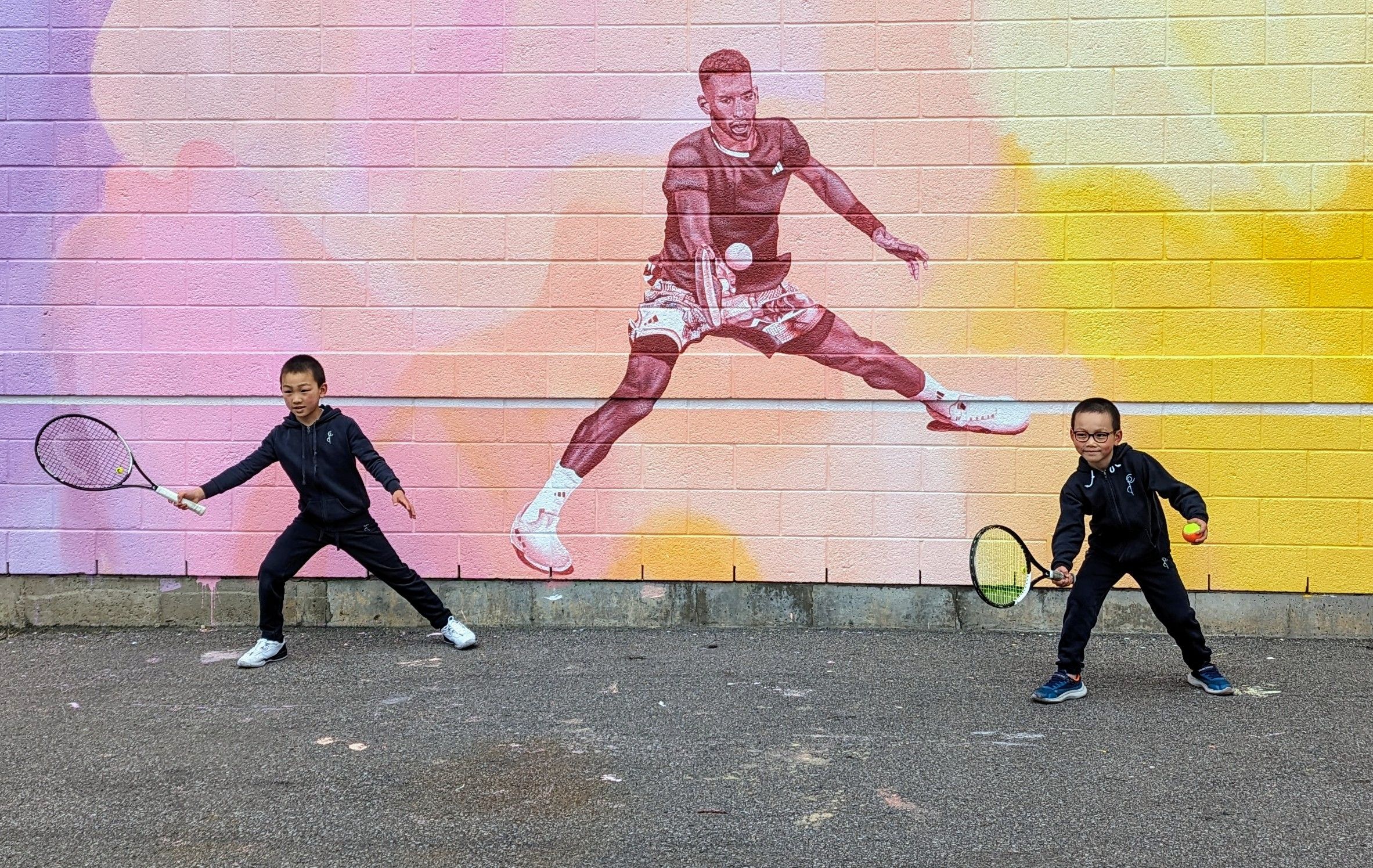
I went back home for a few days this Summer to watch acclaimed local artist Jenna Schwartz paint a giant version of hometown hero Félix Auger-Aliassime—her eighth mural as part of a Tennis Montréal initiative to celebrate the city’s tennis stars. Like all the ones preceding it, this one would become a marquee fixture at a public park with courts accessible to all comers. As the work took shape on a backboard at Parc Marcel-Laurin, I spoke with Hughes Leger, Directeur Général of Tennis Montréal and the force behind the project.
“Festival Mural is a well established festival in Montréal,” he said. “It has been part of the city’s DNA for a long time. And we said, ‘if we bring the quality and talent of their artists with the need for free playing spaces, that would make for a good project for the city.’ They approved it and we got the grant and we got going.
“We're all about accessibility, and our mission is to inspire youth. So we got the approval of top players from Québec and Canada to be featured on the walls,” he said. “The project was really well received by the population, by the media, by the city. And we're now up to our eighth.”
Schwartz says that this type of project perfectly encapsulates the values of the city, as well as the tennis notables that call Montréal home—Leylah Fernandez, Gabrielle Diallo and Auger-Aliassime as well as transplant Victoria Mboko—all of whom are known on the tour for their humility, work ethic and unfailing sportsmanship, as well as their Canadian pride.
“One of the things I love most about Montréal is how diverse we are. We really come together a lot, but we're not patriotic in the American sense,” Schwarz said. “We're communal, and we're small, and we're just locked in together. It just makes Montréal so special.”
Unlike more commercial or comic-book styles that often dominate urban landscapes, Schwartz focuses on creating three-dimensional, realistic likenesses of the athletes. Her work doesn’t just decorate the space, it interacts with it. By placing these murals on accessible, public backboards (or “ballbacks,” as Leger calls them), the program creates vital infrastructure that doubles as a source of inspiration for everyone from casual park-goers to aspiring pros.
“I like when people can relate to the wall. So usually if you see people or shapes that are three dimensional, I feel like we can relate more to it,” she said. “The best part is when I start painting the player and they actually start realizing what the actual project is. So even if I explain it to them as I'm beginning, they don't quite envision what I'm talking about.”
These murals celebrate excellence in a way that feels intimate and connected to the neighborhood, and the impact has been profound. Athletes featured in these works have shared deeply personal reactions to seeing their likenesses immortalized in their hometown, with families moved to tears.
“I think they recognize the importance of those free spaces for the community to try and start tennis. Jorge Fernandez, Leylah Fernandez’ dad, said ‘I cried when I saw it. I was so moved.’ And they were happy to relay it on their social media, same for Félix and Gabe,” he said. “But also they feel that they give back to the city and it's something that's going to last. It's a legacy.”
As the program culminates later this year with 12 citywide murals, it will undoubtedly foster a sense of storytelling, connection to the city’s culture and a lasting legacy. These walls are more than just paint on concrete; they are symbols of Montréal's dedication to access, creativity and the power of sport to unite a community. To Leger, that was the point all along.
“If a kid needs a racquet or a ball here, they can just drop by the offices. We're obviously gonna lend it, for free, and they can go on the wall at IGA Stadium here where we're talking right now, where next summer Félix is going to play, where Vicky won last year. So it's really inspirational,” he said. “We're quite proud of this. I think in my three years and a half as GM here, this is probably my proudest initiative. It's a way to give back.”


