The reason? It is a schlep, but the pilgrimage is certainly the allure. Guests take a short hop from Bali on Batik Air, then ninety minutes overland in a matte green Toyota Hilux from the island's main airport, before one of the best arrival sequences in hospitality: the main gate sits high on a promontory that gives you the resort at an eagle's-eye view, the dramatic sweep of coastline and that cult left wave, named Occy's, capped at fifteen surfers a day.
I first stayed in 2023 and understood the accolades immediately. It feels utterly unique; the type of property that defies the conventions of the ultra luxury category in which it sits. Nihi is perched on one of the most beautiful beaches in the world: a 2.5-kilometer sweep of private sand that draws people who fly ultra-long-haul for it. Sumba itself held onto its Marapu animist traditions, its ikat looms, and visually striking Uma Mbatangu—traditional thatched houses on stilts featuring high-pitched peaked roofs. The resort's line is "the edge of wildness," and—unusually for hospitality copywriting—the place delivers in spades.
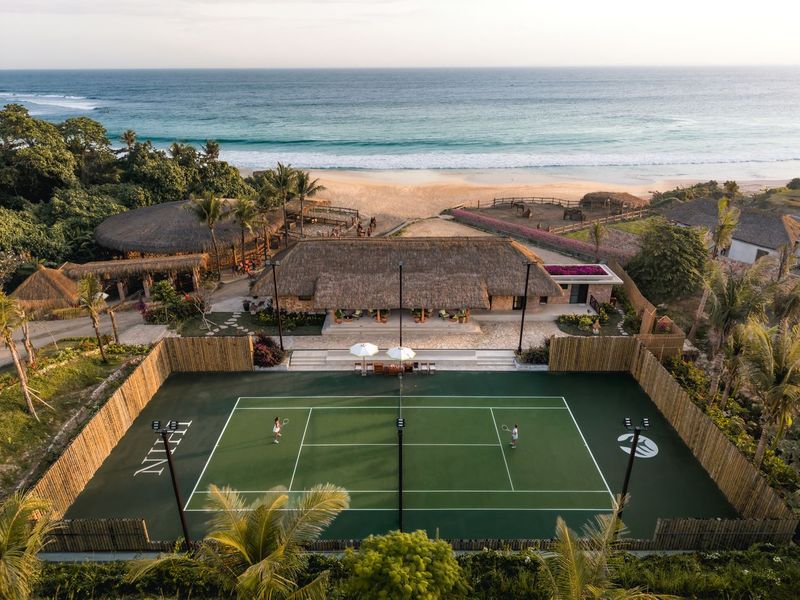
What struck me on returning is how elegantly the property has evolved. Plenty of resorts at this altitude expand by accretion until the original idea is diluted. Nihi has kept building without reducing the pure wildness that made it. The newest entrant is the one that got my attention: the Riding & Racquet Club, set in an area of the resort called Stable Valley, home to the island's first international-standard tennis court and a pavilion that reads like the Polo Lounge meets Africa meets Sumba.
The court sits right beside the beach, with the resort's Sandalwood Stables on the waterfront next door, close enough that the horses become your viewing gallery, ambling past between points on their way in from a morning gallop. The atmospherics are unmatched. You hit your backhand to the crash of giant surf and the drum of hooves in the sand. Caroline Usher of UBD Global designed the clubhouse in dark teak and vaulted thatch, hung with antique wooden racquets, polo mallets and traditional Sumba spears: vintage sporting club by way of the Sumba Strait. "We wanted Stable Valley to have the soul and exoticism of the great sporting clubs I've experienced from Africa and Egypt to Mongolia, Hawaii, London and New York, but with the simplicity and spirit of Sumba," says James McBride, Nihi's co-founder and CEO.
But the pavilion's real genius is what it does for the hours around tennis. It is the place to luxuriate over a morning coffee and a scone before the rest of the resort wakes up, or a coconut, nature's electrolyte, pre- or post-match. Dinner means grilled meats over an open fire after a hit, or cocktails at the elegant bar as the sun drops into the Indian Ocean. You can take in another guest's match over the top of a newspaper, the way one does at proper members' clubs, half-watching a rally between paragraphs while horses pass behind you.
A fun detail: the build had to be blessed by local Sumbanese priests, as the land abuts spiritual territory.
It's not a full-fledged tennis complex. You aren't getting a sprawling pro shop or tanned touring pros, though McBride is quietly holding a court for one. "Whenever my old friend Roger Federer, from my Carlyle days in New York, finally makes the pilgrimage, we've got a rather cool Riding & Racquet Club and a court waiting for him." Until then, the pop of a perfectly pressurized Penn ball off the strings, the jungle meeting the ocean behind it, is enough to delight even the most jaded tennis traveler.
Colin Nagy is a writer and strategist.