

I’ll always remember the one that got away. It was a white, single-stitch Fruit of the Loom t-shirt with the perfect tagline: GO AHEAD…TAKE ME TO COURT. The illustration is signed by Doug Moench, a DC and Marvel comics writer, whose highlight reel includes Batman and Catwoman titles. The randomness of all this made the t-shirt that much more appealing and offbeat because, unlike my other vintage tennis t-shirts from Wimbledon and Wilson, this one wasn’t affiliated with a tournament or tennis brand. And I wasn’t alone; to date, I’ve tried and failed not once, not twice, but three times to purchase the t-shirt on eBay, Etsy or Poshmark. On every occasion, I add to cart, and before I can finish checking out, it’s gone. I keep searching for it, only to find myself in SEO hell, flooded with generic knockoffs, dull graphics, and meh taglines like SEE YOU IN COURT, HAPPIEST ON THE COURT, or TAKE ME TO COURT1.
When it comes to tennis merch, the past isn’t history; it’s a thriving business. Recently, Nike took note by reissuing John McEnroe’s 1984 Mac Attack and Andre Agassi’s Agassi’s Air Tech Challenge II, but stopped there. If you browse most of the tennis apparel lining shelves and landing pages today, you’ll notice that it’s all optimized for performance and not aesthetics—made for life on the court, not off it. If you want color, texture, or pattern, your best bet is vintage or secondhand. Fans of denim activewear, and icons like Agassi and Serena Williams, can pick up a pleated, acid wash denim skirt or denim Fila jorts. Real tennis heads can opt for '90s Sergio Tacchini tracksuits and anything Bjorn Börg-era Fila. Those who have it all can try Harrods Wimbledon towels, Adidas tennis handbags from the '70s, a Wimbledon Racquet Club jacket, or make their way to Sotheby’s.
While the US Open merch sells out every year, many vintage resellers see a spike in traffic in August. Tourists and locals, I’m told, are flocking over to them in search of tennis memorabilia they can’t find anywhere else. I spoke with some resellers and merchandisers about the enduring appeal of vintage tennis merch and whether it can be replicated today.

***
How do you feel about the merch currently sold at tennis tournaments (or anywhere else)?
Kevin Fallon, Owner of Fantasy Explosion: I think that the newer merch, especially from the mid-to-late 2000s to now, has definitely lacked in the creativity they put into design. It does feel corporate. It does feel a little too country club, which can sometimes be a good thing. But the feel and quality of the cotton and embroidery—especially when you compare it to some of the '90s pieces—is what’s really lacking right now. You get poly-blended and heat-pressed, not screen-printed (well, at least) or embroidered stuff. When you look at the technical embroidery on some of these US Open hats from '91 to '97, they’re beautifully done. I think they were hiring great artists to design these pieces rather than just trying to spit them out. I will say that this year, I was impressed by some of the merchandise that I saw from the US Open. The branded or licensed stuff was good, but it's always hit or miss because they're catering to the status of the person attending the event.

Nikolaj Hansson, Founder of Palmes: I grew up skateboarding, and skateboarding is very artistically driven. It constantly references art, architecture, literature, music, and I think that's what tennis [merchandise] did in the past. In the '80s and '90s, you had these very creative things, and then it stopped progressing and became very self-referential, like tennis is talking about tennis is talking about tennis is talking about tennis.

Bijan Shahvali, Owner of Intramural: A lot of it looks like it was designed by an accountant. To me, 1995 was the best year for US Open merch. One thing that I noticed about '90s US Open merch was that it incorporated the city of New York and celebrated that. They even licensed Garfield. There was something for everyone. And I felt like what was communicated in the merch, in the designs, was like something that felt uniquely New York in terms of attitude, but now it feels globalized, where all merch looks the same and not in an exciting way. I hate saying branded merch, because I think branded merch can look really good, but now it doesn't even look like a creative team touched it. It’s like they’re running this same design but changing out the year.

Josh Gettler, Co-founder of Ace the Moon: I just got this Slazenger piece from a local thrift shop in Silver Lake. I didn’t know Slazenger was still around but it is, and unfortunately, they became very generic. Back in the day, you know, in the '80s and '90s, there was a level of detail that all these brands really put into their stuff. I just listed this Russell sweatshirt yesterday, and it's got the color blocking on the shoulders, and a double neck. I think back then, people weren’t as scared of color as they are now. You’re seeing a lot more white, gray, navy and black out there.

Matthew Osterberg, Founder of Vintage Court Collection: One of the reasons I love vintage is because it's built to last. Whereas the stuff now, it’s going to get holes and shrink. You’re going to throw it out in a year.
Zach Reyes, Lead Designer at ONLYNY: When it comes to US Open merch, the more localized it gets, the more special it is because it’s what differentiates it from fast fashion. I’ve seen the H&M tennis merch where they put New York City and like a random year. It feels a little too evergreen. I think it's so important to highlight Queens specifically and not just New York City. I’m from Queens, and we’re so prideful, we wear it on our sleeves every time, so the US Open merch needs to speak to the people.
***
How do you define good tennis merch? What makes it work well?
Kevin Fallon: Quality is definitely high on the list (and in high demand because of fast fashion). There this also a t-shirt with an overhead shot of six or seven tennis courts and it's full of different characters and people playing tennis from all backgrounds, and it just says: Tennis anyone? It's one of those like '90s tennis pieces that is really special, but not directly affiliated with any corporation.
Nikolaj Hansson: I think maybe 20% of people who buy our stuff actually play tennis, but they connect with the brand aesthetically and culturally because we are telling a story in a progressive and forward-thinking way. We’re that cultural connector, the bridge they walk across. It’s the same way when you were younger, and saw another kid wearing the same skate shoes. That started a conversation or friendship because owning the same shoes meant you both probably liked the same music, art, whatever. We want to open up tennis as a sport and culture because a lot of people don't feel like they can identify with this preconceived image of tennis as high-brow. So we’re here to lower the cultural barrier of entry because maybe if someone buys one of our t-shirts, they’ll want to try and play tennis.

Bijan Shahvali: Good merch doesn’t just showcase good graphics. It’s where different interests clash. It should be a signal, a good communication tool.
Josh Gettler: I’m trying to position my clothing as approachable. It’s year-round, unisex, for the court and off it. It’s more of a lifestyle play, like it should be more fun, graphic and relatable. But I’m also trying to work in these vintage details and bring them back, like necklines, color-blocking, and shorts straight out of the '90s.
Matthew Osterberg: I really like this line from Heineken—I don’t know the backstory behind it—with art by John McEnroe. I really like Sergio Tacchini—their current and old stuff is always iconic.
Zach Reyes: I'm from Queens, so I live very close to the Arthur Ashe Stadium. Every time the US Open comes here, it's a big commotion, which is very exciting. I’m not a vintage collector, but I am always scavenging for anything Queens-related. And a lot of the ones I’m drawn to happen to be vintage US Open Arthur Ashe graphics, which always have this really cool handwriting to them—like by hand. It looks so analog and it stands the test of time. I love when a graphic looks like it was done first on paper and then scanned, or even designed with MS Paint.
***
What are you selling? What are customers shopping for?

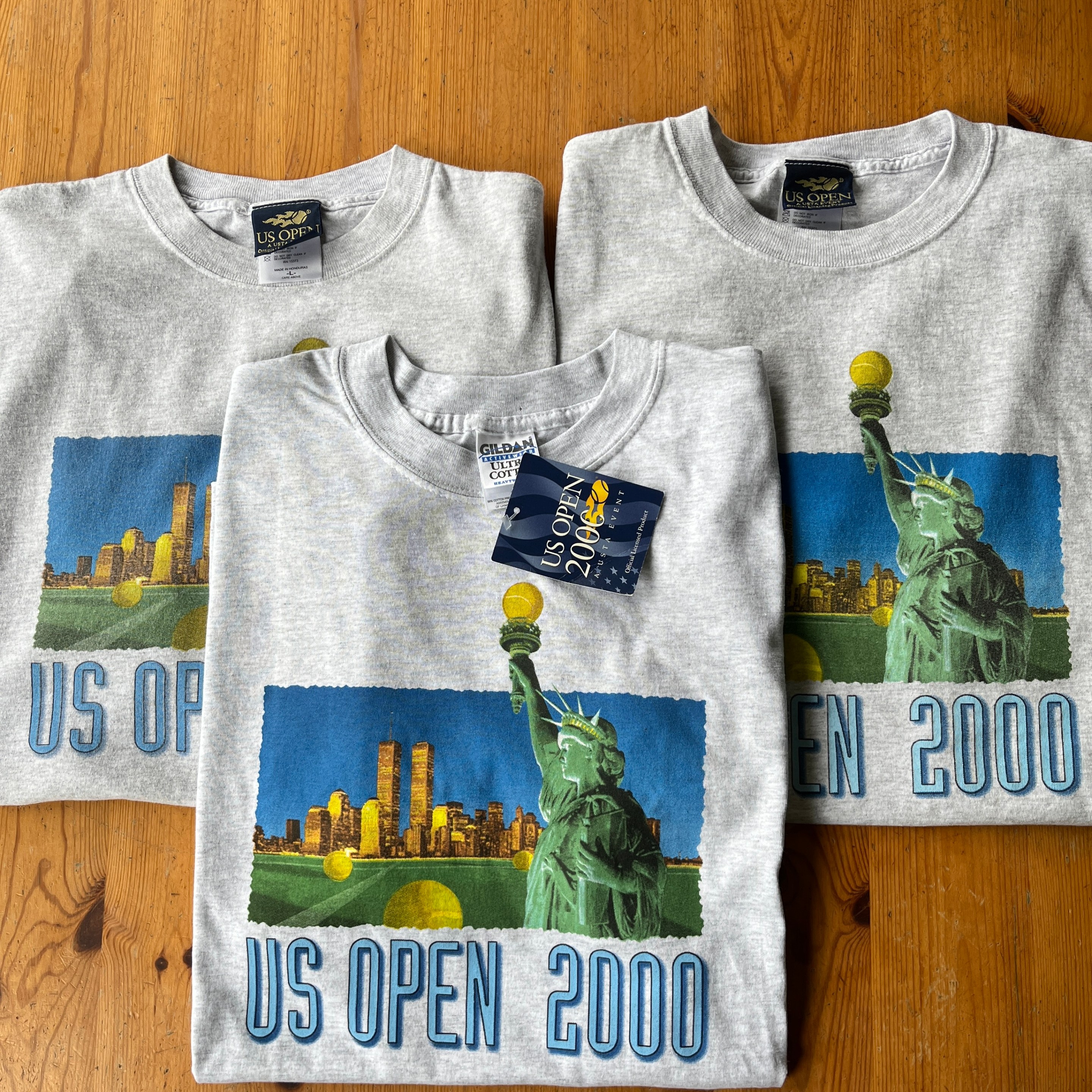
Kevin Fallon: One of the most popular items that I've ever posted was a late 2000s, very simply branded Polo oxford shirt. It was just a white and blue oxford shirt, Polo-branded on one side and the US Open late 2000s logo. Those have been in high demand to the point where I almost wanted to bootleg them because they were so good, you know? There's also a lot of good US Open merch from around 2001 where they used the Twin Towers as a callback to solidarity—those are pretty sought-after as well. Some of the more obscure items of tennis merch have become more popular, like Agassi camp tees and USTA-branded stuff, and then anything from Prince, Head, and Wilson—that has all been more desirable from the consumer's eye. Prince and Penn also made really good '90s snapbacks that are pretty desirable. I’d also say US Open merchandise, especially stuff from Ralph Lauren. It's really tough for me to keep it stocked, to be honest. Also zip fleeces: anything branded or licensed at the US Open, which were fantastic, and Fila, which did a cool line of late '90s fleeces.
Nikolaj Hansson: We launched our first collaboration with the ATP tour back in September during the US Open, which was exciting. I think we're the first brand in like 20 or 30 years allowed to do something with them. We wanted to start from scratch, because I think a lot of people, especially people outside of tennis, don’t know about the ATP. We ran it simple because the ATP logo with the player in the middle is so iconic and nostalgic2. And it sold out. Now we're talking about doing stuff that'll be more creative, conceptually driven and more contextually layered with them. A logo tee is fun when you just do one run, but if we keep doing the same thing over and over again, it gets boring.

Bijan Shahvali: The three categories I get asked about the most are: movies, tennis and art museums. For tennis, it’s always early '90s US Open merch. There was one, it was an abstract painting of a tennis ball. Things like that go very quickly at this point—if you don't jump on it right away, it’s gone. You can’t save to cart. There’s also edgier tennis merch, and strong graphics, or anything where different interests clash. Tennis and movies, tennis and food, tennis and New York City. Something with bagels that actually references a bagel3 in tennis—stuff like that. Those are the kinds of references and graphics that are selling. And anything nostalgic that can hit you with a one-two punch.
Josh Gettler: A lot of funny vintage designs sell right away. We did a Black Friday discount yesterday, and I accidentally applied it to the entire site, so I can see what went right away. There was a brand called Juli, and they did all these really cool, fun caricatures. This one had four ladies on the tennis court. Every time I get a Juli t-shirt or sweatshirt, it sells in a day. In terms of the t-shirts we produce, our Down the Middle Solves the Riddle t-shirt. I get at least one sale a day. I’m also working on playing up the local aspect of American tournaments and I just made these clothing labels with a US flag, but the stars are tennis balls.
Matthew Osterberg: I mean, people love the Nike Challenge Court stuff from the '90s. That always sells pretty well. I had a lot of people wanting that 1992 US open tee, and I did a remake of it for the US Open, with 2025 instead. Fila Bjorn Börg jackets are iconic and timeless, so they sell well too.
Zach Reyes: A bunch of our tennis programs are actually catered towards NYC Parks, which are our collaborators. Tennis courts in NYC are booming right now, so every time we're designing merch, especially for tennis, we're always catering to the people that go to the parks and have access to them. We want to make sure that it feels familiar, and approachable to that customer.
***
Are there any pieces that got away? Anything that haunts you to this day?
Kevin Fallon: There was one tee in particular from 1997. I don't know if they made it just for the US Open, if it was a bootleg or licensed by the UTSA, but it says: US Open 1997 Arthur Ashe Stadium New York, Planet Earth. I thought that was just a fun, out-of-the box-thing for them to do outside of their standard stamp of the brand.

Bijan Shahvali: A 1996 US Open denim barn coat. It sold in a second.
Matthew Osterberg: A ‘70s green Bjorn Börg Fila jacket.
Zach Reyes: A friend of mine owns a vintage shop in Hell's Kitchen, and he had a vintage Wimbledon-branded bomber jacket. He was kind enough to rent it to me for New York Fashion Week. And I could not let go of it, so I asked for the price. He told me, and I said he could have it back. I had my moment with it and I got my fit pics in it. And they’re good pictures, but I'm never going to forget about that bomber jacket.
- I finally found one in perfect condition (thanks to wiring this), and it was delivered today. Don’t ask me what I had to do to get it.
- The logo got a bit of a facelift ahead of the 2026 season.
- We're sure you already know this, but just to be sure: A bagel refers to a set with a 6-0 scoreline (and 6-1 is known as a breadstick).


