

Skip to Content

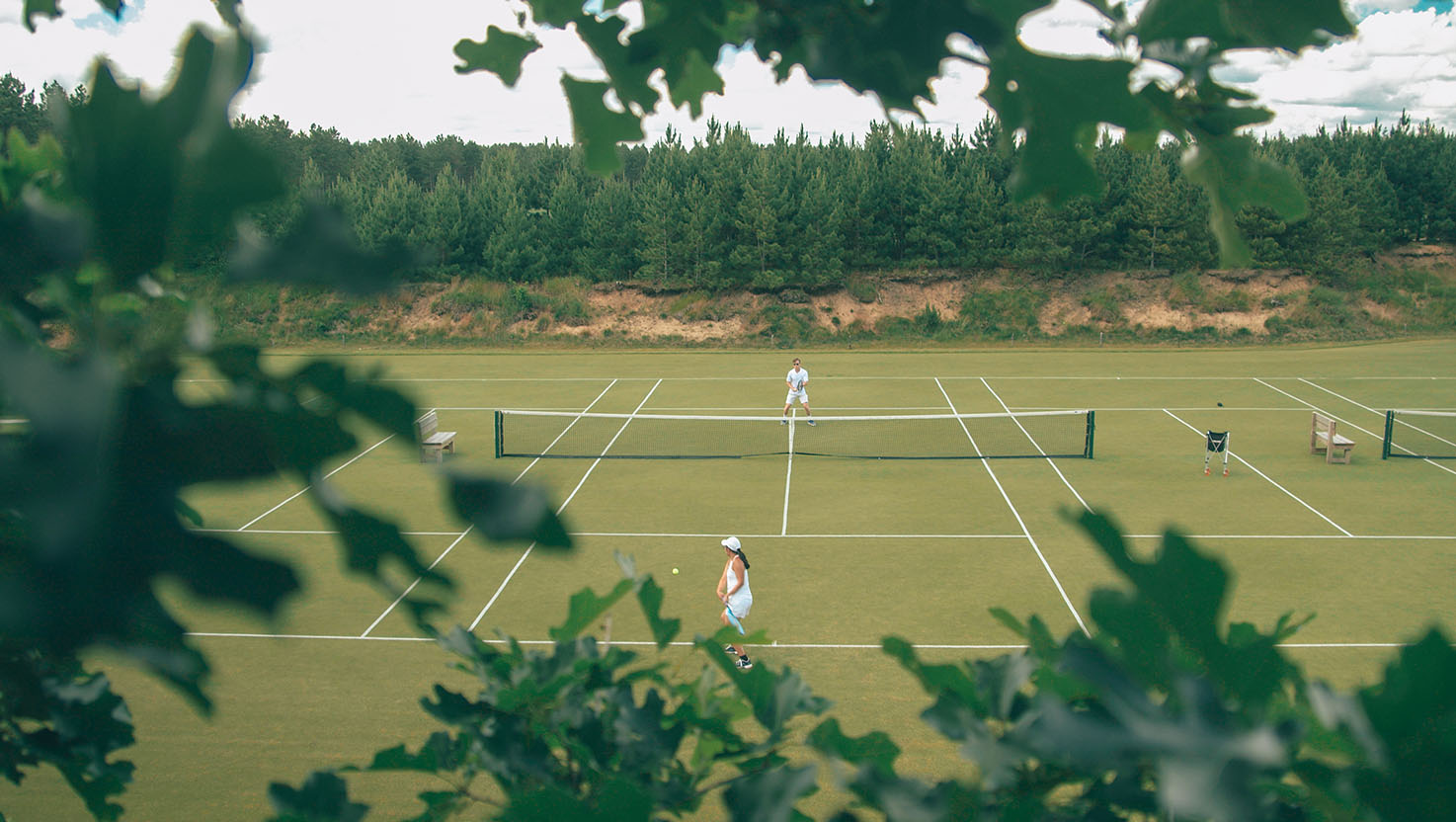
There’s something hard to explain about a grass tennis court. Sure, it offers familiar dimensions to tennis fanatics, and it has its own conventional wisdom: Hard court gives you a true bounce, clay an amplified one—and grass will test your knees and quick hands by hardly giving you one at all. Those ideas are easy enough to understand, but what I’m getting at is a bit more esoteric, a bit difficult to describe and appreciate if you’ve never experienced it yourself. Anyone stepping onto a grass tennis court for the first time might not notice it at all, but it’s easily my favorite part: the quiet.

Playing on a grass tennis court is a rare pleasure, and it’s one that’s getting rarer. Grass is the surface that jump-started the game. In the 1870s, a British Army officer named Walter Clopton Wingfield patented a box set with racquets, a vulcanized rubber ball, and a net that could be placed in one’s lawn, yanking the game out of bespoke indoor courts and out into the backyard. It’s also the surface the modern game seems to flirt with leaving behind. Long gone are the days when three out of the four Grand Slams (the US Open at Forest Hills, the Australian at Melbourne’s Kooyong Club, and of course, Wimbledon at the All England) were contended on grass, and the surface enjoys the professional tour’s shortest season, just four or five weeks long, depending on how you count.

Grass has also evolved from the default surface for a club, mimicking the game’s origins and traditions, into an exclusive and almost throwback curiosity that exists mostly for display. In this country, fewer than 1 percent of all courts are made of grass, and fewer than 10 clubs have any at all. I get to play on grass only a few times a year—as a guest and an explorer, finagling or charming my way onto (or into) the hallowed grounds that tend to house them. I’m not a member of any country club—never have been, never will be—but I’m willing to travel vast distances and take all opportunities to get back to this quiet, beautiful headspace.

sv3
“Anyone stepping onto a grass tennis court for the first time might not notice it at all, but it’s easily my favorite part: the quiet.”

When one such opportunity landed in my inbox two summers ago, it felt like winning a contest I wasn’t aware I’d entered. I was invited to a place called Sand Valley, eager to showcase its 15 grass tennis courts located among wild sand dunes in central Wisconsin. The sheer delight at an invitation to come visit a new, previously unmapped entry into my mental geography of grass tennis courts—new ones no less!—is hard to overstate.

The details: a short plane ride, followed by a drive through alien lands filled with massive sand dunes native to a state I’d never visited. Then arriving at a golf resort known for its rustic and spectacular beauty, all culminating in a weekend of grass court tennis.

My only response: “How soon can I come?”

Two years later, after accepting the invitation and visiting Sand Valley, the experience has stayed with me. I’ve spent the past two years trying to get back, the urge so strong that I tracked down Chris Keiser—who created Sand Valley along with his brother Michael under the guidance of their father, golf developer Mike—to find out why Sand Valley’s grass tennis stands out, even among my rarefied experiences of this version of the game.

sv4

Maybe it’s the fescue and rye—a blend of grass that plays firm and fast on a golf course, allowing it to “bring the strategy of the course’s design to life,” as Chris explained it to me. So, of course, it would provide a perfect manicured surface for a tennis court. Maybe it’s the flat expanse set among giant sand dunes, which, when looked at from another angle, provide the perfect location for 15 grass courts, set in banks of three. The sweeping vistas that being adjacent to three golf courses provides. Not to mention the quiet I love so much. Maybe it’s all of the above.

But I suspected it had more to do with the story of how these courts came to be, the story of a sporting family who’d held tennis tournaments in a Buffalo, New York, backyard involving generations, occasional tensions, and the thrill of competition.

The willingness to experiment, create, and innovate, came from Mike’s long career in the greeting card business, previous to the time in which he built legendary golf courses around the country. It didn’t hurt that both his sons were obsessed with racquet sports.

Chris told me a story that so perfectly encapsulates how tennis came to be at Sand Valley that I’ll share with you unabridged:

“In 2017, it was our first full year of operations, we had this big practice facility,” Chris said. “The teeing grounds were built large and flat. So out comes the idea for tee-ground tennis. My dad said, ‘Guys, you should just put up a net, leave a few racquets around, and see if people come play.’

“At that point in time, there was no name, no branding—my dad was really good about testing ideas and seeing what people liked,” Chris added. “That goes back to his greeting card days where he’d try 1,000 things and see what the customers liked.”

sv6

Turns out the Sand Valley golfers liked the tennis courts so much that word of mouth started to spread.

“People would make the turn at the ninth hole, see the racquets and the nets, and say to their caddies, ‘What’s this?’ Then they’d have a few hits and a laugh, and then get back to their round,” Chris said. “It became a story—something people talked about.”

Before too long, Michael brought a group up from Chicago—friends including club-level players to former D1 collegiate athletes—and the reaction from everyone made it clear that the Keiser family needed to build grass tennis courts at the resort. And built they have: The 15 courts are maintained with an extraordinary amount of care by Superintendent Jimmy Humston, who can tell you the exact percentage of fescue to rye perfectly calibrated from bank to bank, and shears the courts at a bench height of 0.325 inches—no more, no less. USPTA pro Jack Stuart oversees clinics for all levels, and a junior ball kid program means you’ll have attendants shagging balls for you, just like the All England Lawn Tennis Club.

It’s tempting to see the development of these tennis courts as a happy accident, but the Keiser family—Mike and his sons Michael and Chris—don’t do accidents. They experiment, create, and innovate. The Keiser family likes to say that their golf courses showcase, “Golf as it was meant to be.” And I’m here to tell you, from the breathtaking scenery, the immaculate courts, the serene sightlines, and yes, the meditative and abundant quiet, they’ve made an experience as it was meant to be for grass court tennis.

sv5
sv7

Stay in touch

Sign up for our free newsletter

More from Racquet

Dispatches from the Desert

Our Managing Editor Wendy Laird is on the grounds and has Dispatches from the Desert coming in on a regular basis: Today’s covers everything from the Hottie Coaches Bracket, to Queen Vee (and of course, the Escape from Oman after a Dash from Dubai—sorry).

March 6, 2026

A Playable Feast

There’s something wonderful about seeing “closed for the season” on a hotel’s website. They’re just four words, but they say so much: we don’t wring every penny from this property; this location has a “season;” this hotel values your experience far too much to stay open during sub-par weather. “Closed for the season” has a lot of sexy indifference to it; it makes you want to visit even more.

March 2, 2026

In Dubai, Uncertainty on Court and in the Skies

By the end of the week, it was hard to tell what felt more fragile: the schedule, the draw, the final, or the belief that sport can stay separate from the world around it.

February 28, 2026

Jessica Pegula has a Serious Sleep Routine

World No. 5 Jessica Pegula has had a busy few weeks. From lifting the trophy in Dubai for her fourth Masters 1000 title to becoming Blueair’s air wellness ambassador, her results call attention to what many of us already know: sleep hygiene, including managing air quality, is an important part of recovery and overall health.

February 27, 2026

Racquet’s Guide to Indian Wells

For the uninitiated, we humbly present the following guide to the area surrounding the area. While by no means exhaustive, here are some picks for places of interest while on your way to and from the tournament: some restaurants, sights and even a couple places to stay. And if you’ve been to Indian Wells before, welcome back: It’s going to be another great year.

February 27, 2026

Postcard from Doha

With the call to prayer echoing in the evening, you can even pick up a slight scent of aromatic oud in the air.

February 25, 2026
See all posts