

Skip to Content
Newsletter

Now Open: The Billie Jean King… Field Hospital

[vc_empty_space height="5px"]

By Giri Nathan

[vc_empty_space height="15px"]Among all the essential workers involved in coronavirus relief at the Billie Jean King National Tennis Center, at least one has a sporting connection to the grounds. Gary Barawidan, 40, grew up playing tennis on the same indoor courts that are now being converted into a temporary hospital. “I went to the National Tennis Center in the early and late ’90s. I was going to camp there in the summertime, and then I decided to enroll for winters, too,” he told Racquet during a day off from his job packaging some of the 25,000 meals that are being assembled there daily for relief workers, patients, and city kids.

Meal packaging and distribution is one half of the operation at the NTC; filling the indoor practice facility with hospital beds is the other. Danny Zausner, COO of the NTC, told Racquet last week that he heard Gov. Andrew Cuomo’s call for 1–2 million square feet of open space for patient care, and soon enough received a call from the city’s Office of Emergency Management. The city was interested in Arthur Ashe Stadium, the centerpiece of the US Open. As Zausner pointed out, Ashe offers only 6,000 square feet of open space on its single show court, but 12 on-site indoor practice courts offer somewhere between 75,000 and 100,000 square feet. Last week, the USTA received confirmation that the city was moving ahead with the project. Grounds crews cleaned out all nets, screens, and hoppers.

Hospital prep crews laid down plywood to protect the court surfaces. Then vinyl linoleum flooring was placed on top of that. Metal piping and black curtains were installed to cordon off the space into individual rooms for patient care, and beds were brought in. “And they ran everything else—all the utilities they could possibly need in the hospital areas. They set up a pharmacy, they set up labs in various spaces, they do whatever they need to do to operate a hospital,” Zausner said this Tuesday.

“By no means are we hospital builders, but we are kind of the landlord for these city agencies that are fitting out the space,” he said. The first bank of courts, which holds roughly 150 beds, will begin receiving patients today. In total, the court space is being prepped for a projected 475 beds, in hopes of taking pressure off of nearby Elmhurst Hospital Center, one of the hardest-hit facilities in the city.[vc_empty_space height="45px"]

billiejeankingfieldhospital
A look at the hospital facilities (Image: Getty)

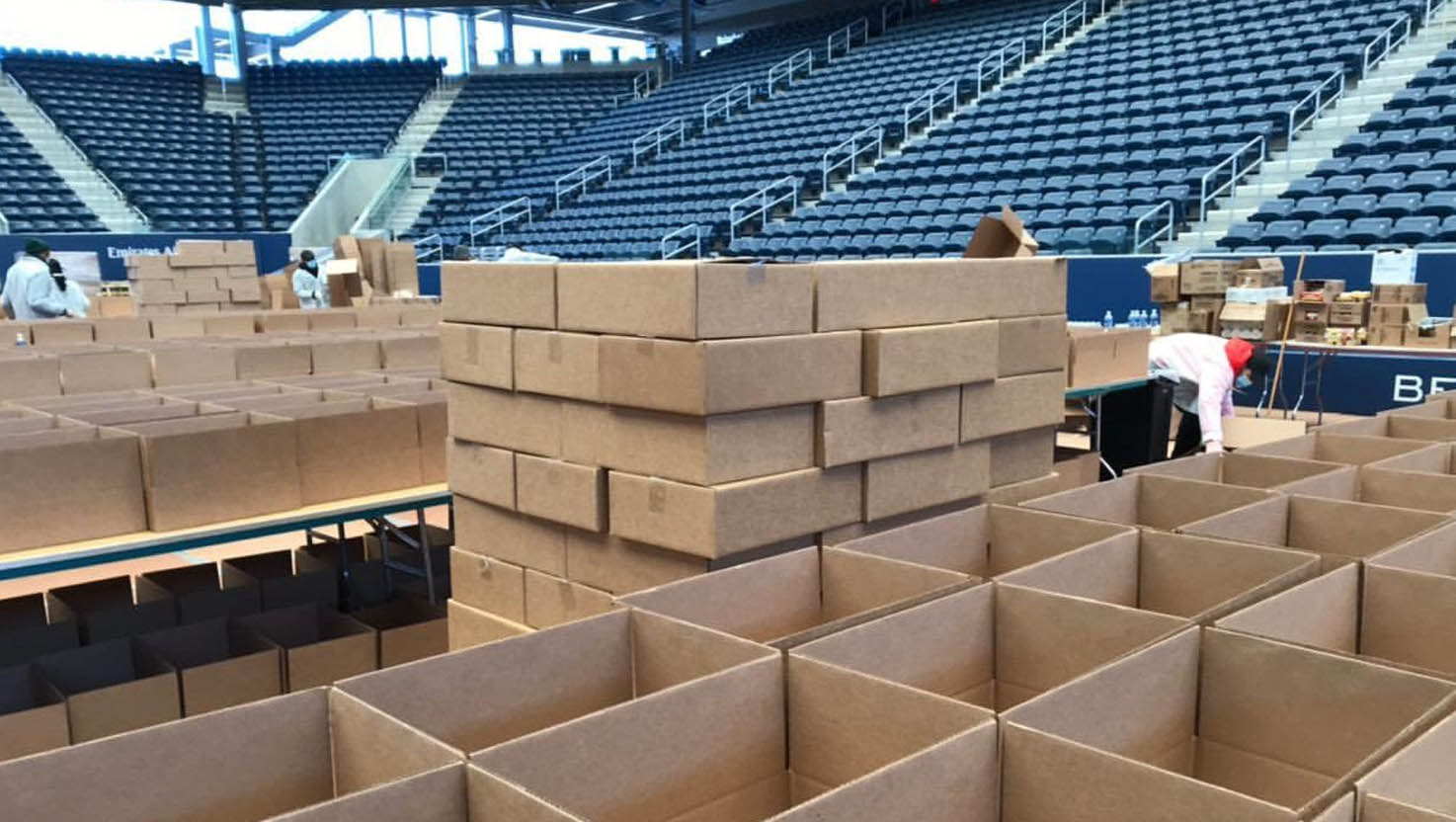
Meanwhile, in Louis Armstrong Stadium, a meal-packaging operation has been underway since last week. The USTA was approached by Restaurant Associates, a food services company that has been part of the Open for over three decades. They had been prepping meals at the Jacob K. Javits Convention Center in Manhattan and needed to expand the operation. The USTA offered use of the court area itself, along with the commissary, dining rooms, and warehouse-type spaces. Every day approximately 25,000 packages are assembled, each of which contains six meals (two breakfasts, two lunches, two dinners). The meals are then loaded onto trucks and shipped out to workers, patients, and children who would have relied on the free meals at school. There are over 400 sites around the city where the food can be picked up; the program has been extended to all New Yorkers who need a meal. (Before lunch was made free for all 1.1 million public school children in NYC in 2017, about 75 percent of them qualified for free or reduced-price lunches.)

Last week, Billie Jean King sent “love, prayers, and strength” to all the relief workers at the site that bears her name.

Gary Barawidan, the meal packager who grew up playing tennis on the grounds, was a sous-chef until he lost his restaurant job due to the pandemic. While searching for freelance work, he got connected with Restaurant Associates, which stationed him at the Javits Center—also functioning as a temporary hospital—before moving him to the National Tennis Center.

“You come in and there is a check-in point where they take your temperature and ask your name. And you wash your hands, and you get some PPE,” or personal protection equipment, he said of his daily routine. Start times for the workers are staggered by 15 minutes to allow for social distancing. They are then assigned to separate zones for tasks like receiving goods, building boxes, and packing up the parcels.

“It’s not actual meal prep, it’s more of a fulfillment center. It’s all shelf-stable foods, stuff that you’d find in the inner aisle of the supermarket as opposed to the outer aisles. It’s broken down into a breakfast, a lunch, and dinner. So two fruits, two juices, six snacks, a lunch, and then a hot meal—consisting of either canned food, or ramen, or whatever we have on hand that day. Peanut butter and jelly kits are also provided, as well as some water, if we have water that day. But all of them get fresh fruit.”

Barawidan has taken some surreal photos and videos of his new workplace. In one, he surveys dozens of boxes full of Pop-Tarts, pretzels, fruit cups, and granola bars. In another, he passes signage for “Player Court Entry,” descends some stairs, walks through the tunnel as if to play the Open day session, and then emerges onto a blustery court covered in tables and boxes. Because Armstrong Stadium is roofed on top and open on the ends, it is exposed to the elements. On cold, rainy days last week, workers would wear double gloves and multiple layers of clothing, plus PPE.[vc_empty_space height="45px"]

gary-barawidan
Gary (front) and a coworker on Armstrong (Image: Gary Barawidan)

“People are either working, or inside the house and isolated. I think people have been noticing people being emotional and on edge, and there’ve been little arguments and fights back and forth, and it’s essentially quickly forgiven. Because people understand that we’re going through a lot,” said Barawidan.

“And working there, there’s a person that comes in that goes, ‘Six feet apart, six feet apart, social distance, wash our hands.’ And you have the other part going, ‘Oh we need you to produce this amount of boxes for this amount of time.’ So there’s that level of working pressure that you have to manage emotionally to get through. And there’s also a feeling of gratitude that people just have, to be working and out of their homes.”

Barawidan, a lifelong player who also taught tennis for brief periods in his 20s, felt he was combining the professional and personal with his relief work.

“So for me this was just nice, to come and bring my professional experience of food into tennis. It’s just nice to be there, honestly.”[vc_empty_space height="25px"][vc_column width="1/6"][vc_tweetmeme share_via="racqetmagazine"][vc_column width="1/6"][vc_facebook type="button_count"][vc_column width="1/6"][vc_column width="1/6"][vc_column width="1/6"][vc_column width="1/6"][vc_empty_space height="45px"][vc_column width="1/4"][vc_column width="1/2"]

Listen Now
The Racquet Magazine Podcast with Svetlana Kuznetzova

sveta2

[vc_btn title="LISTEN" style="outline" shape="square" color="success" size="lg" align="center" button_block="true" link="url:https%3A%2F%2Fracquetmag.com%2F2020%2F04%2F08%2Fthe-racquet-podcast-svetlana-kuznetzova%2F|title:LISTEN||"]The Russian stalwart joins us at Racquet House to share her philosophy of life, talk through her post-career plans and clear her name against Kim Clijsters’ accusation that she let out the pigs.[vc_column width="1/4"][vc_empty_space height="85px"]

Stay in touch

Sign up for our free newsletter

More from Racquet

An Open Letter To Daniil Medvedev: Are You “So Back?”

Racquet’s See You In Court is a regular column in which Melissa Kenny, a famously mediocre lifelong player, opines on pro tennis. She also writes Hard Hitting, a Substack about the thrills and frustrations of recreational tennis.

March 20, 2026

Dispatches from the Desert

Our Managing Editor Wendy Laird is on the grounds and has Dispatches from the Desert coming in on a regular basis: Today the BNP Paribas Open is over. Long live the BNP Paribas Open.

March 6, 2026

A Playable Feast

There’s something wonderful about seeing “closed for the season” on a hotel’s website. They’re just four words, but they say so much: we don’t wring every penny from this property; this location has a “season;” this hotel values your experience far too much to stay open during sub-par weather. “Closed for the season” has a lot of sexy indifference to it; it makes you want to visit even more.

March 2, 2026

In Dubai, Uncertainty on Court and in the Skies

By the end of the week, it was hard to tell what felt more fragile: the schedule, the draw, the final, or the belief that sport can stay separate from the world around it.

February 28, 2026

Jessica Pegula has a Serious Sleep Routine

World No. 5 Jessica Pegula has had a busy few weeks. From lifting the trophy in Dubai for her fourth Masters 1000 title to becoming Blueair’s air wellness ambassador, her results call attention to what many of us already know: sleep hygiene, including managing air quality, is an important part of recovery and overall health.

February 27, 2026

Racquet’s Guide to Indian Wells

For the uninitiated, we humbly present the following guide to the area surrounding the area. While by no means exhaustive, here are some picks for places of interest while on your way to and from the tournament: some restaurants, sights and even a couple places to stay. And if you’ve been to Indian Wells before, welcome back: It’s going to be another great year.

February 27, 2026
See all posts