

Skip to Content

[vc_empty_space height="5px"]

By Giri Nathan

[vc_empty_space height="15px"]If you’d told me two months ago that I’d be writing three consecutive newsletters about American men’s tennis players I’d have assumed that I’d been crushed under the boot of mandatory sponcon. Or that some covert USTA operatives had landed some really good dirt on me. Or that tennis broadcasting had somehow found a way to become even more tragically fragmented such that fans could only watch players belonging to their own demographic category (for the reasonable price of $89.99 a month). Blessedly none of the above is the case. We are instead witnessing a late-season surge by my countrymen; after the encouraging rise of Brandon Nakashima and Jenson Brooksby, and after the heart-palpitating peak reached by Frances Tiafoe last week, I am again writing on this topic of my own volition, because the last month of Taylor Fritz has come out of nowhere.

Knee surgery seemed like the last thing Fritz’s game needed. The 24-year-old has power and clean technique, and while no one could ever question his talent for hitting a tennis ball in front of him, getting in front of said ball has historically been a much dicier matter. Fritz can look like a creaky and heavy-footed mover. You could see it in his unimpressive straight-line speed, in his knock-kneed change of direction, his laggy return of serve. This isn’t really a knock on the athleticism of this obviously extremely athletic person so much as it is a commentary on the state of modern tennis: There’s little room at the top of the game for a 6-foot-4 person who actually moves like a 6-foot-4 person. This is the era of the 6-foot-6 counterpuncher, after all. We have Daniil Medvedev playing lockdown defense 10 feet behind the baseline. We have Stefanos Tsitsipas closing the gap between the baseline and net with a few explosive steps. There are few big stiffs left. Just people who can do all the mind-bendingly agile work of tennis and also, incidentally, happen to be very large.

That’s why I saw Fritz’s career high of No. 24 in the world as an excellent outcome, about the best he could muster given the structural limitations. (To me these limitations also absolutely screamed “weight room” and “yoga,” but no professional is paying me for training advice. Yet?) It’s also why I was not expecting much from him for the rest of the season, given what happened at the end of his grueling four-setter against Dominic Koepfer at Roland-Garros. Fritz took a bad step on match point, heard a pop in his right knee, and later had to be wheelchaired off the court. An MRI revealed that he’d torn his meniscus. When he went under the knife, he wasn’t yet sure how involved the procedure would be. ​​“First thing when I woke up, I was loopy from the anesthesia, and the first thing I said was, ‘Did he repair it or did he snip it?’” Fritz told Tennis.com. “They said, ‘He snipped it.’ Immediately from then on I was just thinking, like, Wimbledon, everything I can possibly do to be here.” 

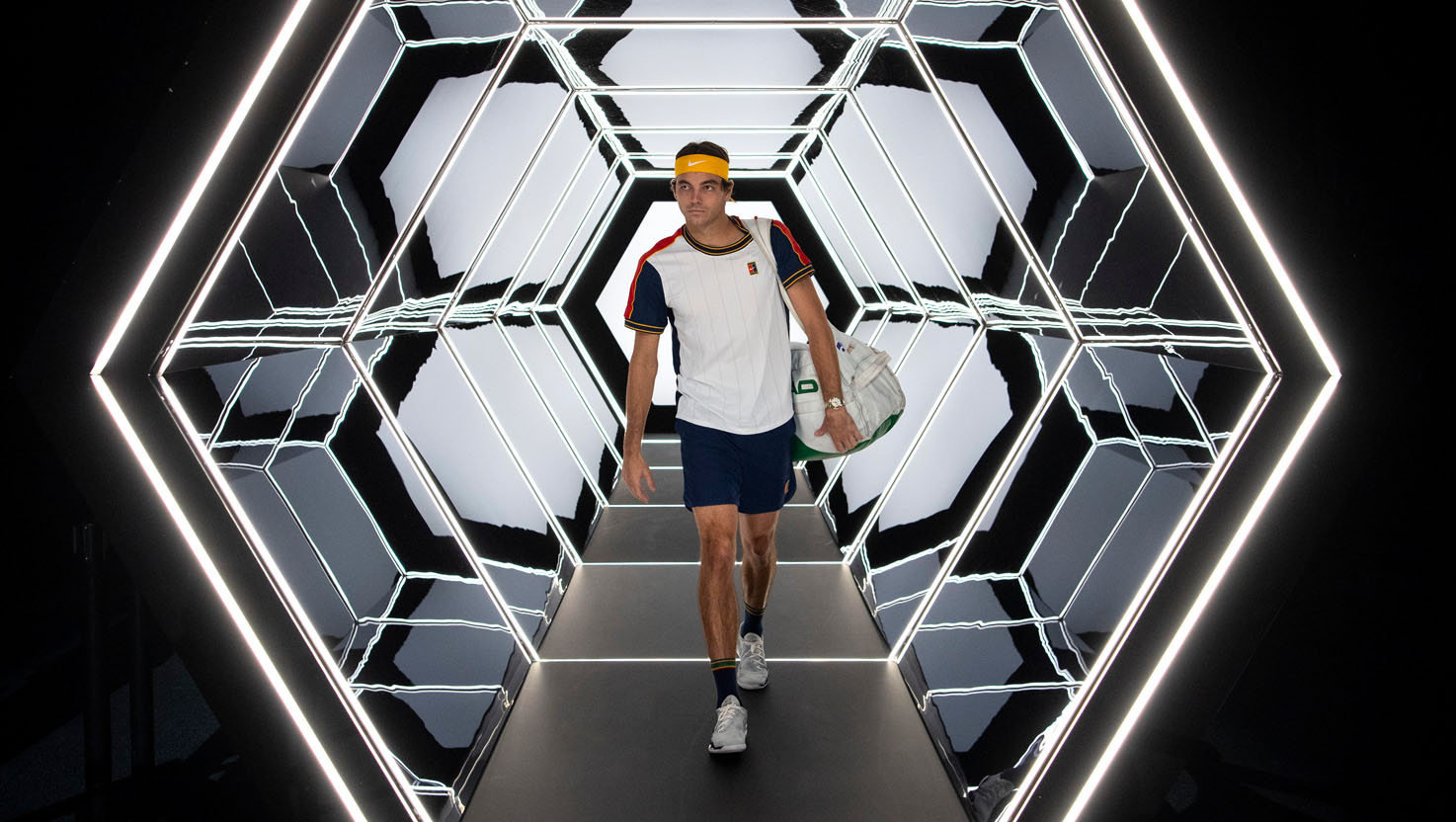
Fritz heard that pop on June 3; after what must be one of the most impressive rehab jobs in recent memory, he somehow suited up for his first-round Wimbledon match on June 30. With no warm-up tournament to get back up to speed, Fritz advanced to the third round, his best-ever result at the grass-court major. The rest of the summer was steady, and then October turned heroic. A semifinal run in Indian Wells passed through three consecutive top 10 seeds: Matteo Berrettini, Jannik Sinner, and Sascha Zverev. He then went to the final in St. Petersburg the next week. He kept rolling this week in Paris, right through Andrey Rublev and Cam Norrie, now with 11 wins over his last 13 matches. Fritz has said he’s regained the “cold-blooded mentality” he had as a prodigious junior. While the movement is still far from an asset, he’s looking comfortable enough on the run—that rehab really worked—and perhaps more importantly, the pace and placement on ground strokes has never looked more aggressive. The logic is sound: If you’re not fond of running, you really ought to hit the hell out of the ball so it never comes back over the net to bother you. Fritz has always had the firepower on his serve, and if he maintains this heat in his baseline game, he might just hang on to the title he surprisingly just claimed for the first time in his life: the top-ranked American man in tennis. Don’t worry, it’s already in his Twitter bio.[vc_empty_space height="10px"]Above: Taylor Fritz takes the court in Paris. (Getty)[vc_column width="1/6"][vc_tweetmeme share_via="racqetmagazine"][vc_column width="1/6"][vc_facebook type="button_count"][vc_column width="1/6"][vc_column width="1/6"][vc_column width="1/6"][vc_column width="1/6"][vc_empty_space height="45px"][vc_column width="1/4"][vc_column width="1/2"]

SUBSCRIBE TO RACQUET

racquet_subscribe

[vc_btn title="SUBSCRIBE NOW" style="outline" shape="square" color="success" size="lg" align="center" button_block="true" link="url:https%3A%2F%2Fracquetmag.com%2Fproduct%2F4-issues-of-racquet%2F|title:GET%20IT%20NOW||"][vc_column width="1/4"]

Stay in touch

Sign up for our free newsletter

More from Racquet

Saying Goodbye to the Stan We All Stan

We contemplate an ATP tour without Stan Wawrinka, who lifted trophies and bared it all in a memorable Body Issue spread: In a room full of Pat Rafters, our See You in Court columnist Mel Kenny would still stan Stan.

February 6, 2026

Postcard from Melbourne

Photographer Hritika Chaturvedi was on the ground in Melbourne capturing the biggest moments from the Australian Open and she shares her experience trying to capture the world's greatest amid shadow, light, foibles and fanfare.

February 3, 2026

Tennis Gets its Heated Rivalry Moment

The Open Era, an upcoming novel by debut author Edward Schmit, follows Austin Hardy, an openly gay tennis player, as he navigates two weeks playing in the US Open. We sat down with Schmit to talk tennis, books, and… the gay sports genre that is suddenly everywhere.

February 2, 2026

Where Has All the Good Merch Gone?

They just don’t make tennis merch like they used to, so we asked our favorite indie brands, resellers and stylish tennis friends (and fiends) where they find the best tennis apparel.

January 16, 2026

Daniel Yaw-Miller & Mel Kenny on Substack (and in Satin)

Melissa and Daniel—the authors of Hard Hitting and Sportsverse, two of the best newsletters around—are friends, neighbors, hitting partners, and for one magical afternoon at our new Clubhouse location, muses of style.

January 16, 2026
See all posts