Skip to Content
Newsletter

What’s Happening to Maria Sharapova

By Giri Nathan

[vc_empty_space height="25px"]

The Struggle Is Real

[vc_empty_space height="35px"]Is it better to blood-dope your way out of the game than to fade away? That’s what I wonder while watching an all-timer, who had not won a tennis match in 161 days, wither away in the first round of the Australian Open, under the full heat of the prime-time ESPN spotlight. That’s the odd position Maria Sharapova finds herself in—to be (1) one of the biggest attractions for a casual viewership, but (2) not good at winning tennis matches anymore, and (3) unclear about how much longer she’ll keep trying to win them.

And it makes for strange television, because nobody is really sure how to reconcile those facts in a narratively satisfying, or even tolerable, way. Unlucky commentators Cliff Drysdale and Chris Evert wandered through the straight-set loss to Donna Vekic, alternately worrying over Sharapova’s nerfed serve and movement, burnishing her past credentials, and calling attention to the differences between the Maria of then and the Maria of now. It was like a dress rehearsal for a funeral. There are more coming.

“This is a woman who won five Grand Slam titles, who’s been riddled with injuries; she doesn’t really—she doesn’t really care what people are thinking about her still being in the game. You know, her passion for the game is what’s keeping her in the game,” said Evert, pausing to admire a Sharapova forehand winner as she broke early in the second set. “That’s nice.

“She’s won tons of money. Remember, she was the biggest earner off the court, even more, earning more money than Serena for a lot of years there. But she just has that passion for improving. I know it’s frustrated her—the fact that she’s been injured—because she hasn’t been able to get any momentum in her game.”

The lead was lost; eulogy turned to autopsy. Evert pointed out how Sharapova’s chronic shoulder injury and recent surgery have constrained her serve: “She sidearms it, first of all. She doesn’t go up straight after it. And the other thing I see is she doesn’t load up on her back foot.” On cue, Sharapova hit fault, a let, another fault.

“She’s a very well-rounded person. She went to some classes at Harvard Business School. She went to some internships at the NBA, at Nike. She’s business-minded. Very crafty. But I think she’s feeling pretty good about this second set,” Evert said, brightening the mood, as the No.19 seed Vekic thumped a return winner down the line.

Then this infographic appeared, prompting a literal “Wow” from Evert.[vc_empty_space height="45px"]

sharapova_struggle
"The confidence level can't be that high right now."

[vc_empty_space height="25px"]After the final commercial break, a clip of Sharapova winning the 2008 Australian Open, followed by some glowing words from Drysdale, followed by “Croatian Donna Vekic is serving for the match, Rod Laver Arena.”

Sharapova dumped a return into the net and Evert said the quiet part out loud. “And I’m wondering right now, will this be the last time Maria will play the Australian Open? Will this be her last Australian Open? Will she be here next year? That’s the question on my mind right now.”

I was, to my mild surprise, a little sad. I was not quite a fan, but I was in awe of her prodigy, and the way she later adapted her power to clay, and I felt most of the knocks against her were pretty cheap. Was she lame? Yes, she was a saccharine brand-being; but then, not too many people who win five majors keep much of their cool. Did her top marketability in the face of a superior talent reveal the bias rotting at the core of society? Absolutely, but I’m not sure what Sharapova specifically was supposed to do about it, and I’m not sure any person should have as much money as any of these people anyway. Reviled for drug use? Every top player flirts with the (arbitrary, ever-shifting) line of legality, and it’s hard to invest much moral weight in the fact that her agent got lazy one off-season while sifting through documents by the pool. In terms of timing, that suspension likely robbed Sharapova’s career of its natural downslope; she couldn’t end on that note, so she’s back out in the sun trying to reclaim her story, without the cooperation of her body.

Contrast this with her junior, Caroline Wozniacki, who made it clear that this Open is her last tournament, and that she’d be settling down with her one major. There’s closure there, clarity for athlete and audience alike.

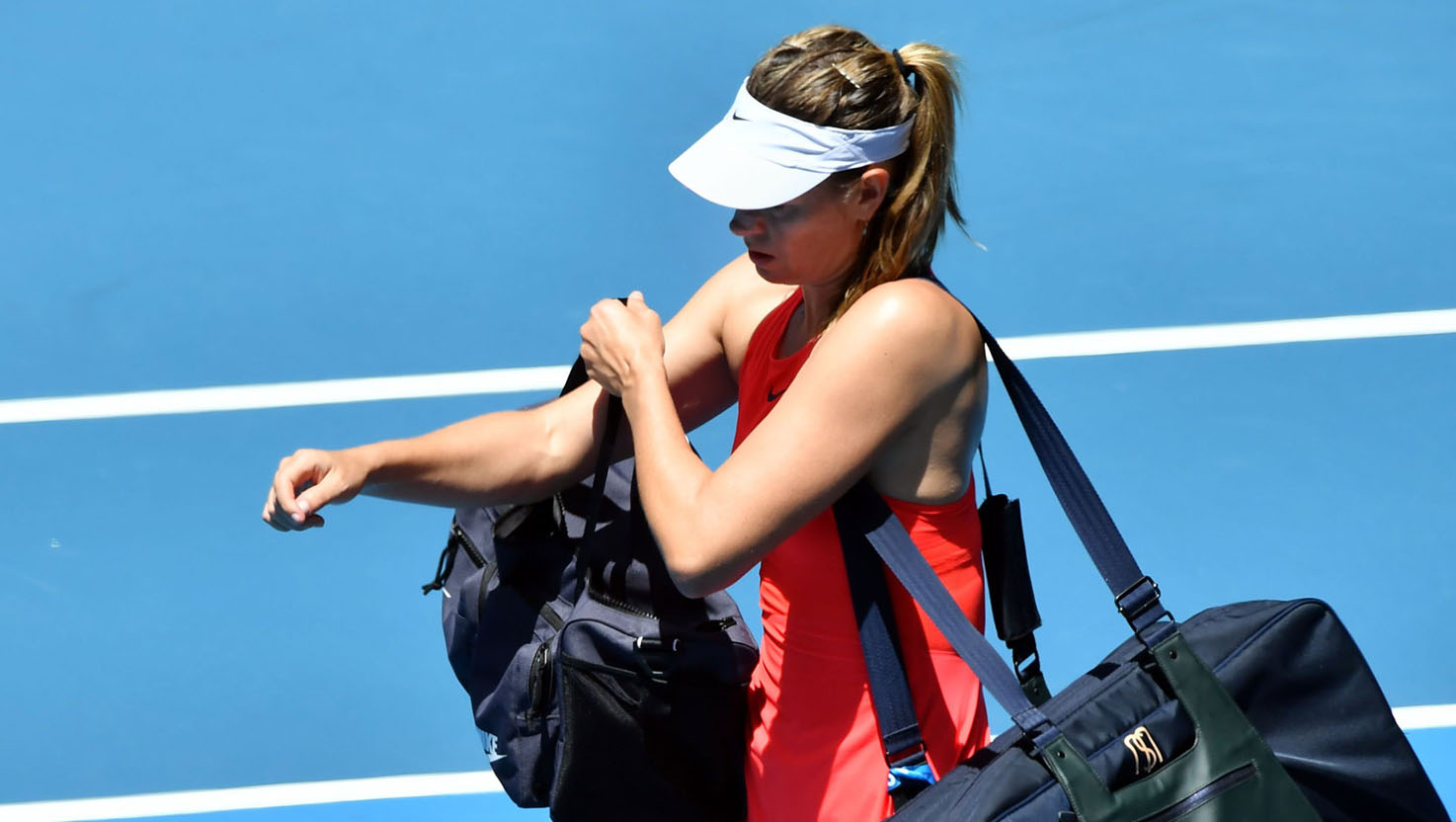
“She will slip off into the night quietly,” said Evert, as Sharapova walked the tunnel. “She is not an attention grabber by any means, and she will do it on her own terms.” Just how chosen were these terms, exactly?[vc_column width="1/6"][vc_tweetmeme share_via="racqetmagazine"][vc_column width="1/6"][vc_facebook type="button_count"][vc_column width="1/6"][vc_column width="1/6"][vc_column width="1/6"][vc_column width="1/6"][vc_empty_space height="45px"][vc_column width="1/4"][vc_column width="1/2"]

Buy Now
Issue Nos. 11-12 Bundle

racquet_nos11_12

[vc_btn title="Shop" style="outline" shape="square" color="success" size="lg" align="center" button_block="true" link="url:https%3A%2F%2Fracquetmag.com%2Fproduct%2Fissues-11-12%2F|title:Nos.%2011%20%2B%2012||"]What happens when a tennis bubble bursts? In this special limited-time package, we present Ben Rothenberg’s two-part story on Monique Viele, deemed “the next Anna Kournikova.” Monique’s journey illustrates the dangers of letting men of a certain age plot the career of a teenage girl – especially when one of those men is Donald Trump.[vc_column width="1/4"][vc_empty_space height="85px"]

Stay in touch

Sign up for our free newsletter

More from Racquet

From the Trenches of the World’s Most Obscure Racquet Sport

Stické tennis was invented in the 1870s in England, i’s a hodge-podge of tennis, squash, and real tennis. The game disappeared after the First World War. Just two courts are still playable. Yes, stické is the world’s most obscure racquet sport.

April 17, 2026

Racquet Retreat at Sensei Had us Breathing Easier

During this year's Indian Wells tournament, we launched a first-ever restorative trip for our nearest and dearest at the exclusive Porupine Creek property, and the results were... relaxing.

April 17, 2026

Jannik Sinner Can’t Lose (Except at Content)

When Aryna Sabalenka’s on-court intensity translates into campy, self-congratulatory TikToks, harmony is felt and sense is made. But Jannik’s on-court persona, tightly controlled like an unseasoned chicken breast, respectfully, need not be repackaged for YouTube. Because where is the flavor?!?

April 13, 2026

Issue No. 28: Tennis is the Blueprint

“To create one’s own world takes courage.” —Georgia O’Keefe

April 13, 2026

The Disappearing American College Tennis Player

These days, American college tennis is barely that: American

April 3, 2026

The Elegant Order of the Court

Sure, game-play conditions may vary, and a maintained court is more enticing for actual play, but as purely aesthetic fascinations, the inherently satisfying rationality of court design endures. 

April 3, 2026
See all posts