


Skip to Content
Features

ACE: Form and Function of Tennis Wear

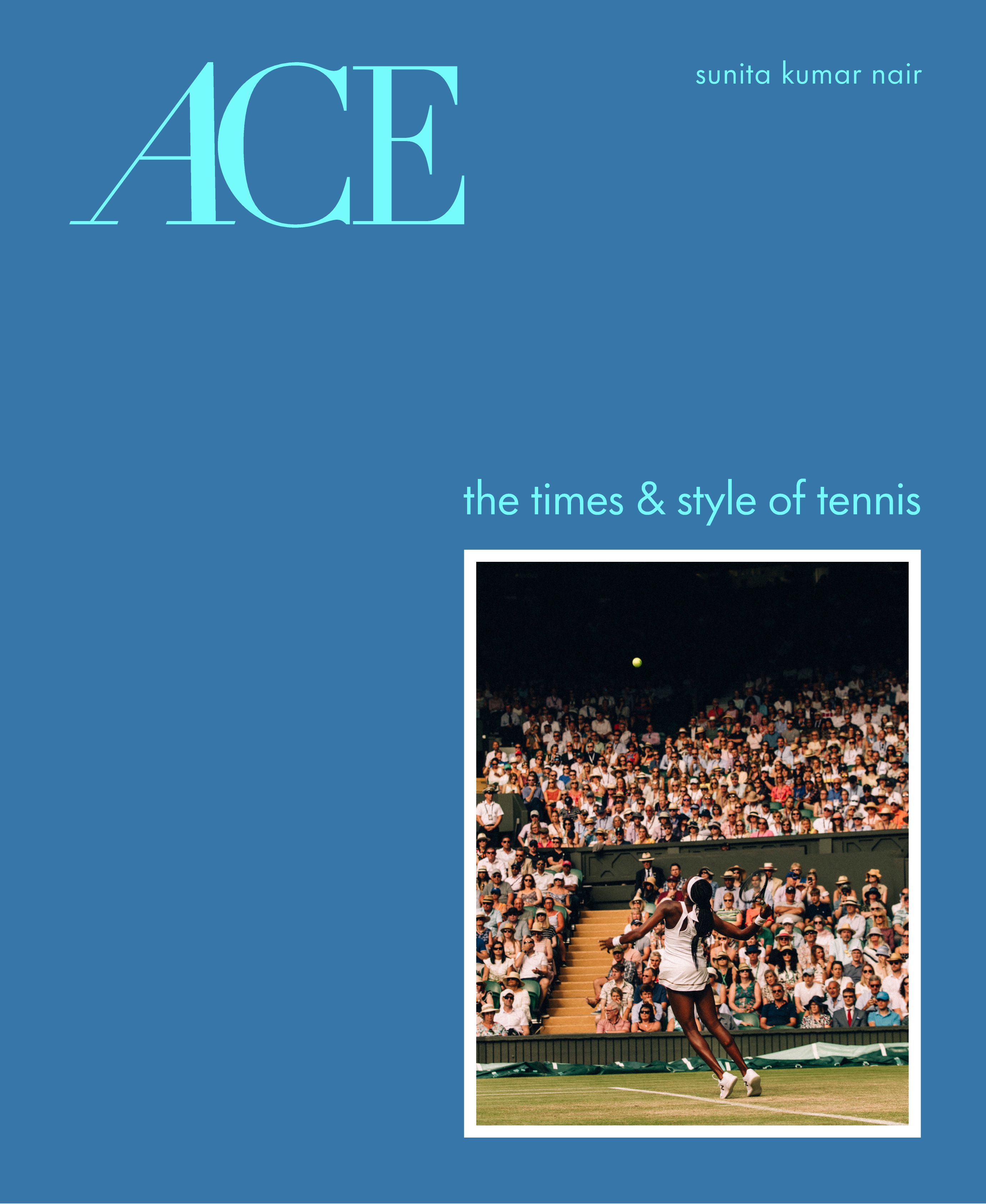
In her new book, ACE: the times & style of tennis, creative director Sunita Kumar Nair delves into the history of tennis clothing, and what makes the court a de facto runway.
2008 Wimbledon Championships

|IMAGO / ABACAPRESS

We spoke with Nair—whose last book chronicled the style of Carolyn Besette Kennedy—about how she categorized a century of sportswear, and who wore it best.

Image courtesy of adidasCourtesy of adidas

Racquet: What made you want to do this? Because ACE is quite an undertaking.

Sunita Kumar Nair: Initially when I presented the idea, I had in my mind just a very beautiful kind of slim, flip-through book. And when I reached out to the sporting brands to say, “hey, I'm doing this book looking at the marrying between fashion and tennis”—they put me on a plane and showed me their wares. So I knew then that I was onto something quite important—not only for the brands, but for the consumers, for tennis, the game.

R: You've divided the players and their styles into three categories: Classic, Maverick, and Cool. Why those categories?

SKR: When I was thinking about how I was going to lay out Ace—and this normally happens when I start thinking about a book—I always have the reader in mind. I want a reader who knows nothing about tennis and everything about tennis, and nothing about fashion and everything about fashion, to want to pick up that book.

I didn't want it to be a history book, but I was really mindful of being respectful of the origins of the game and the kind of trials and tribulations that the players had gone through. And the more I was looking through these three genres, I realized that it was actually the beginning, middle, and continuation of how the game was and is and continues to be.

The Classics was a no-brainer, because it's where the story begins. There are a lot of players who still like to that aesthetic—it's the quiet luxury part of tennis performance sportswear: it's the staples, like the pleated skirt and cardigan, and the polo shirt.

The Mavericks were the ones who just broke free from all of that, and were like, “oh hell no, we're not touching that.” They were their own personas; to generalize, it was a kind of biopic of time when we look at Agassi through to Becker and Serena and Rafa.

And then the Cool—I'm really interested in the cultural aspect of tennis. We see it pop up in films, and we see Hollywood embracing it, and music, and streetwear. People wear Lacoste and Fred Perry and Stan Smiths and don't actually know sometimes that it comes from the tennis story.

Geoff Burke-Imagn Images

R: So who are the archetypes currently playing? Who would you say is the archetypal Classic player currently on tour? And who is the Maverick? And who's the Cool?

SKR: I think definitely Coco [Gauff]—she's such a lady, and she's so inspiring, and so graceful. She embodies all the elements of the lady in classical wear, and yet still she comes from a completely different background from some of the other people that are in that category. And I think her style still has that essence. Mr. [Jannik] Sinner falls a little bit into the Cool side, but there's this maverick waywardness with his hair, and being with Gucci. And the Cool: that's a difficult one. I put Stefanos Tsitsipas in there, and Felix [Auger-Aliassime]; they kind of have this flair about them, and the flair in their play, which I quite enjoy.

R: What do you think makes tennis in particular so stylish?

SKR: There are so many aspects of the game where you are looking at one player for two to five hours, depending on the duration of play. It's a non-contact sport, so looks, at worst, get clay on them or sweat on them, and they're not torn, and they can come out in some really serious garb. Looking back in history, going back to Coco Chanel and Jean Patou, there's been this very natural liaison between fashion and tennis and the liberation of men and women in that sport. And fashion brands are noticing it and considering it as a serious vehicle for their design message, and to support the player as well.

R: Tennis players seem to be natural muses.

SKR: They are muses, and they have their own vision, and that's interesting. There are some tennis players who feel confident in how they want to be presented; obviously Naomi [Osaka] is one. And some are developing their style choices, which I love. I got to go to the New Balance headquarters, to see the beginning story of Coco's style, and how it's progressed; she's literally growing up in front of you, taste-wise. To me that is just so brilliant to watch.

Photo by Mike Frey/BPI/ShutterstockPhoto by Mike Frey/BPI/Shutterstock

R: Did fashion change tennis, or did tennis change fashion?

SKR: This is the second time someone’s asked me that! Fashion changed tennis. Women, especially, and men were either flailing in their long flannel trousers and long-sleeve shirts, or in their corsets and picnic wear. And then Suzanne Lenglen came along and said, “I want to play, I want to win.” She went to Patou, and I don't think she would have been able to wear what she did if she hadn't gone to someone who understood the human body and its need to move. And that is essentially what ACEis about: the exploration of supporting the human body in movement, and the clothing that allows that.

R: Does clothing confer cred? Are you cool before you put the Fred Perry on, or are you cool because you put the Fred Perry on?

SKR: You have to be cool before you put it on. That is the general rule when it comes to fashion. The fashion part enables the persona. I do think there needs to be an element of you wearing and understanding why. People don't think about it in depth, but the you're moved to certain things is because that's who you are—that's your intrinsic kind of inner character.

R: Is this a book about what to wear to play tennis, or what to play when you're looking your best?

SKR: I would say both. This is an inspiration for the people who want to dress a certain way. There are so many aficionados when it comes to sportswear, that this is hopefully going to be their tome—to look at how it's evolved. I enjoyed showcasing the designers, particularly for the big sporting brands, because I don't think they get a shout-out. I had a very happy chance to discover one designer who had worked with Nike and Maria Sharapova, just completely by accident—(former Nike designer) Natalie Candrian—and she explained everything about how she managed to design for Sharapova for a long time. She did an amazing job. And then of course the adidas designers—Ben Harris has been doing this incredible job for such a long time. There's so much energy and effort and thought that goes into enhancing the design. I really felt lucky to witness their process, and I felt that it was close to couture. There are so many different programs and steps that they have to take before the athlete goes on court, and to me that’s incredible.

ACE: the times & style of tennis (Abrams, 2026) is available for purchase beginning June 2.

Stay in touch

Sign up for our free newsletter

More from Racquet

My Love-Hate Relationship with the French (Open)

There is a simple explanation for why Roland-Garros has so often decided to go its own way: because France thinks it is the best at everything. 

May 22, 2026

Rafael Jódar Isn’t Waiting for Anyone

Sinner and Alcaraz have split the last two calendar years of Grand Slams and counting, and have set themselves scarily far apart from the rest of the pack. But beneath their momentous, center-stage war, another is incubating.

May 18, 2026

Only the Most Tenacious Thrive on the Terre Battue

Rolex Testimonees Garbiñe Muguruza, and last year's women's singles champion Coco Gauff reflect on what it takes to lift the Suzanne-Lenglen trophy at Stade Roland-Garros in Paris.

May 18, 2026

Murder on a Roman Tennis Court

Renaissance painter Caravaggio killed a man at Campo Marzio, surrounded by pimps and pallacorda.

May 15, 2026

What’s Next for Sloane Stephens is What’s Next for Tennis

Between Patrick Mouratoglou’s Ultimate Tennis Showdown, India’s Tennis Premier League, and INTENNSE, innovators are looking for ways to shorten matches, add pizzazz, and balance inequities in an attempt to draw, and keep, a younger crowd.

May 15, 2026

Dad Had a Bad Day, A Winning Tennis Novel

In Ashton Politanoff’s new novel, a man defenseless against his repetition compulsion unravels in chiseled and unnerving prose.

May 11, 2026
See all posts