

Skip to Content
Features

Grass at Last!

Racquet welcomes a shift to the green stuff, and chats with Matteo Berrettini on injuries, BOSS, and the genetic lottery.

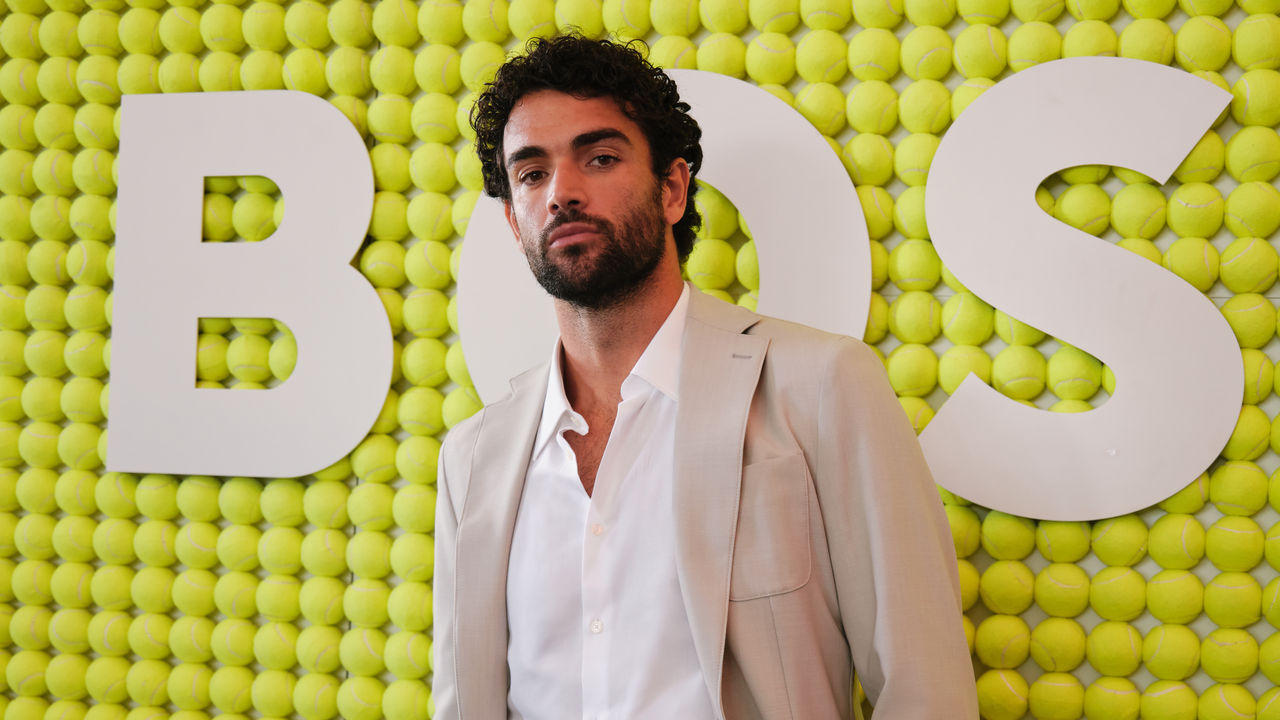
Matteo Berrettini at the BOSS OPEN

After two full months of watching the sun bounce off crushed bricks, the soft green of manicured grass hits the retinas in June the way ice cream hits a sore throat: it slakes. 

For ochre-weary spectators, switching to grass is easy: leave Roland Garros, catch a train at Gare de l’Est, read something for three hours, and hop off at Stuttgart Hauptbahnhof with tickets to the BOSS OPEN.

We associate lawn tennis with England, and rightly so, but don’t sleep on Germany: the country is rife with grass-court tournaments in the run-up to the third grand slam of the tennis calendar. Besides Stuttgart, there’s Berlin, Halle, and Bad Homburg, so if you wanted, you could spend the weeks between the French and Wimbledon eating only schnitzel and currywurst. 

I was at the BOSS OPEN last week, and I can confirm that there is very good schnitzel, and superb kaiserschmarrn, in the VIP tent (I cannot speak to the currywurst). BOSS took the reins of the tournament in 2022, and the experience is now what you’d expect from the German luxury clothing brand: sleek; tasteful; elevated; cohesive; delicious.

The label sponsors two ATP players who embody their aesthetic: last year’s winner Taylor Fritz, who lost in this year’s final to fellow American Ben Shelton; and Matteo Berrettini, who’s nursing an injury that forced him to retire in the quarterfinals of the French. I spoke with the Italian after he watched courtside Sunday at the Stuttgart final. 

Racquet: You had to miss the BOSS OPEN [due to a hip injury] this year. How is it, sitting out one of your “signature” tournaments?

Matteo Berrettini: It's pretty sad, you know? I have such great memories of this tournament, since I won the title in 2019 and 2022. I saw some pictures from when I was really young, coming here, so it wasn't easy [to have to miss it], but unfortunately I just couldn't play. But I'm so happy that I came today to support the BOSS team, the BOSS family. They're improving every single year. The tournament looks better and better; the food was amazing, and it was a good match for the crowd: three tight sets. I hope I helped the tournament as well.

R: We were all very sad when you had to retire [during the French Open]. How is the hip doing? 

MB: The hip is way better. Thank you. I'm already back on training, and I'm gonna be ready for Wimbledon. Or—that's the goal, and I'm feeling good. Obviously, it was sad, what happened, but at the same time, I left Paris with a smile on my face, because I reached the quarter finals, which hadn't happened in a long time. I hadn’t been able to play the French Open since 2021, so I didn't go to Paris expecting to reach the quarter finals like that. It was a hell of a run, and I'm so proud of that.

R: And now grass! You’re such a good grass player. What is it about grass that translates so well to your game?

MB: It's funny, because the first time I played on grass, I didn't really love it. I felt like it was a little bit too quick. I grew up on clay, and I felt like I needed more time. And then from 2019, which was the year that I won the title here, I just started to like it, because obviously, my weapons—my serve, my forehand—playing aggressive pays off a lot. Also because normally, in the matches, it's a matter of few points, and you have to handle those situations really well, and that's one of my strengths. When I'm fit and I'm good, when it’s five-all, six-all, four-all, I always play my best tennis, and on grass that’s so important.

R: With that in mind, is there any chance you're going to get a warm-up tournament, or will you just be going straight to Wimbledon?

MB: Well, right now I'm out of the main draw. If nothing changes, I'll have to play the qualies, so of course then I have no time for a warm-up tournament. If I get into the main draw next week, then potentially we can think about it. With my team now, we're trying to do everything we can in order to be as fit as possible. If this means that I have to take an extra week, for sure, I don't want to rush and get injured again, so let's see how it goes this week. That is going to be so important, and then from there we see.

R: Are you or your team considering changing your training regimen, or have you already, to try to minimize the injuries? Whether that's maybe playing fewer tournaments, or changing something else?

MB: Yes, we definitely thought about that, and did something, but it's been some years. People who know me really well know that, unfortunately, I started getting injured when I was 12. One of the reasons [for that] is because I always give my best, and even more, so I push through my limit every single time, mentally and physically. The other thing is that this sport now is just so intense, physically, mentally. All the players who normally would never be injured, are struggling a little bit. Even Taylor [Fritz] with the knee this year, and Carlos now is out for many months, and Jack Draper—hell of a player. Unfortunately, he hasn’t found the right rhythm yet. 

I just think that the sport is getting too intense, the calendar is just too intense, and the speed of the game is so intense. I was watching, actually, some of my matches from some years ago, and I think we were playing slower. 

The game is evolving; everybody's so explosive, so it's really demanding, mentally as well. These two-week tournaments, they're really hard on a player…they are obviously great for the tour and for the fans, but at the same time for players it's tough to be healthy. And that's the mentality that I have: I just started to accept the fact that it's normal to get injured when you do something like this at this level. There is nobody that doesn't struggle. Some players might struggle a little bit more, but once you accept that, it's just easier to come back on court and enjoy your time out there.

R: We're always interested in how much input a player gets into their kit. For some players, maybe not so much. It seems like BOSS collaborates with you a lot; how do you work with them to make sure everything is comfortable when you're on court?

MB: From the very first time that we met, here in Metzingen, they showed me the collection, the ideas, everything. Everything was basically almost handmade, everything suits me so well…and because I'm between an L and an XL, they have to make a special fit for me, which is so nice. It's been working so well, and it's so important to feel comfortable on court, and to feel that your performance is not affected by what you're wearing. With BOSS, it's always been like this; we’ve created some great collaborations—different colors, different things, and keeping the elegance that’s the most important thing for me on a tennis court. Because it's a classy sport for me. I'm really happy with that, and I think we're going to do great things. Watch out for Wimbledon.

R: Apologies for this question, but: you are one of the “handsome men” on tour. Which is kind of weird, because we don't really talk about women that way anymore. How does that affect you? Are there different expectations?

MB: I hope that during my career I left something on court that wasn't, you know, my looks. Even though I grew up with my grandmother telling me every day that I was the best in the world, that I should have been a new 007. Jokes aside, it's not like I did something for that; it’s just my genes. I respect when people are telling me that, but at the same time I know that I'm not my face. I'm what I am inside; the tennis player way more than my look. Then, of course, if you talk about my partnership with BOSS, it's so important to look good, to feel confident, and this is what I feel when I step on court. Of course, BOSS is making my job easier to look good on and off the court. It's just so nice to have someone that is taking care of you in that way, and I'm so proud of that. But I'm also telling you that the tour is full of good-looking tennis players out there!

Stay in touch

Sign up for our free newsletter

More from Racquet

Spoils Rotten (and Good)

The Best and Worst Trophies on Tour

June 17, 2026

What if Dan Evans is the Hottest Player on Tour?

On the eve of his retirement, we celebrate the working-class hero with the definitive list of the kind of hot guy shit he's been up to for decades that suggests maybe he is.

June 11, 2026

Racquet’s 2026 Summer Must-Have List

Our Must-Have list is is also a Must-Do and frankly a Must-Be list as well. We don’t make the rules; we just help you abide by them in style, by finding and play-testing and visiting our way around the globe.

June 9, 2026

What Roland-Garros Inherited from Central Africa

Before France inherited its last men's Roland-Garros champion, Arthur Ashe spotted an eleven-year-old boy in Yaoundé. The miracle made Yannick Noah. The question is why tennis never built the road again.

June 8, 2026

Stella Artois, in Paris (and in Clay)

The “Stella Clay Bar” brought together the greats—including legendary Roland-Garros champion Gustavo Kuerten—and tons of raw terre battue on a gorgeous Paris rooftop for everyone to make their mark.

June 4, 2026

Red Shift: Training on the Terre Battue in LA

A garden in the San Fernando Valley is ground-zero for West Coasters eager to unlock the secret lessons only the slidey stuff can teach.

June 3, 2026
See all posts