


Skip to Content
Features

Postcard from Wimbledon: Practice is a Privilege

In this letter of recommendation, our correspondent reports from the All England's Aorangi Park, where the press can sit and absorb a sense of wonder and astonishment and porous, melancholy outsiderness. Where we are reminded, after all, that we are mere witnesses to these shapes and strokes of beauty, and not their arbiters.

By Caira Conner and Photos by Maia Flore

10:33 AM EDT on July 6, 2026

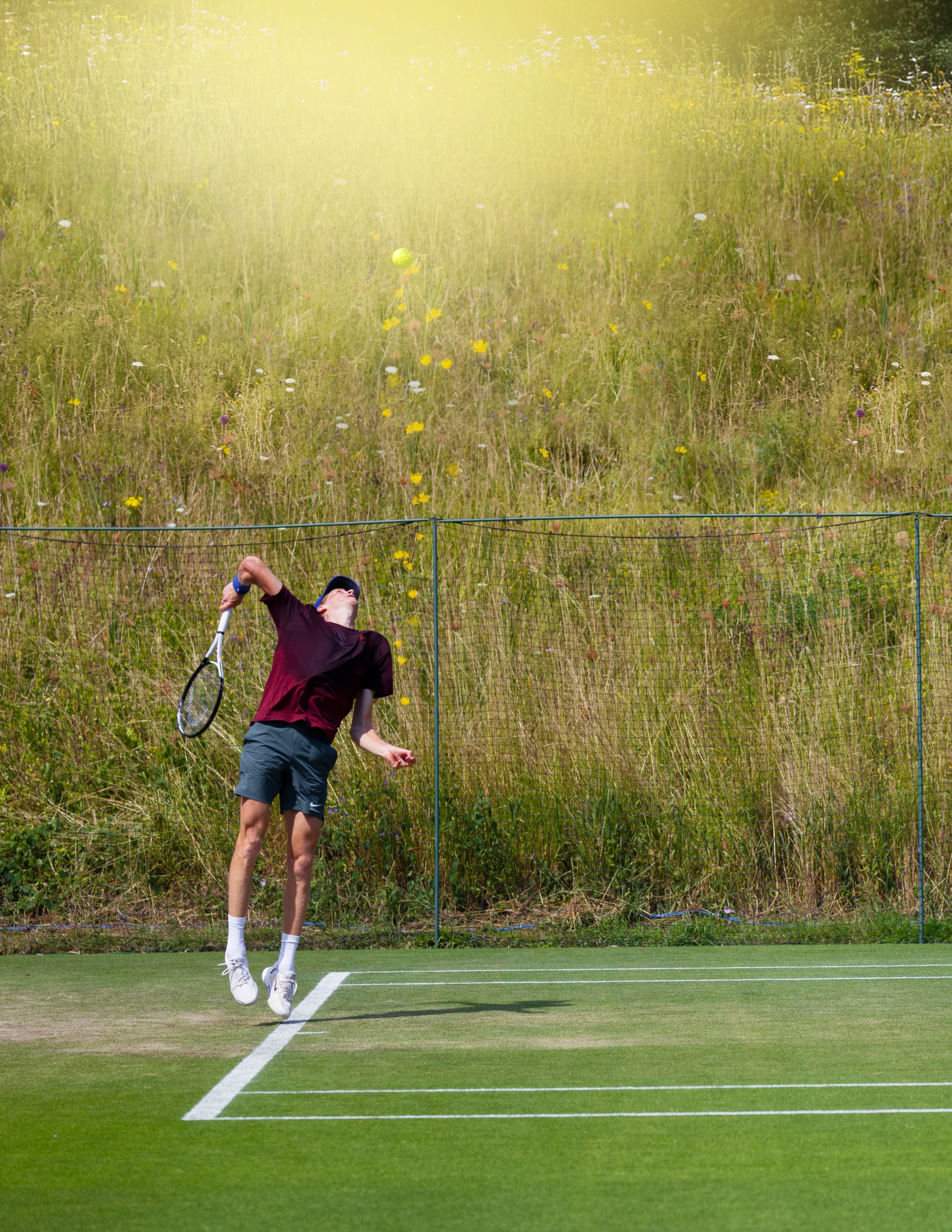
Jannik Sinner hits on Wimbledon’s Aorangi Park practice courts.

In 1967, one year before the first Wimbledon Championships of the Open Era, the All England Lawn Tennis and Croquet Club—the private members' club that hosts the green- and purple-hued tournament—purchased an unassuming 11-acre parcel of land directly north of its grounds, which until that point had extended no farther than Centre Court. The club had no immediate use for its new acquisition, so they leased the grassy expanse to the London New Zealand Rugby Football Club—a home for New Zealand expatriates who had been playing rugby in England since 1926. The group named the ground “Aorangi,” after Aoraki, or Mount Cook, the highest peak in New Zealand, roughly "cloud in the sky," or “cloud piercer,” depending on which translation you consult. All England ended the lease in 1981 (the same year perhaps the first-ever tennis meme was coined during a first-round match at the Championships: “You cannot be serious!”), bidding goodbye to its Kiwi tenants while holding onto the name they gave it.

Parts of Aorangi Park remain firmly democratic. This includes Henman Hill, the famed slope where a grounds pass buys you the opportunity to recline and watch the competition on a jumbo display, brimmed hat optional. (Although nicknamed after Tim Henman, the British former world No. 4 who inspired throngs of patriotic spectators to congregate and watch televised broadcasts of his matches, this hill is technically called Aorangi Terrace.)

But go a little further, toward the practice courts, and a spirit of aristocracy reasserts itself. To access, one must be a player, or a member of the player’s team, or a hitting partner, or, humbly, finally, a credentialed member of the press. When I arrive, the lanky press-office assistant who escorts me explains that it’s his favorite area of the tournament. This is his first Wimbledon, he tells me with a grin, and anytime he’s had the chance to show someone where the practice courts are, he takes it; so, no, he doesn’t mind the walk or the crowds we cut through as we wind out of the Media Centre, past the Walled Garden, and around the backside curve of Court No. 1 that faces Henman Hill. The Hill is a prime spot for people watching, yes, but where we’re headed is better. 

The practice courts are (and now we lower our voices, to a Steve Irwinian whisper) a bit like going on a safari. There are fourteen of them, plus a rectangular exercise yard: a replicated habitat for those who sweat and smack fuzzy yellow balls for a living.

When I arrive, Elena Rybakina is jumping rope. Venus Williams is on her cell phone. Frances Tiafoe high-knees back and forth, wearing over-ear Beats headphones, and laughs as he then stretches his piriformis. Iga Świątek, donning a coral set, appears to waterski off the resistance band gripped by her trainer. She clasps her hands and twists side-to-side, the outlines of a lethal two-handed backhand retraced in lateral movements. Nearby, on a court, Taylor Fritz mutters, “Oh, no,” when he thwacks a serve into the net.

This is a different universe from the professional tennis scenes I’m used to. At the US Open––my beloved home and favorite tournament, warts and all––just to enter, one must sweat through thousands of fans, over an uneven boardwalk, with street vendors hawking bootleg merch and scalpers trying to unload putatively legitimate tickets; during Fan Week, anyone who so desires can watch the greatest athletes of the sport grind away, their careers and reputations on the line; music blares, influencers influence. In the practice courts of Aorangi, I am transported to a liminal space where the volume never rises above 50 decibels. Andrew Garfield and Monica Barbaro may be canoodling on Centre Court—good for them—but here, now, it is just the players and the smattering of muted bystanders allowed to observe them. We are permitted to wander the premises for 40 minutes at a time, as long as we remain seen and not heard. 

*** 

At first glance, the players’ section of Aorangi looks like an oversized playground, the kind with adjoining public courts some of the players might have practiced on when they were children, before thoughts of getting injured or fears of getting bageled or burnt out or broken stalked their every waking moment. Here, they bounce on one leg, faster than you think would be possible, while throwing a rubber dodgeball into the air, the hulk of their quad muscles gleaming with each bend and flex. Where physiotherapists stretch their respective players’ hamstrings and release their backs, and the treated patients can freely grimace and let out yelps when their scapulas are pressed and thoracic spines extended. 

Up close, in direct sunlight, the players are all so talented it makes your teeth hurt. Teenage, ponytailed Mirra Andreeva, fresh off her Roland Garros title, hits with an aching consistency that will be hard to reconcile against the player who loses her nerve and her match hours later in a shocking second-round exit to Barbora Krejčíková. 

Here, the top seeds wear standard issue t-shirts and gym shorts (from their clothing sponsors) as they drill their forehands and make fun of their coaches. Here, the press, including your correspondent, can sit and absorb a sense of wonder and astonishment and porous, melancholy outsiderness. Where we are reminded, after all, that we are mere witnesses to these shapes and strokes of beauty, and not their arbiters. We have been granted polite and ephemeral portal access to a world we live to see, and don’t belong to. And when our 40 minutes of observation pass, and they will always pass, we will be called on our cell phone and left a voicemail by a staffer of the All England Lawn Tennis and Croquet Club to please immediately return to the operations office and deposit our badge.

The practice courts at Aorangi are the in-between: the hours in the sun composed mostly of the thrum and repetition that transpire before the matches these elite specimens will probably lose and, if they do, the not-infrequently sadistic questions from the press they must endure afterward and the brand deals they have to post about on Instagram all the same. Here, they don’t need to appear grateful or gracious or thank a higher power or mask the nausea they’re feeling before or after or during any given point. There are no VIPs to meet and greet, or objects to autograph; any shouts of their name from the limited public access bleachers can be safely, blissfully ignored.

Leaving is a breeze. There is no queue strangling the pathway exits. Security officers will nod their heads on your way out, and you’ll nod back. The way out is the way you came in, and so you can turn, just before you leave, one more time, to look back at the courts and the tented fitness area and the human beings wearing hoodies and rolling their eyes, hours and sometimes minutes before the biggest win or most embarrassing defeat of their career, to try and take it all in, since you don’t know when, or if, you’ll be back.

Stay in touch

Sign up for our free newsletter

More Stories

How Wimbledon Stays Elite, but Not Elitist

Wimbledon Court is the All England Lawn Tennis Club’s effort to give New Yorkers the chance to play on a rare surface in the city’s backyard. It’s also part of a larger effort to ensure the tournament delivers on its promise of “the pinnacle of sport” and broadens the tennis fanbase to the next generation.

June 29, 2026

Postcard from Mallorca

The racquet-sports draw to this Balearic gem is no longer for rabid junior prospects only—now it’s the grown ups with a taste for design hotels, regional hospitality and a seamless itinerary of sport and wellness who are recalibrating the island’s racquet-sport vibe.

June 28, 2026

The Art of Staying Present

A Canadian artist finds inspiration on Texas tennis courts

June 26, 2026

Spoils Rotten (and Good)

The Best and Worst Trophies on Tour

June 17, 2026

Grass at Last!

Racquet welcomes a shift to the green stuff, and chats with Matteo Berrettini on injuries, BOSS, and the genetic lottery.

June 17, 2026

What if Dan Evans is the Hottest Player on Tour?

On the eve of his retirement, we celebrate the working-class hero with the definitive list of the kind of hot guy shit he's been up to for decades that suggests maybe he is.

June 11, 2026