

Skip to Content
Features

“Mister Sport” on the Isle of Wight

Peter Malachi's grandfather took tennis from his swashbuckling days dodging torpedoes in the second world war to a tiny, bucolic island.

By Peter Malachi

9:28 AM EST on December 12, 2025

My grandfather, Geoffrey Thomas Jury, first picked up a racquet at St. Anne-On-Sea Lawn Tennis Club in Lytham St. Anne’s, an affluent seaside town a few miles south of England’s rowdy resort city of Blackpool. By the 1930s, Blackpool had become Britain's most popular vacation resort, hosting more than ten million visitors a year. It was in this setting my grandfather competed as a young man on the grass, once winning the Lancashire Country Men’s Doubles Championships. 

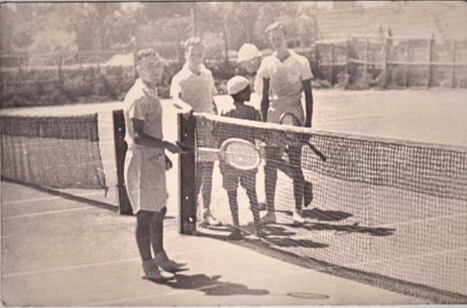
Drawn into the second World War as a civil engineer and surveyor, Grandpa told tales of building tank bridges in the desert, and hair-raising accounts of being torpedoed on a troop ship. Despite the conflict, tennis remained a passion and practice; black and white wartime photographs show him on the court drilling his serve, accompanied by a robe-wearing ballboy. 

Following the war, for much of his career, my grandfather was responsible for supervising the building of infrastructure and new home construction across the United Kingdom, Northern Ireland and latterly on the bucolic Isle of Wight, a small but perfectly formed resort island floating off of the south coast of England. 

On “the island” as it is affectionately called by residents (as if it were the only island on earth), he discovered a kind of nirvana. Sport and leisure activities thrived here, due to the hordes of summer crowds who flocked to the sunny south coast beaches and holiday camps. For generations, British holidaymakers have swarmed the boardwalks, piers, golf and mini-golf courses, outdoor swimming pools, ice-cream kiosks and amusement arcades here, while Island residents, dressed in their smart whites, played lawn tennis, croquet and bowls.

In the last years of his professional working life, “G.T.” was appointed guardian of all the island’s sports facilities as County Recreation Officer. This was a dream job; he was able to combine passion for sport, exercise, and healthy living with his strong sense of civic duty. His pagoda-shaped office was perched on the roof of the Ryde Pavillion, overlooking the sea promenade and hovercraft terminal, where he could monitor the unrelenting arrival of tourists. His remit included operation and upkeep of swimming pools, football fields, golf courses, cricket pitches, bowling greens and tennis courts. 

From around the age of eight, when my father moved our family back to the Island from Cambridge, I was recruited by my charismatic “g-pa” to accompany him on his many official visits and charity outings. For pocket money, I was his assistant in kids’ “short tennis” coaching sessions—with rubber racquets, foam balls and mini nets, all loaded into his distinctive sky-blue VW camper van for free lessons at local schools. 

When he retired, press coverage of his retirement ceremony named him the Isle of Wight’s “Mister Sport,” a title none of us in the family had been aware of. In the local newspaper, he is credited with close involvement in the promotion of sports holidays on the Island, and for fielding Island sports teams to compete in national competitions. 

Retirement was by no means the end of my grandfather’s sport-related activities. Instead, he enrolled in groundsman classes at the local college, learning the art and science of lawn craft and groundskeeping. This was first practiced with great enthusiasm at his Newport home, where the greenhouses became a lab filled with ominous receptacles of weedkiller marked with skull and crossbones, gasoline mixes for his collection of lawnmowers, and a myriad of grass seeds carefully encouraged in growing trays. He made the most of the luxurious lawns he nurtured; he often basked on a lounge chair wearing a skimpy speedo, listening to a transistor radio tuned to sports reports. 

This extra-curricular education was likely part of a campaign to secure his next prestigious appointment: as President of the Ryde Lawn Tennis & Croquet Club. The VW camper became an extension of his lawn-keeping enterprises; ramps were added to allow for a great green gas-guzzling lawnmower to be loaded on board. I helped by staking down lines of twine to ensure that grass-cutting stripes were precise and perfect on the tennis and croquet lawns. 

Every Tuesday after school, I cycled eight miles to join him in a doubles’ game with his friends at the Club. Dressed in tennis whites, I was schooled in slice, spin, chip shots, and witty social banter. This was the basis of my tennis training: loopy shots fired off by a largely stationary triptych of deeply tanned, elder players as Grandpa yelled coaching instructions: “Keep your eyes on the ball! Bend your knees! Feet parallel to the net!” After matches, the players gathered on the veranda of the wooden clubhouse for gin & tonics while I sipped from an ice-cold bottle of Coca-Cola. 

He was sporty, but he was also an aesthete. I keenly remember the white paint he would daub onto his tennis shoes to cover grass stains. His signature: a jaunty blue ascot tied around his neck, the only splash of color in his all-white ensemble. 

In retirement, Grandpa stepped-up global travels as the President of the Newport Rotary Club. Overseas, the Jurys would meet up with fellow Rotarians and visit the work of charities supported by their fundraising efforts. Tennis whites and racquets were packed for these trips, in case of opportunities to play.

Watching Wimbledon was a highlight of the mid-summer, when the television was brought out onto the garden lawn for festive match viewing. These were the 1980s heydays of McEnroe, Connors, Bjorg, Becker, Navratilova and Evert. Grandpa was not at all a silent spectator; each match was accompanied by his own running commentary and loud booming applause on notable winning points. 

While this part of his history is a little murky, lost in the mists of time, it turns out Grandpa had himself played doubles at Wimbledon prior to the war. Thirty years later, as President of RLT&CC, he reunited with his former doubles partner to compete in the British Veterans Over-45s Tennis Championship, immediately following the Wimbledon Championships. Among the famous players appearing were Jaroslav Drobny, Bobby Wilson and Roger Becker. “I don’t suppose we shall last very long if we run up against them,” he said, “but it will be a great honor to simply play there again.”

I departed the Island in 1991 to attend King’s College, and my tennis game languished for nearly 20 years. After moving to New York, I rediscovered the game, joining a posse of tennis-obsessed friends who played weekly at Midtown Tennis: Horacio Silva, former New York Times writer; Armand Limnander, Deputy Editor of W Magazine; Stefano Tonchi, Editorial Director Harper’s Bazaar Italia; late PR executive George Kolasa, and agent Massimiliano Di Battista to name a few. Back in 2012 one of our number, Bee Shapiro, penned an article for the New York Times Styles section: “Tennis and Fashion; It's a Love Match,” about this community, subtitled “A Sneakers-Only Runway.” 

My grandfather was able to play the game he loved well into his late 70s. My last memories and images of him are happy ones; he’s seated in a chair in his conservatory surrounded by his six grandchildren.

Now, I play tennis with my grandpa’s memory top-of-mind and with a deep sense of gratitude for the gift of the game he gave me as a young boy. A miniature model of that blue VW van sits on my desk, to remind me of those times as his trusty sidekick, promoting tennis all those years ago. 

Peter Malachi is a third-generation tennis player and works in fashion communications. 

Stay in touch

Sign up for our free newsletter

More from Racquet

Men Have Already Lost the Battle of the Sexes

Now that tennis represents a broader purview, it churns out the same cheap tricks as the overstimulated ecosystem it dwells in: shock jockery, cash grabs, frenzied efforts for “engagement” that materialize as gauche emblems of brodernity. So I turn your attention, instead, to the real battle of the sexes: that women’s tennis is amply more exciting than men’s.

December 26, 2025

We Launched a Clubhouse

Just in time for the holidays, we are so thrilled to be opening our doors to the Racquet Clubhouse. In our hometown of New York City, there's only one club that offers best-in-class tennis, padel and squash—alongside a spa, juice and coffee bar: CityView Racquet Club. That's where we've launched our first IRL pro shop.

December 23, 2025

Courtside Orange Blossoms in Marrakech

In this postcard from Morocco, local player and commentator Mamoune Hazmoune explains the meaning of high-level tennis up close and personal.

December 17, 2025

Jelena Ostapenko is at it Again

Hawkeye might be forever stacked against her, but dammit, Ostapenko is going to wrest back the favor of the gods one waistless eponymous tennis dress at a time, for offers in good faith from Believers in her DMs.

December 10, 2025

Greetings from Tennis City, USA

A postcard from our favorite indie zine Portland Tennis Courterly's Wet Issue release party, where each microclimate seemed completely and utterly devoted to tennis, from the bagels toasting in the kitchen to a 1997 Riesling with notes of... tennis balls.

December 3, 2025
See all posts