


Skip to Content
Features

Red Shift: Training on the Terre Battue in LA

A garden in the San Fernando Valley is ground-zero for West Coasters eager to unlock the secret lessons only the slidey stuff can teach.

1:56 PM EDT on June 3, 2026

There’s a gem hidden in a Woodland Hills back yard, tucked behind the Santa Monica Mountains, far from the huge tennis complexes where most promising U.S. juniors hone their games on hard courts.

Last weekend, Zibu Ncube and Manfredi Vergine stood on the terre battue that fills the space behind Ncube’s house where a shady LA lawn should be, and drilled Katrina Scott, the rising pro and University of Tennessee Lady Vol. 

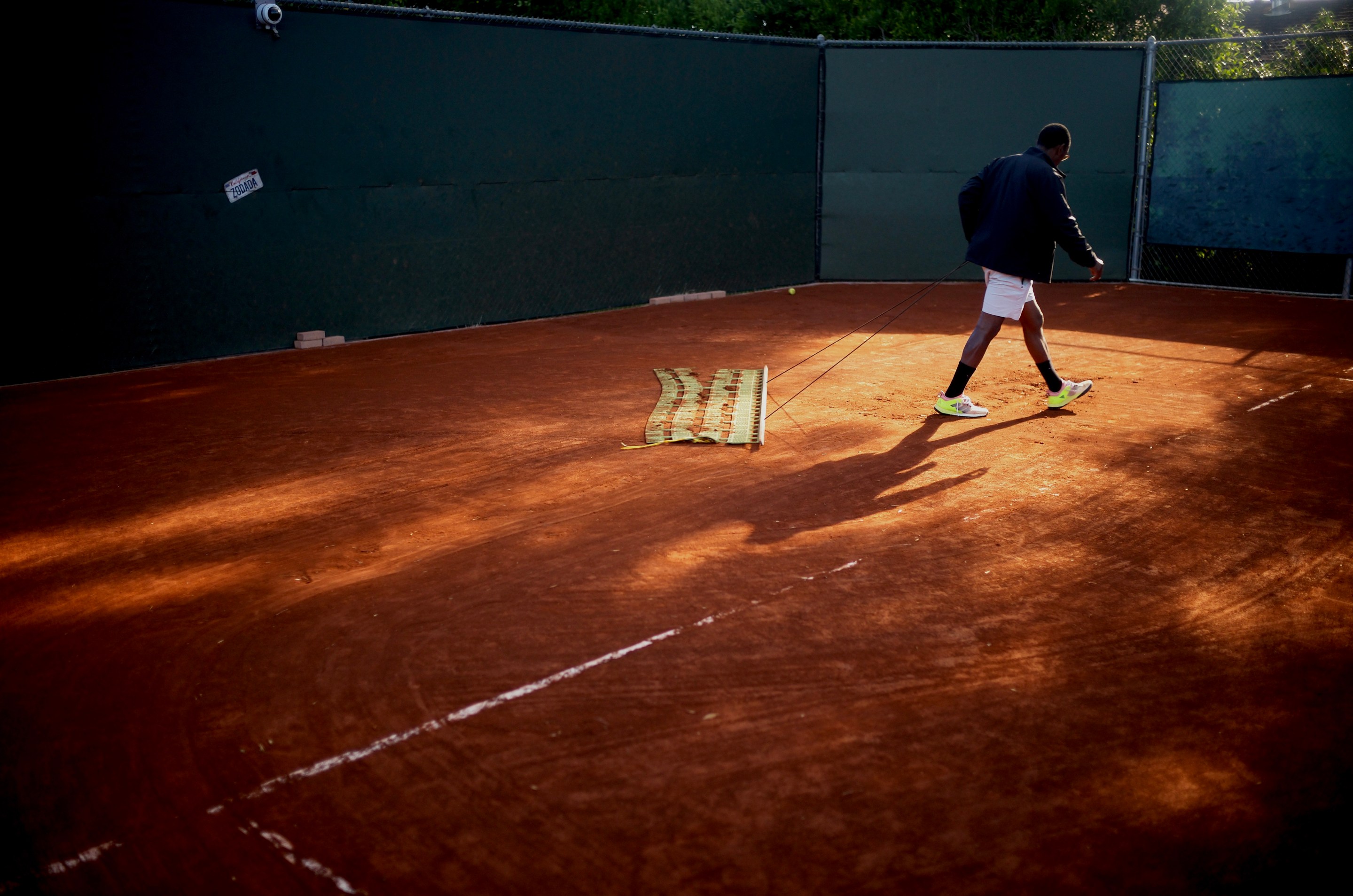
Ncube, a former college player from Zimbabwe who's seen first-hand the benefits red clay confers, is committed to training U.S. juniors in the ways of the old world. So committed that he bought a house with a tennis court, swapped out Har-Tru green for imported Italian red, and made terre battue the de facto training surface for his blue-chip juniors. 

The former member of the Zimbabwe Davis Cup team spent years coaching tennis in Barcelona during the Big Three heyday, watching players develop on red clay exclusively. It was there that he came to recognize the unsteady-but-also-forgiving surface’s benefits for the mind, the game, and the body.

“All these guys grew up on red clay […] they easily could put in an extra hour each day of reps, building their body and building the game,” he said. “It's not just executing the shots early, but constructing the point, and if you add those hours up after 10 years of playing, you're going to see a significant difference in levels.

Photo by Davis Guggenheim

“You’d see a Spanish player who is 5’9”, 5’10” make it to the ATP top five in the world, but it was kind of unheard of in the U.S., outside of Michael Chang. The federations in the U.S. were looking for these amazing athletes that have to be 6’4”, big serve, big forehand, more or less following the athletic abilities of the Andy Roddick-type of player, but Europe in general was producing good athletes of average height and making it into the top 10 in the world.”

Manfredi VerginePhoto by Davis Guggenheim

With these disparities in mind, upon his return to the U.S., Ncube went about building a bespoke program for juniors seeking a leg-up in the race to the top. Since then, he’s developed a loyal following among SoCal’s top developing players, some of whom come back after they go pro to refine their technique. Lately, Manfredi Vergine’s joined the team as a coach: a young Italian with a red-clay background and pro-level talent, he is of the same opinion when it comes to clay court training.

“If you want to build your game, Roger Federer said it best: the best players are the best movers,” Ncube said. “Clay is not forgiving. The bounce is not always consistent. Surface ball-speed changes depending on the weather. If it's gloomy, it’s a little slower, it's more dense, it's heavy. If it's warm or hot, the ball is thin, the ball is bouncing high, so it favors the players with heavy spin and acceleration, so you're constantly adapting and changing. When Federer says ‘the best movers are the best players,’ clearly he has the luxury to say that, because he grew up on clay.”

Passant le filetPhoto by Davis Guggenheim

Growing up on clay is not something most Americans do. The lucky ones, those who live near Ncube or can travel for specialized training, are seeing results. 

Vergine, Scott, and Ncube

“In the U.S., clay is missing, and also it's underestimated,” he said. “I believe I've had 30 or 40 players in the last five years, maybe more, go to college, D-1 and D-3, and I've done that with one court.

“I've had players winning gold balls—we're training on clay, we're not training on hard courts as much—but we're winning tournaments on hard courts.”

If it’s difficult to get a European red-clay court to LA, the maintenance is even tougher: lines must be replaced and hammered in frequently, due to temperature swings and the dry California climate, which necessitates a water system beneath the substrate. Ncube insists it’s worth it, though: “Top-tier tennis players are super dedicated, so I built the court to match their demands.”

Wendy Laird is Racquet’s Managing Editor. She wishes she’d grown up on clay.

Davis Guggenheim is an Academy Award-winning screenwriter, director, and producer.

Stay in touch

Sign up for our free newsletter

More Stories

Reilly Opelka’s Art x Tennis Club is in Session

The TVLG ART x TENNIS club is Reilly Opelka writ large(r).

August 10, 2026

Tennis Art en Plein Air

The supercool city of Montréal is EVEN COOLER now: tennis murals adorn citywide backboards at the home of the Canadian Open Championships.

August 10, 2026

The Art of the Open

The gold leaf-adorned artwork by CDMX artist Euri Lorenzo is magnificent, and makes us want to head South, pick up a poster, and frame it on the wall of our new home on the Sea of Cortez. 

July 30, 2026

Can Green Clay Save the World?

Tennis has a complicated relationship with the climate, but new initiatives—including a switch to good ole Har-Tru—show it can be part of the solution.

July 23, 2026

Racquet’s Guide to Los Cabos

When you bring your racquet to Los Cabos, you discover a travel experience where tennis meets the sea, the desert and a vibrant Baja culture—a perfect blend that’s made the Mifel Tennis Open by Telcel Oppo an unmissable stop on the ATP Tour for ten years running.

July 20, 2026

Fit(s) For a Queen

The Serena Williams Fit-Dex is hands-down the best use of the internet.

July 16, 2026