


The 19th-century textile designer William Morris (STAY WITH ME HERE) had a useful rule of thumb: Have nothing in your houses that you do not know to be useful or believe to be beautiful. I bear Morris’ core tenet in mind when I visit the home of a new acquaintance; it helps me decide whether we can ever truly be friends. I also use it when I take the measure of a professional tennis trophy, which I do every time I watch a tournament winner heft aloft someone else’s idea of beauty, or utility, or both.
Of course, “useful” was a simpler concept for Morris, who as it happens was a resident of Wimbledon but no tennis player himself. Unlike, say, a butter churn, a trophy must act as a proxy for all the work that led up to this win; all the junior tennis and all the early-morning workouts and all the Doughnuts Not Eaten. It must be shorthand for “I was the better player today,” and “This is the best competition I could have entered this week,” so it should celebrate the place as well as the victor. It must also be reasonably hoistable™. That’s a tall order for an inanimate object, but some trophies have managed to do all that and, sometimes, more. What follows is a by-no-means exhaustive list of the most, and least, successful tennis awards.
The Good

Australian Open Women’s
Who could ever be mad at a silver cup? As with all the Grand Slam trophies, some designed to look like actual chalices of the gods, it reads “trophy” with no effort at all. It’s a manageable size; the hoistability™ score is high. And it looked so very good in the gondola with a pink-frothed Aryna Sabalenka after this year’s win. In this list, it stands for all the silver cups and plates out there, quietly doing their jobs.

Rolex Paris Masters
Love it or hate it, it’s an art nouveau-esque masterpiece with a delicate-yet-substantial presence. As such, it is of-its-place and would not look amiss amongst a well-curated group of objets d’art.

Dubai Tennis Championships runner-up
No trophy in professional tennis is as successful at taking just the right tone as this glorious, golden khanjar dagger, a ceremonial symbol of manhood, power, and authority. The runner-up can squeeze this and quietly fume next to the guy who’s struggling to hold up a giant silver boat. This trophy also gets bonus points for embodying a veiled threat.

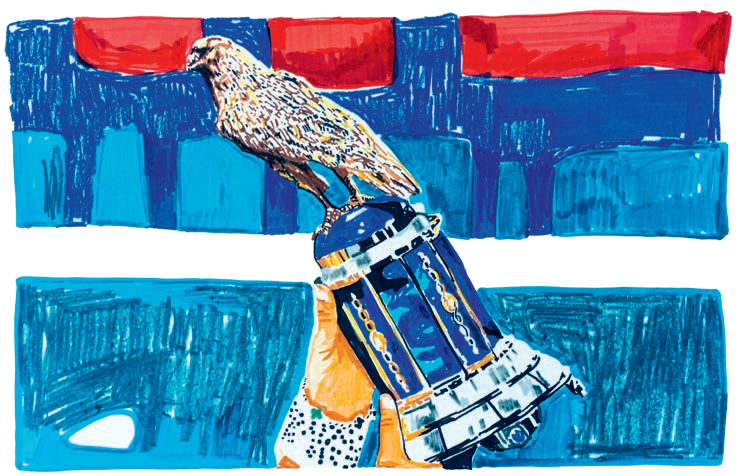
Qatar Open Women’s
It’s gold. It’s on a base of what looks like solid lapis
lazuli. It’s an eagle. Who wouldn’t want this on the mantel? No one.

Acapulco Gourd
You thought it was a pear. We all did. That's part of its mystique—its tooled-silver, hook-stemmed mystique. A good trophy must walk a fine line between underwhelming and ridiculous; only Acapulco could cross that line, add a sombrero, and keep 'em coming back for more guaje (gourd).
The Jury's Out
Dubai winner’s dhow
You’ve won an ATP 500! Take this unwieldy silver boat and sort of peek from behind the giant sail in elation while the runner-up is glowering next to you holding a golden dagger! Then take home a replica and try to find a place for it in your curio cabinet.

The Bad

Qatar Men’s runner-up
This is the actual worst trophy ever, outside of your kid’s Most Improved speech trophy. Kudos to little Susan for putting herself out there, but the Qatar runner-up deserves better. It fails for the sheer disparity between the winner’s award—a golden eagle—and that of the guy WHO ALMOST WON.

Indian Wells
Every glass or crystal trophy runs the risk of looking like a prize for making your Third Quarter Sales Goals. Crystal is also heavy, which is unfortunate since it's famously easily breakable. In spite of the fact that the IW trophy looks a little like a very expensive piece from glass-blower Simon Pearce, and could convincingly be part of a holiday dinner centerpiece, its hoistability™ score alone puts it squarely in the bad column.

Mutua Madrid Open
We don’t even know what it will look like in 2024 because, after presenting the tournament winner with a 16-pound, diamond-encrusted, solid-gold phallus for a decade, then pivoting to what can only be described as, er, the opposite of that, and taking such a gleeful ribbing for it all, they’ve abandoned all commitment to continuity and announced that the winner’s trophy will change yearly. However, I feel we know enough already about tournament tendencies to condemn it unseen.

Hamburg Open
The best thing about the Hamburg European Open, aside from the ingeniously shaded stadium, is that their logo changes every year to reflect the trajectory
of the previous year’s winning point. The worst is the trophy, which doesn’t change like the logo, and is, or appears to be, a 3-D printed version of an earlier winning point (perhaps the first year’s—who knows?). Regardless, the winner of this tournament has to smile and hold what looks like the Hamburg Middle School Science Club’s latest projekt.
The most useful and hoistable™ item in Wendy Laird’s Seattle trophy case is a crystal highball glass engraved with “Runner Up—Women’s Doubles.


