

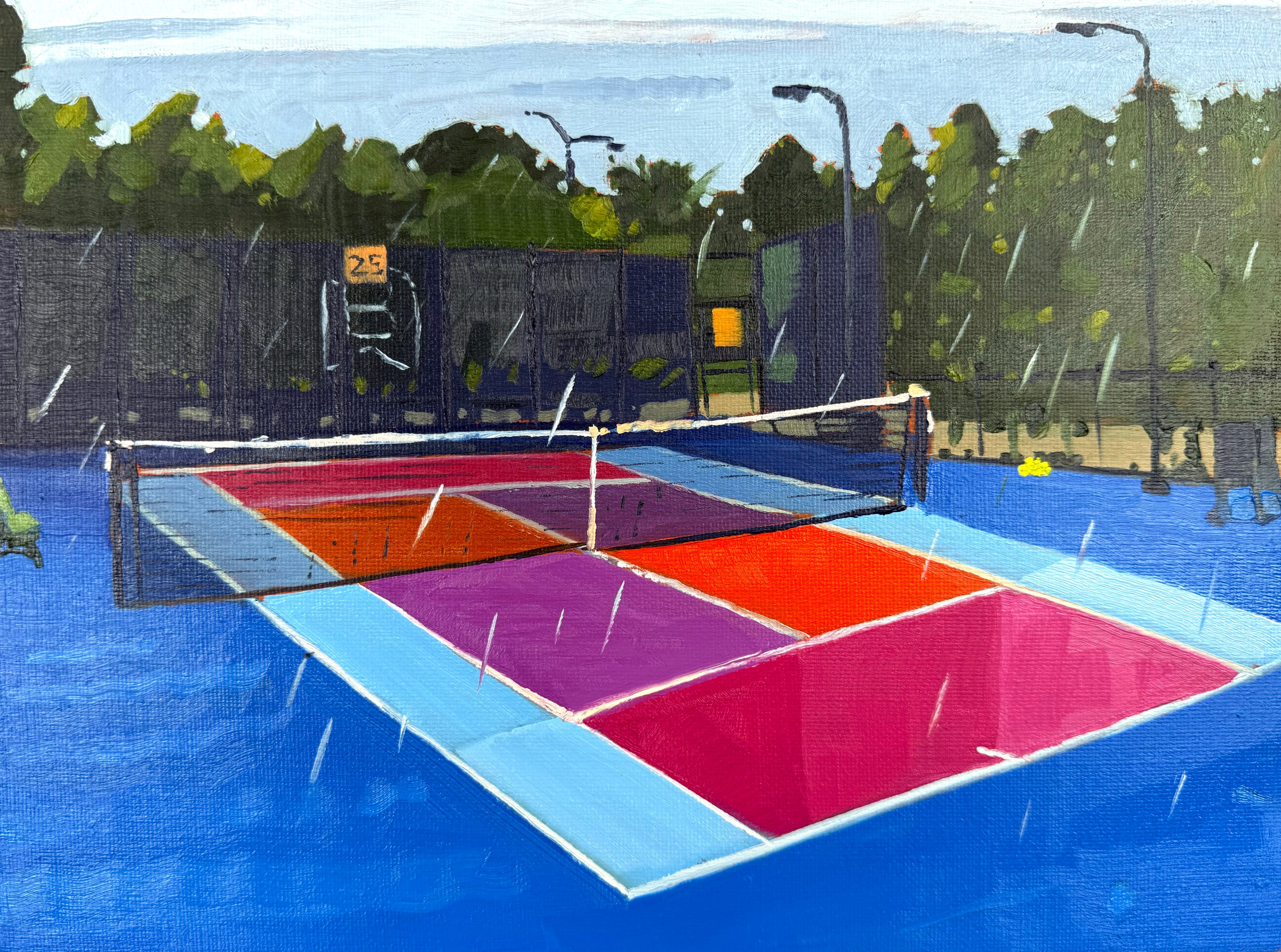
Toronto-based painter Keiran Brennan Hinton spent a week in residence this spring at Banner House in Dallas, creating a series of plein air tennis paintings on site during the Dallas Art Fair.
A relative newcomer to the sport of tennis—as an artist and as a player—Hinton points out surprising parallels between painting and tennis: the importance of staying present, the challenge of responding in real time, trusting oneself, and getting into the flow state.
We caught up with him to discuss the project.
Racquet: How did the Banner House project come about?
Keiran Brennan Hinton: It happened during the Dallas Art Fair. I've been working with a gallery called SOCO in North Carolina. They're good friends with the owners of Banner House, who had recently purchased and renovated the club. My wife and I picked up tennis a couple years ago and quickly got really into it. So when the gallery brought me this project and asked if I'd want to go to a tennis club and make paintings on site, I was really excited by the opportunity.

R: Was this your first time painting tennis?
KBH: It was. I wanted to explore the relationship between painting and tennis. I think they're actually quite similar. Both happen within a frame. In tennis, you're playing within the confines of the service boxes and the court. In painting, you're working within a rectangle and trying to move someone's eye around that space. I was also thinking a lot about the color theory of courts, and how they became the colors they are. Courts shifted to blue so people could see the ball more easily on television. Those things are really interesting in relation to painting and how color impacts the way we perceive the world.

R: You’ve mentioned staying present and trusting yourself when you’re painting.
KBH: I paint exclusively from life, which means you have to respond to things in real time: the weather changes, the wind blows, someone comes over to talk to you, the sun moves. The whole thing in front of you is active. Learning how to paint this way is about letting go of expectations and listening to what you're looking at. Being perceptive and receptive to things as they're changing.
R: Do you think painting has a similar “flow state” to what athletes experience?
KBH: Totally. You practice and practice, and then you're hoping that in the moment you can just respond and capture things in real time. When you get into that flow state of responding without thinking, that's where things really start to click.

R: Are there other similarities between painting and tennis?
KBH: Tennis and painting are both such internal processes. Even when there's an opponent across the net, in a lot of ways you're playing against yourself. You're relying on what you know and what you've built. Painting feels the same way. You're looking at the world in front of you, but you're also dealing with yourself and your own decisions. Both require trust.
R: What was challenging about painting tennis for the first time?
KBH: The geometry of the court itself. The lines are so exact. You know when the lines are wrong. When I'm painting outdoors or painting interiors, you can sometimes fudge things a little bit. With a tennis court, everything is in relationship to everything else.

R: What do you hope viewers take away from these paintings?
KBH: In a lot of ways, they're about joy. Painting is really about paying attention. I spend a lot of time mixing colors, and often the preparation and color mixing takes longer than the painting itself. It's about paying attention to the nuances of things and not assuming you know what something looks like, but actually looking at it.
I hope that willingness to be present comes through in the paintings and gets passed along to the viewer. One of the paintings was of someone practicing their serve over and over again. You're trying to paint something that's impossible because it's so active and constantly moving. How do you hold onto the feeling of that moment? How do you hold onto movement and energy within a still image? That's really what I'm after in the long term.
Kieran Brennan Hinton lives and works in Ontario, Canada. As a tennis neophyte, he captures aspects of the sport that many of us may take for granted.


