

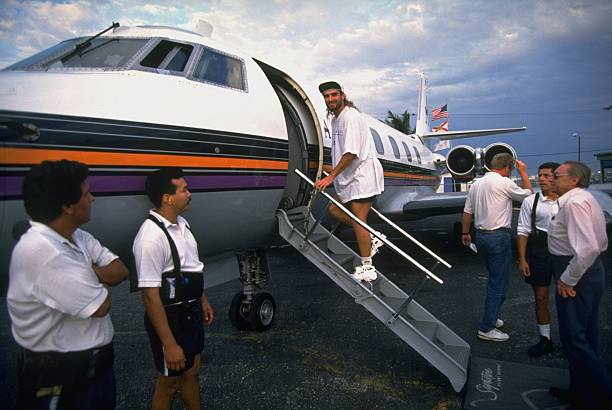
On the afternoon of September 11, 2005, an aging Andre Agassi took control of a U.S. Open Final and pushed a young Roger Federer to find the inner warrior hiding beneath the robes of an artist. I’ve never forgotten that furious, glorious hour when the world outside Arthur Ashe Stadium vanished. Federer carried no scars then. He was 24. A child. Agassi had become dad-bald cuddly, no longer mullet dangerous. As a teenager, I’d found solidarity in his punk-rock earring, his neon, his ripped shorts and long hair. A kid got suspended from my high school tennis team for refusing to wear his hat forwards. That’s what Agassi brought to a patrician game: youth and rebellion. It was the fall of 2005. I had not yet begun to lose things, and people, and parts of myself. I still believed in the one true way, as Federer did. Agassi knew better but I hadn’t lived enough to understand what I was watching. I was 29 years and two days old.
Agassi lost the first set 6-3, but then he found a version of himself long-dormant. It was thrilling to watch. He broke Federer in the second game of the second set and went up 3-love, winning the game on a 126-mile-per-hour serve for an ace. He took the second set 6-2. The crowd rose as one. In the third set, Agassi broke Federer again, going up 4-2, and the whole stadium shook. The video board caught Robin Williams and Dustin Hoffman giving a standing ovation. Donald Trump and Lance Armstrong, too. Beloved and hated men alike felt the wave. Federer limped to his bag and got a new racket, returning to the court to retake control and steal the third set in a tiebreaker. The stadium fell silent, and in the fourth set, Roger finished Agassi for good.
Federer sat afterwards, victorious, in the locker room with a relaxed smile. I didn’t understand this scene either. I imagined then that Federer’s youth and talent made him invincible, not realizing that Federer had not been playing an opponent so much as his future self, just as Agassi had been struggling against the ghost of his past. The opponent is always yourself, I’d learn many years—and scars of my own—later. These two athletes were men moving through the sky, at wax and wane, occupying different cardinal points on the same wheel. They were the same man, really, occupying multiple dimensions, with dozens like them turned to dust in their wake and dozens more rising to take their place.