

During the 2025 Eastbourne Open, Dan Evans took the grass to square off against Tommy Paul. Tommy, wearing a custom New Balance shirt in gradations of green and mid-calf socks matching his signature trucker hat, seemed the epitome of modern tennis style. Square-jawed, 6’1”, with a lean athletic build, Tommy is the consummate all-American jock. US Weekly, Gayety, and the Nothing Major podcast have all listed Tommy one of the hottest players on tour—a Ranker.com poll placed him No. 1.
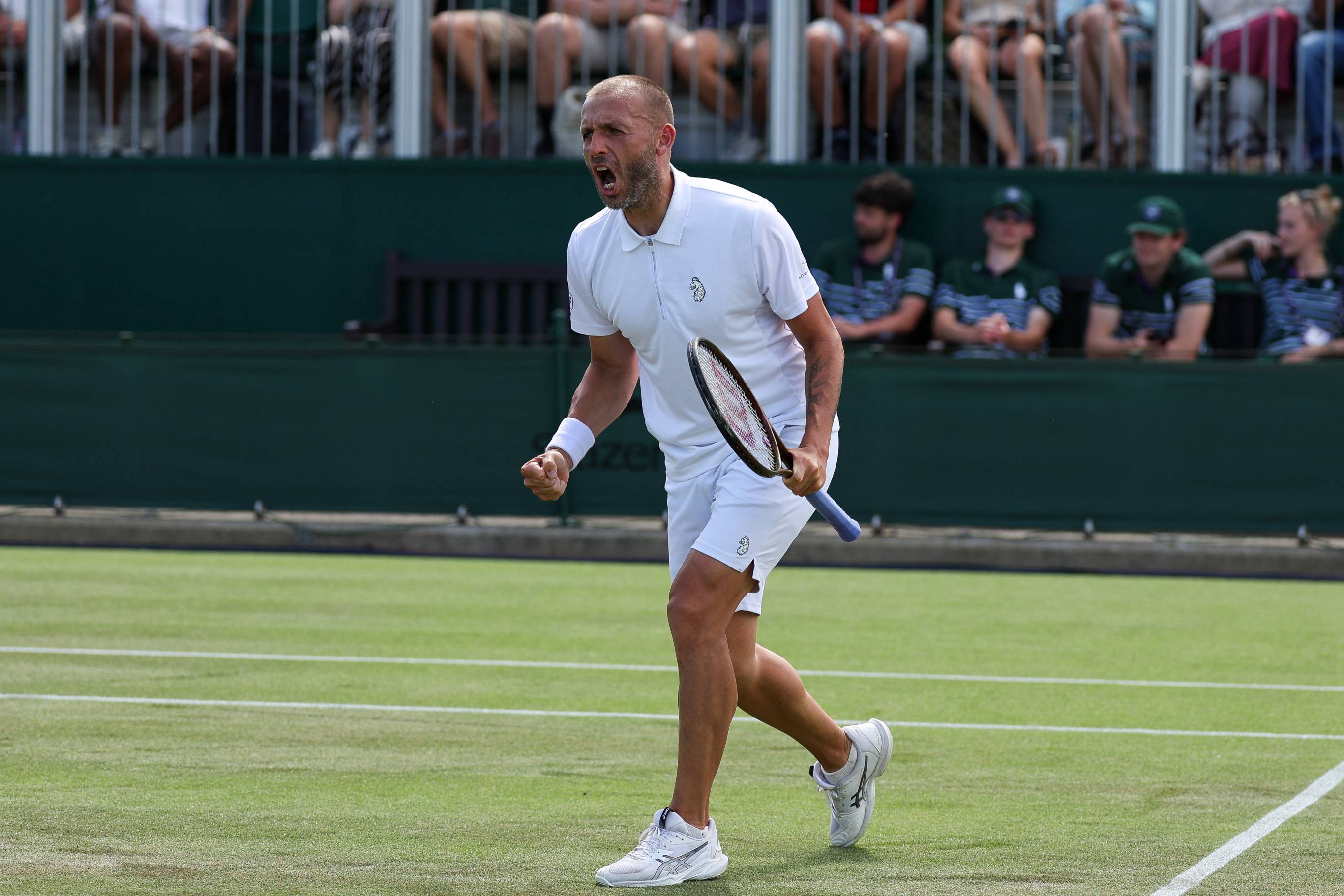
Across the net—and across an aesthetic chasm—stood Dan Evans. Dan is listed at 5’9”. That is almost certainly generous. At 35 years old, Dan is balding and slightly pigeon-toed, his central incisors jut over a row of crooked lower teeth, his mid-section is somewhat soft. As always, Dan sported low-cut ankle socks, an unfashionable choice he attributes to concerns about tan lines. To be blunt, Dan looks more like an Aston Villa soccer hooligan than a professional tennis player. If Tommy is a walking 2000s Abercrombie catalogue, Dan is the human embodiment of four pints of beer and a cigarette.
But on that day in Eastbourne, it was the unseeded Evans who beat Paul in three sets. And what if I told you that not only was he victorious in that match, that Evans is the true pinnacle of tennis cool. That in a tour filled with monied, modelesque athletes, no one is as appealing, swaggering, and unique as Evans. Nobody has ever called Evans the hottest player on tour. What this essay presupposes is, maybe he is.

1: Man of the People
One of the coolest things about Evans is that he has bona fide working-class roots. Tennis has long had trouble shaking its perception as a country club sport. And despite producing some stars from modest backgrounds, many pro players do come from privilege—born into an elite athletic lineage, raised with tremendous means, or some combination thereof. Ben Shelton’s, Casper Ruud’s, and Sebastian Korda’s dads are all former professional tennis players; Taylor Fritz’s mom is a former professional tennis player and department store heiress; Jessie Pegula’s and Emma Navarro’s dads are both billionaire entrepreneurs.
Dan Evans’s dad is an electrician. His mom’s a nurse.
Evans grew up in Birmingham, England—far from sun-drenched tennis meccas like California or Mediterranean Europe—without the wealth or sporting pedigree that eased the paths of many of his peers. He was a promising junior but was cut off from British Lawn Tennis Association financial support at age 18 (more on that later), nearly derailing his fledgling career. Evans played Futures for months to make ends meet and found just enough money to keep things afloat.
In his years on the pro circuit, Evans has never lost the perspective formed by his upbringing. In a 2023 press conference, Evans slammed the LTA and British tennis infrastructure for its elitism.1 “I just don’t think there's a chance for people from working-class backgrounds to get into the sport and get a chance if their parents don’t have money.” “I want working-class kids to get the support they deserve,” said Evans, “I'm doing it for working-class people like I was.”
In late 2025, when Alejandro Davidovich Fokina complained about a match being scheduled for 11 am, Evans responded on Instagram, “Wake up an play. The world wakes up an works 9-5 even 8-6 pathetic.” Obviously, match scheduling is a real issue for players, and pro tennis can be a grueling trade. But growing up, Evans watched his parents work physically demanding jobs for a fraction of the paycheck Foki commands, without any of the attendant glamor. And as someone who spent years of my life working 65-hour weeks, I’ll admit it felt damn good to see Evans reminding the tennis community that their lives are comparatively charmed.2 The most upvoted comment in response to Evans’s Instagram post on the r/Tennis sub-Reddit reads, “He’s a real one for this.”
Evans is real. Evans is one of us. That’s what I want from a tennis star, that’s cooler than 20 stories about Jannik Sinner being a child skiing prodigy.
2: A Bump in the Night
And speaking of skiing…
In 2008 during Junior Wimbledon, Evans went out drinking into the early hours. Not only did Evans lose his match the next day, his antics lost him the support of the LTA for the next four months. Evans was stripped of his funding by the LTA for a second time in 2012, and the British press bashed Dan’s lack of commitment to the sport.3 In 2017, Evans was banned from pro tennis for one year after testing positive for cocaine. Evans has been called “the bad boy of British tennis.”4 The moniker was clearly well-earned.
We can all appreciate the scandal-free statesmen of our sport, we can all feel warmed by the constant stories about how well-behaved Carlos Alcaraz is, but we can also admit that being the “bad boy” is a different degree of aura. Feuding with authority is cool; being banned for doing key bumps is cooler than being caught doping with a performance enhancer like Roxadustat.5 And while I’m certainly not here to extol cocaine (which Evans himself called a “life-ruiner” in a 2018 interview), isn’t there something refreshing about a professional tennis player who actually parties?
We live in an era of hyper-optimized health plans for tennis players. Top pros measure calories, train six hours a day, and limit themselves to the occasional glass of wine; Dimitrov, Andreescu, and others don’t drink at all. Novak switched to a plant-based diet (and recharges with cosmic energy emitted by secret underground pyramids built by an ancient lost civilization in Bosnia). What’s more, modern players socialize much less than previous eras. They are shepherded from the court to the fitness center to the hotel to the airport by a team of coaches, hitting partners, trainers, psychologists, and agents, often nearly twice their age.
The commitment to honing your body to extend your career, the sheer discipline this lifestyle requires, it’s all very commendable. It’s also dull as dishwater. Every story from tennis players in the '70s is basically: “I was flirting with Debbie Harry at Studio 54 while Gerulaitis was laying out the fattest lines of blow I’d ever seen. We left at 3 am after McEnroe fell off a table, and I still took Connors to five sets the next day!” These days, most players lives are so anodyne and hermetic, the only “stories” we get are clips of them lying on the beach in the Maldives. But isn’t it more fun to hear Evans talk about partying with Andy Murray all night after the Paris Olympics?
I admire that Evans has enjoyed some night life. It’s unique that he allows his body a life outside of tennis, and it harkens to an earlier more swaggering era of the tour. It’s human that Evans hasn’t always been perfectly dedicated to the sport. Who among us is a paragon of virtue—who among us even wants to be?
3: Love Means Something
You can tell a lot about a person based on their partner. Who you share your life with reflects your values, character—your soul, even. By this metric, Evans is also that guy.
Dan met his partner, Aleah Evans, in Winchcombe, England in 2017. Aleah travels with Dan and is often seen courtside at matches, but she formerly worked as a forensic scientist for a solicitor’s firm (which is cool). Aleah is stylish and prettier than Dan (go off, king). At some point, Dan and Aleah seem to have secretly gotten married (super cool). The couple largely shun social media and keep their life together under wraps (cool as hell).
It’s common to see ATP players dating models, influencers, or other professional tennis players. There’s certainly nothing wrong with that, but the fact that Aleah appears to be a real person with professional accomplishments of her own implies that Dan has a certain depth—that he’s a rounded person with a firm connection to the world outside of the pro tennis bubble. That they don’t plaster their relationship all over social media in our distorted hyper-online era is a small miracle. It takes confidence to go against the grain in a time when everyone seems desperate to be perpetually perceived.
Maintaining an air of mystery is cool. Constant social media access is lame. Dan’s relationship with Aleah—the very fact that I can find so little about it online—is true hot guy shit.
4: One of These Things is Not Like the Others
Modern men’s tennis is increasingly homogenous. Huge players bomb huge serves, then trade heavy topspin groundstrokes off both wings from a few feet behind the baseline. Almost everyone uses two-handed backhands. Almost no one consistently pressures the net. Tournaments have slowed the speed of their courts, and clay, grass, and hardcourts play more alike than ever. Fitter players, heavier tennis balls, and improved string technology have all contributed to a game style that looks the same.6
But never from Dan Evans.
Evans, by contrast, uses a one-handed backhand and slices the vast majority of shots off that wing. In fact, from 2017-2021, Evans sliced his backhand 71% of the time (the tour average was 20%). Evans’s slice is a beautiful change of pace in the age of big hitting and a multi-faceted weapon. He uses it to neutralize pace when opponents unload on a ball; he floats it short, inviting the opposing player to net on a sneaky tough ball before passing them down the line; and he knives it deep into the corners, forcing weak balls from tall players trying to pick up shots from below their knees.
As an example, in the round of 32 at the 2025 Citi Open in D.C., Evans was serving for the first set against Alex Michelsen. Michaelsen rips the return deep to the ad-side corner. From his back foot, Evans eases a slice barely past the service line that Michaelsen has to take on the run. Three shots later, Evans slices the backhand again, this time floating it nearly to the baseline on Michaelsen’s ad-side. No longer in an attacking position, Michaelsen lofts a medium-paced forehand, which Evans belts back into the same corner: Michaelsen sends his down-the-line backhand wide. Evans wins the set, and goes on to take the match 6-4, 6-4.
I could watch Evans’s game all day. He employs a platform serve where he arches so far back it looks like a yoga pose. He darts around and counterpunches. And he’s a true all-court player who loves to come forward and find a volley winner. Per Tennis Abstract, Evans got to the net on over 16% of his points from 2021-2024.7 In a round of 64 match at the 2024 Olympics, Evans closed down the net on one out of every four points. Medvedev, Ruud, and Sinner all come to net under 10% of the time, Fritz under 8%. I’m a firm believer in “first to the net, first to the bar.” Evans seems to be too.
Evans’s game is varied, creative, and aesthetic; he might not be conventionally attractive, but his tennis is beautiful.
5: David vs. Goliath(s)
As discussed, Dan Evans is around 5’9” (and I’m convinced that’s with shoes on). The average height of top ATP players is somewhere between 6’2” and 6’3”. Ben Shelton is built like a linebacker. Evans looks more like a guy you play at your local club. But despite his smaller stature and lack of an overwhelming weapon, Evans has two career ATP titles, including the D.C. 500 in 2023. He’s won over $9 million in prize money and rose as high as No. 21 in the world (at age 33, no less). Evans has beaten the likes of Zverev, Rublev, Fritz, Thiem, Tiafoe, Khachanov8, and Djokovic in straight sets in a shocking upset at the 2021 Monte Carlo Masters. He even spent time as the British No. 1.
What’s cooler than an underdog story? It’s easy for a 6’6” Zverev to win points behind a 130 mph serve. It’s a lot harder for a Dan Evans, whose average serve speed is around 105 mph.9 It doesn’t move me to watch Jack Draper use his 6’4” 200-pound frame to overpower opponents. But when I see Evans use craft and cunning to win a match against some god-like opposition, I feel a sense of pride! It’s inspiring for the underdog to come out on top; it’s aspirational for the 99% of us who aren’t natural athletic marvels. For Evans to have accomplished so much, considering where he came from, considering the physical obstacles, is remarkable.
*****
Dan Evans’s career appears to be slowing down. He played around 45 tour-level matches per year from 2019-2023. That number dipped to 28 in 2024, then to 13 in 2025 (he also broke his left wrist during a match in September). Let’s appreciate Dan while we have him, appreciate that players of his style are getting rarer by the year.10 As long as Evans is on court, I’ll be watching. And the next time you see Evans walking to the baseline—in-toed gait, ankle socks, and all—I hope you see the real hottest player on tour.
Morgan Mason is an attorney, writer and tennis fanatic based in New York. His work has appeared in Racquet Issue No. 27 and the Vanderbilt Law Review. He lives on the Upper West Side with his wife and his three Yonex VCOREs.
Footnotes
- Critics assert the LTA metes out its scholarship program too narrowly, and sometimes to wealthy, privately educated juniors who least need the assistance.Return to content at reference 1↩
- In a 2025 interview, Evans said of life on tour: “You’re living the dream, you know, you’re living every minute of it…. A lot of people moan about the schedule, but we’re living a fucking amazing life.”Return to content at reference 2↩
- Tim Henman said of Evans, “When you talk about commitment there are no grey areas, you are either in or you are out—and at the moment he is out.”Return to content at reference 3↩
- Admittedly, not the highest bar to clear.Return to content at reference 4↩
- No shade to Simona, who I love and don’t blame. Her coach, on the other hand…Return to content at reference 5↩
- Evans bemoaned this himself in a recent interview: “A lot of skill’s gone out of the game. These guys are smashing the ball around, [but] the full court game’s totally pretty much gone…. I just feel it’s all a lot of the same.” Return to content at reference 6↩
- In 44 matches Tennis Abstract charted during this period.Return to content at reference 7↩
- Including a win in the longest match in US Open history.Return to content at reference 8↩
- Per Tennis Abstract, analyzing Evans’s first and second serves in 39 matches from 2020-2024.Return to content at reference 9↩
- Luckily, Evans has at least one spiritual successor on tour: l’enfant terrible Corentin Moutet.Return to content at reference 10↩


