

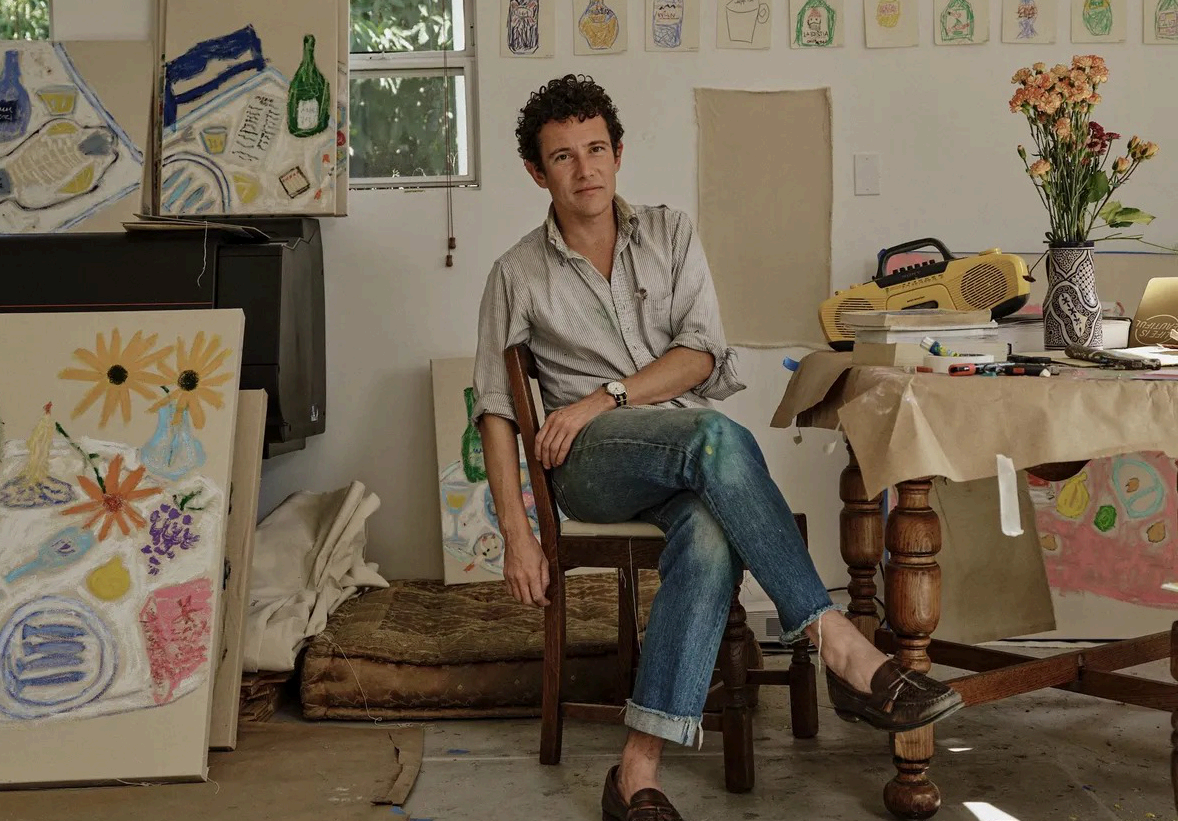
Decorating a flat in downtown Athens, Greece, is a worn-in 1960s-era Wilson Jack Kramer tennis racquet. The warped wood and gnarled gut strings are not just a striking visual, but also a family heirloom and a source of inspiration.
“I’ve had it on the wall of every apartment I’ve ever lived in. The wood looks all kind of crazy. I’ve tried to hit with it, and I’m like, ‘what is this?’,” says Michael McGregor, who is equal parts critically acclaimed visual artist, world citizen and tennis enthusiast. The racquet is one his mother played college tennis with—she and her five siblings were all Division 1 players—and for its second life, it has been a reminder of McGregor’s roots in a “huge tennis family” from northern New Jersey in homes from Brooklyn to Mexico City, Austin, Los Angeles and now Greece.


“Right now I’m staring at three racquets,” McGregor says from his Athens living room, as he’s cutting construction paper that he nicked from his five-year-old niece in New Jersey over Christmas. He’s using it to design a friend’s album cover, and he’s getting ready to work on a ceramics project that will bring him back to Hydra, the carless Saronic island where he lived for three months in 2023 and published his observational sketches in Memories of Hydra (Hyper Hypo). A perfect example of his style is the thick lines with brilliant Matisse-like use of bold colors for a pack mule, with the witticism, “What do the donkeys think?”

Racquets and tennis balls are recurring themes in his work and have featured prominently in still-lifes sold by the prestigious gallery Hashimoto Contemporary. “Honestly, because the imagery has been in my brain for so long," he says of tennis, “it’s part of my visual DNA.”

What has arguably attracted the most attention to his work is McGregor’s series of whimsical sketches on stationery from leading hotels across the globe. He first posted them on Instagram, then they gained traction at Hashimoto and finally more than 100 of his oft-cheeky, snapshot-style sketches were transformed into a beautiful hardcover monograph, Room Service (Paragon Books and Hashimoto Contemporary).
(top to bottom) Cartier Watch, 2026; Tickle the Ivories, 2024; Take a Holiday from the Neighborhood; 2024
He was profiled in The New York Times in 2024 for it; it's also why he was approached to design a capsule collection of apparel and accessories for the newly reimagined Naples Beach Club.


On 1,000 feet of the purest white sand fronting the Gulf, the property that now includes the 220-room Naples Beach Club, A Four Seasons Resort and 153 luxury residences started its life as the legendary Naples Beach Hotel & Golf Club. Owned and run by a prominent local family for 75 years and around for longer than that, it became as woven into the fabric of the community as the fibers in the nets strung across its six Hard-Tru courts. When the elevated 2.0 version debuted in November after a four-year reconstruction spearheaded by BDT & MSD and The Athens Group, locals delighted in how much the changes preserved the spirit of the historic hotel—they could still cheer sunsets from the tables at HB’s (yes, even the name remained!), and the doors have very much stayed open to the public. In fact, The Racquet Club—the new name for the Mary C. Watkins Tennis Center (where I got my tennis mojo back 16 years ago after an extended hiatus following lettering at University of Chicago)—has the exact same footprint on the southeastern end of a Tom Fazio-designed 18-hole golf course opening later this year.


Call it kismet, but McGregor’s hotel stationery sketches caught the eye of Mike LaVitola, who consults for BDT & MSD. When it came time for creating merchandise for guests to be able to bring home a piece of this paradise, LaVitola reached out to McGregor. “His book really resonated with what we felt about hospitality. High quality of service but not taking itself incredibly seriously. You’re on vacation, it should feel fun, it should feel light, especially in Naples—to be held to incredibly high standards yet also be able to let your hair down.”
McGregor, for his part, had grown up visiting his great-grandparents who had a home in Naples. He knew the area, including its fabled Grande Dame. McGregor used his preferred pastel-on-paper medium to achieve the vivid hues and broad strokes for the embroidered t-shirts, tennis skirts, bathing suits, hats and more. “I went with the things I care about when I think of Florida: citrus, parrots and tennis.”


To this day, tennis and a flight are the only things McGregor says he’ll wake up for at 6 a.m. “I really don’t like waking up early. But if it’s tennis, the alarm will be on at 5—that’s because I like playing a lot. It’s way better than going to work or sitting in traffic. You start your day, and it’s only 8:30 when you walk off the court. You feel like you’re winning.”

He divides his time between Athens and L.A., maintaining his studio space and gallery ties in the U.S. McGregor admits there really isn’t too much of a distinction between life and art. “At this point it’s kind of mixed and mashed,” he says. “If I go somewhere as pure vacation, it often turns into a work thing.” He recently visited Brazil for the first time, and it yielded what he thinks will be another book that should come out next year. He equates his artistic process with that of a photographer—except his medium is a sketchbook rather than a camera roll.
He actually fell into the visual arts relatively late in life. After graduating St. Lawrence University, he moved to Brooklyn and spent his 20s handling communications for Kickstarter, the crowd-funding platform that helped launch Sundance- and Oscar-winning films. He also was a freelance pop culture journalist, publishing his own magazine, and founded a small record label (he still gets calls for a cassette-only album he released by Daniel Lopatin, the electronic musician who scores films from the Safdie brothers, including Uncut Gems and Marty Supreme).


Deciding he had enough of New York and needing a change, he moved to Mexico City. He stayed there for four years and began his country-hopping lifestyle, all the while art came to the forefront. “The color scheme of the city, especially, really changed my visual relationship with the world. I realized I’d rather be a fan of music, and it kind of just naturally shifted very quietly to focusing on making visual art than making music,” he says.
When thinking about his identity, and how people often apply labels like “jock” or “artist” in school, McGregor says, “I am an artist who likes sports. I’m like, it’s not a big deal, guys. It used to be you had to choose one in a more binary world. That’s been kind of erased at this point. In L.A. a lot of my friends who play tennis are in the arts. Everyone needs to exercise.” For him, it’s just always on a tennis court.


