

Skip to Content
Features

Murder on a Roman Tennis Court

Renaissance painter Caravaggio killed a man at Campo Marzio, surrounded by pimps and pallacorda.

By Michael Corvo

11:16 AM EDT on May 15, 2026

Criminal records paint the clearest picture of Caravaggio’s game.

Rome was an oppressive police state in 1592 when the Lombard swashbuckled in, emotionally unripe as one of his figs. The ambitious gutterpunk, having survived a bleak post-plague upbringing, arrived ready to paint fruit, play pallacorda, and raise hell. 

Caravaggio compiled a lengthy rap sheet on his rapid ascent through Roman society, per police reports in the Rome state archives. He abandoned Pandolfo Pucci’s hospitality over excessive salad. He pulled a knife on a waiter for undercooked artichokes. Even after he began mau-mauing the flak-catchers, Caravaggio continued to slash ex-soldiers, and—even more contemptibly—don all-black rags to match his unkempt hair. Che orrore!

Caravaggio’s virtuosity was nearly as threatening as his violent proclivities. When uncuffed, he shivved conventions: infusing “still life” (a term that would have been nonsensical to him) with psychological depth and naturalism, and casting barefooted commoners as saints and apostles—most notoriously Fillide Melandroni (a “scandalous courtesan,” declared the diocese of Rome), with whom he developed a close relationship.

Caravaggio would shiv you over artichokes.

As Caravaggio climbed Rome’s art rankings, he hustled street pallacorda (á la Real Tennis, or Court Tennis). Once he’d crashed high society, Caravaggio gained access to the Medici courts at Palazzo Firenze near Campo Marzio (on what is now Via di Pallacorda, roughly four km from the Foro Italico).

“Caravaggio … will swagger about for a month or two with a sword at his side … from one ballcourt to the next, ever ready to engage in a fight or an argument, making him a character that is very difficult to get along with,” Karel Van Mander observed in 1604.

Pallacorda made sense for the painter. He was ruthlessly competitive, shouldering a chip as dangerous as the illegal sword he always carried. In the summer of 1600, Caravaggio raised his game for a hyped showdown with Giuseppe Cesari at the Contarelli Chapel, unveiling the showstopping altarpieces The Martyrdom of Saint Matthew and The Calling of Saint Matthew. Four centuries later, they still overwhelm Cesari’s neighboring frescoes. 

The Crowning with Thorns.

And Caravaggio must’ve talked ruthless stronzate [in essence, shit]. In 1601, he was irked by Giovanni Baglione’s Resurrection, which Caravaggio felt aped his signature chiaroscuro. In response, he co-authored a diss poem that circulated Rome. A few bars:

He wants to call himself a painter
even though he couldn’t even grind colors for me…

…you who want to criticize other people’s paintings
even though you know that yours are still nailed up in your house
because you are ashamed to show them….

…I want to give up
trying to speak of your reasons to be ashamed

because I feel I have too much material to work with,
especially if I get started on that gold chain you unworthily

Owear

…Of all that he has said with passion,

It's certainly because, I believe, he’s drunk.

He ought to be, or otherwise

he’d just be a fucked-over cuckold.

Caravaggio possessed self-assured courage and elite natural hand-eye coordination–a killer combo, as the hard, leather palla violently ricochets off the grilles, galleries and penthouses. His blade skills were only surpassed by his brushwork. In lieu of scouting tape, one can get a feel for his deftness in Medusa’s serpents, Narcissus’ wet sleeve, and Saint Catherine (Fillide)’s shimmering, bloodied sword.

The Crucifixion of Saint Peter.

But temper overshadowed talent. In 1608, Caravaggio squandered his Knighthood in Malta–a key milestone towards a pardon–by brawling with a comrade. He languished in Ft. Saint Angelo prison as his largest canvas, and the only one he ever signed, The Beheading of Saint John the Baptist, was unveiled. 

Ever-resilient, though, the artist would pull off a miraculous high-seas escape to Sicily…not long after being defrocked in the Beheading’s oratory. Caravaggio would not roll over, regardless of the score.

Caravaggio’s greatest asset on the court may have been his next-point mentality. His paintings intensified the present moment. To the painter, anyone unable to depict life authentically was not merely a poor artist, but an unworthy soul. For all the havoc wreaked and paradigms shifted, he valued the fundamentals above all else—in art, athletics, and artichokes.

“To me, the term ‘good man’ means someone who knows how to do things well—that is, how to do art well,” Caravaggio declared while standing trial for libel over the Baglione poem (he was sentenced to house arrest). “In painting, a good man knows how to paint well and imitate natural things well … I consider good painters Cesari, Zuccari, Roncalli, and Caracci. I don’t hold the others to be good men … I don’t think there’s any painter at all who thinks Giovanni Baglione is a good painter. … I find [Resurrection] the worst he’s done. And I’ve heard no painter speak well of it. Of all the painters I’ve spoken to, nobody liked it.”

Judith Beheading Holofernes.

On May 29, 1606, two teams of four—one captained by Caravaggio, one by Ranuccio Tommassoni, Filldie’s pimp—convened inside Palazzo Firenze. The inciting moment remains in scuro, but the competition devolved into chaos. Legal documents indicate that a “10 scudi” gambling debt set off the rumble, though Caravaggio and Ranuccio had preexisting beef, perhaps over their mutual friend. In his final act in Rome, Italy’s most famous painter stabbed Ranuccio in the heart and fled. The pope called for his head.

10 scudi pales in comparison to the 250-scudi-a-pop commissions Prime Caravaggio was earning, but as the biographer Andrew Graham-Dixon notes, “The fama of an individual, which referred not only to his fame or reputation but also to his good name, was paramount. Any insult to it had to be paid for, and the price was often blood. Caravaggio went to greater extremes than his contemporaries, in life as in art.”

Caravaggio spent his final years evading bounties in Malta, Naples and Sicily, constructing beautifully haunted works that reveal a lone wolf contemplating death. He would be killed in 1610, en route to Rome to plead to the pope for a pardon. 

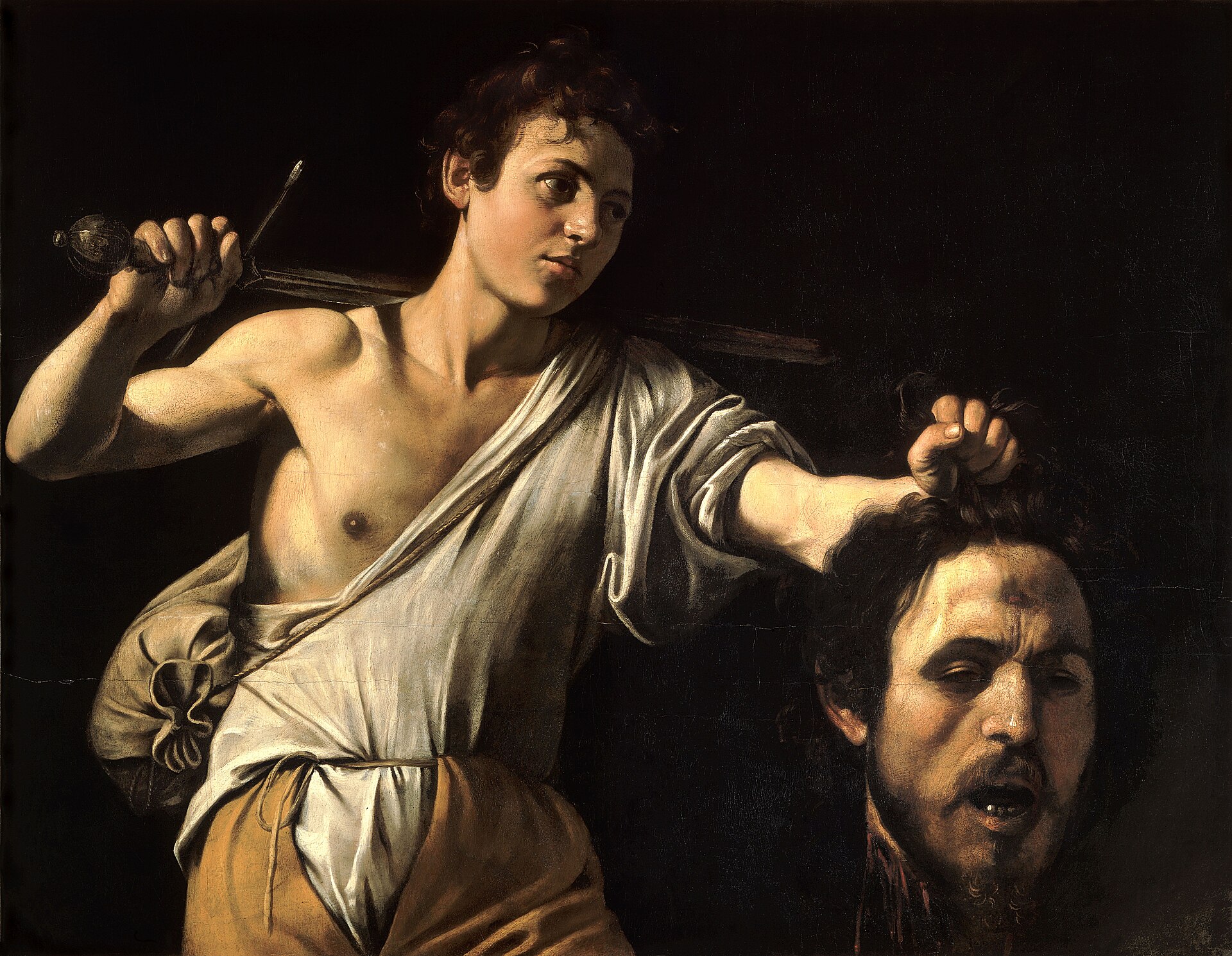
Had Caravaggio been re-embraced by Rome, the pallacorda scene might have provided a sense of community he sorely missed, and a second chance for the artist to become a more hospitable citizen. One imagines a weathered player—more Goliath than David—slowed by a hand damaged fending off a likely assassination attempt. And yet, Seasoned Vet Caravaggio might have taken up the racquet as Saint Jerome does his pen: a more thoughtful man, willing to look beyond the present and reflect on unforced errors. 

Michael Corvo is a journalist and filmmaker based in London. He directed the award-winning documentary Playing Through.

Stay in touch

Sign up for our free newsletter

More from Racquet

What’s Next for Sloane Stephens is What’s Next for Tennis

Between Patrick Mouratoglou’s Ultimate Tennis Showdown, India’s Tennis Premier League, and INTENNSE, innovators are looking for ways to shorten matches, add pizzazz, and balance inequities in an attempt to draw, and keep, a younger crowd.

May 15, 2026

Dad Had a Bad Day, A Winning Tennis Novel

In Ashton Politanoff’s new novel, a man defenseless against his repetition compulsion unravels in chiseled and unnerving prose.

May 11, 2026

Postcard from Egypt: I Turned a Vacation into an ITF

One 37-year old former D3 player trying to stay fit while traveling with her husband and toddler gets carried away and enters a pro tournament at the encouragement of her hotel pro. What could go wrong?

May 1, 2026

Michael McGregor’s Tennis Love Story

The vibrant and idiosyncratic still lifes—often composed on hotel stationary—are the work of artist Michael McGregor, whose roots in a “huge tennis family” inform one of his favorite themes.

April 28, 2026

Pàdel Shots: a Lexicon

A by-no-means-exhaustive list of the names and neologisms that define a new(ish) sport

April 27, 2026

Why Everyone You Know is Playing Padel

Many sports like to claim that they’re the fastest-growing, and they often have a legitimate claim to the title, depending on how you measure it. But, by almost any yardstick, pàdel really is the world’s fastest-growing sport.

April 27, 2026
See all posts