

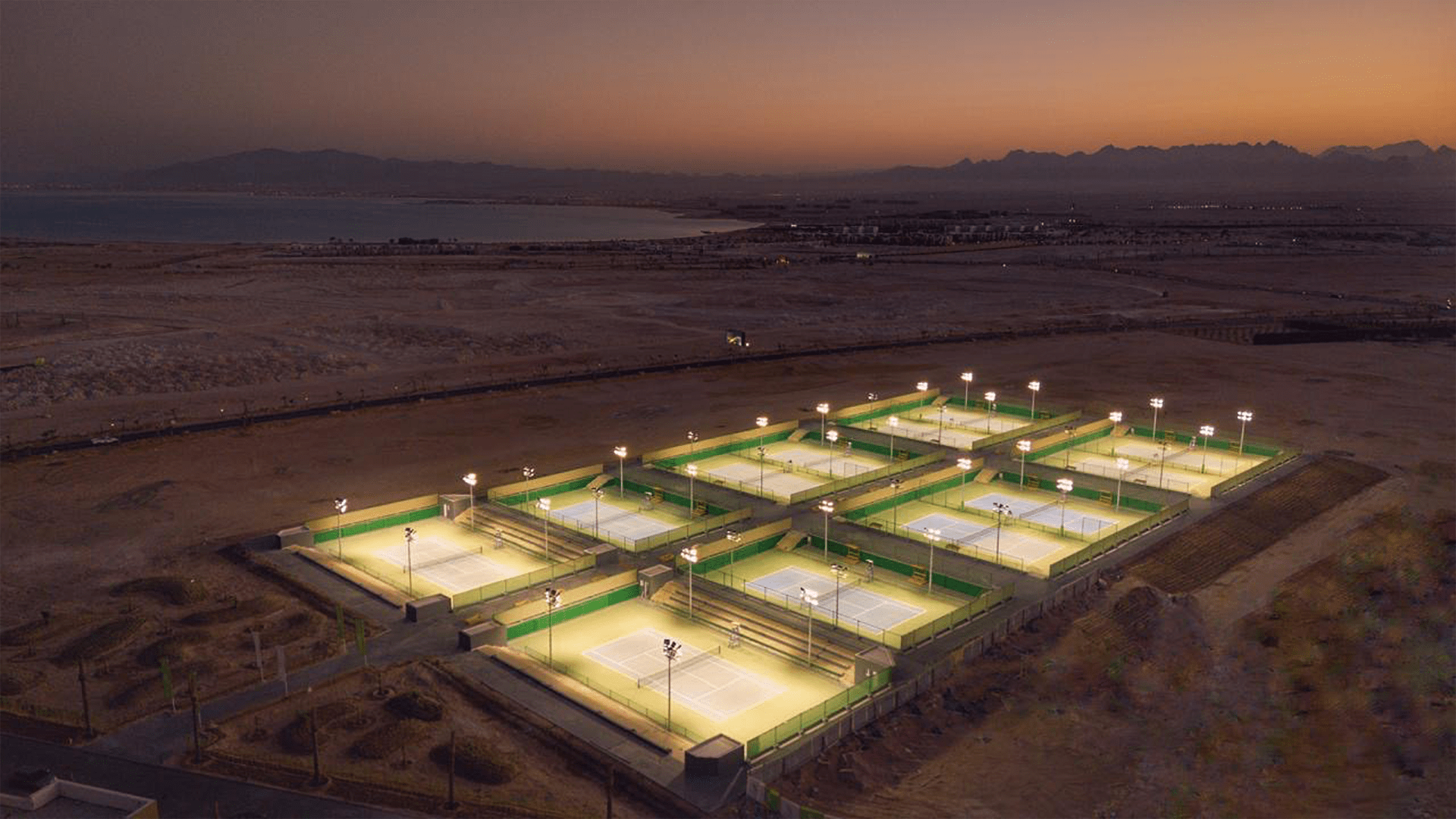
It’s like I can see the future: It’s my vacation and tomorrow at 9:50am under the blazing Egyptian sun and like many a pro tennis player, I will be in a golf cart getting escorted to my court. The only difference being my lack of a tennis bag, entourage and any professional tennis ability. I will have left my family at the breakfast buffet where they will enjoy an assortment of tiny pastries before heading to the pool. Meanwhile, I will have emptied my toddler’s diaper bag to use for my single racquet and water bottle and be headed to play a 10am first-round qualifying match of a $15,000 IFT. Tennis has hijacked my vacation.

The discerning reader might think “isn’t 10 min cutting it a bit close for what (to everyone else signed up) is a professional match?” And I would answer, yes my friend it is. But I have never been a timely person nor (to my own detriment) a warmer upper. * I did ask my husband to warm me up early but a mysterious arm pain arose like mist from the Red Sea and he declined. He is okay with me doing crazy things on vacation but refused to let tennis overtake his relaxation time. He did agree tentatively to watch my match—a moral support I feel I need to get through the ordeal I have entrapped myself in because yes, this endeavor is entirely my fault.
In my Division 3 collegiate tennis career I only played one qualifier for a low level IFT previously. It was held in Atlanta, GA in 2012, the summer after I graduated and a last hurrah before I hung up the racquets for what I thought would be for good. I lost speedily to a 14-year-old from Alpharetta and slouched home to begin a career in an office.
So how did I get here? As it turns out, the tennis bug doesn’t die easily and I continued playing recreationally in adult leagues and in club tennis until finding myself on court in Egypt with a wiry sun baked pro nicknamed Bizou at the S tennis academy in Soma Bay. He Christened me Viku and for 60 minutes we scope each other out as we rally and try to keep the ball in the court. Soma Bay is a small peninsula, rather like the bottom of a whale’s tale, that protrudes into the Red Sea on more or less the middle line of the country.

It’s windy year round—a kite surfers paradise—and I’m afraid the tennis here feels like being in a wind tunnel. But the S tennis academy has courts sunk low into the dry earth, so that they are magically sheltered from the constant drafts yet somehow exposed enough to the breeze that the hot air moves off the court and I am not baking like I expected to be. It’s also April so maybe the true North African heat hasn’t set in yet. The bay itself is ringed halfway around by a dramatic mountain range which is visible from the courts and as the sun sets, I take several breaks to try and capture the desert glow lingering behind what in my head I am now calling the Egyptian Rockies.* (From my later Google searches I surmise they might be called “The Red Sea Hills.”)
The S tennis staff is busy taking down ATP banners courtside and erecting ITF tournament advertising and sponsors. One of the directors says, trying to flatter his new client I’m sure, that I “should enter the tournament.” And just like that the beast of vanity is awoken. What would it be like to slug it out against young talent now that I am older and wiser and only a little (I tell myself) worse for the wear. I announce to Bizou that yes I will enter and to his credit, he keeps a straight face.
We train together the next two days for 60 minutes which is about the maximum I can handle given his training program; our sessions have evolved from the easy hit our first day to rigorous footwork drills. “Relax, take oxygen. When you’re tired, please focus” are his now constant refrains. Bizou asks if I can stay longer to practice points and I tell him no, tennis is already the third person in my marriage and I need to get back to my family, but the other truth is I don’t know that I can hold up for that long.
Every day there are increasingly more players arriving to practice pre tournament. Most of them stream in from the Kaktus Hotel, a modern geometric building directly across from the courts, billing itself as a hotel/wellness/workspace hub. It reminds me of the Ace Hotel in Palm Springs from the general layout and aesthetic to the smaller details— catch phrases on pillows and macrame by the pool. It’s fascinating to watch these younger players practice. They move effortlessly to the ball, as if they were playing on a smaller court instead of the same one I was just slogging around, and their shots cannon off their racquets with resounding thwacks, amplified by the echo of the sunken court. I watch one player paint the baseline several times in a row at which point I start to think maybe I have made a mistake. The women look to me to be about 14 which means maybe they are in reality roughly in their early 20s. I am by a decade plus the oldest and I imagine, at almost 37, perhaps the oldest person ever to enter a low level ITF qualifier. More signs of my mental miscalculation?
The day of the sign ups, I am finally over my jet-lag and the Egyptian summer time-change enough to play in the morning instead of evening with Bizou. After we’re done hitting, a Frenchman recruits me to hit with his son whose sparring partner “has nowhere to be but is always late.” I want to validate his righteous indignation but as this phrase could often be applied to me, give a nervous laugh and slide onto the court. For the next three minutes it’s all I can do to keep the rally going through the middle against a barrage of speedy, well-timed shots coming from the enthusiastic 18-year-old across from me. I’m disappointed but also relieved when his partner arrives just a few minutes later. The Frenchman, perhaps to make up for the brevity of the session, explains to me that his son is trying to achieve a high IFT ranking so as to be recruited to North American Universities on scholarship. I feel a pang, wondering if by playing in the tournament, I am in the way of someone playing with real purpose, trying to launch a career or get access to higher education. Then I tell myself, that at the worst, if I can beat them, there is really no hope for them anyway and best case, it’s an easy warm-up round for them.
I am staying at a family-friendly hotel on the ocean, a 15-minute golf cart ride away. It’s easy enough to book a ride with the “G” app, an uber type app for the golf carts within the walled Soma Bay community, but between the drives and the wait time for a cart “captain” the commute usually takes me up to 30 minutes. The time commitment is not endearing to my pursuit of the sport to any of my relatives so, to save myself another round trip, I arrange with the tournament and club Director that he will sign me up later that day when registration opens at 4pm. I buy a new grip, leave my racquet to be freshly strung, and feeling self-satisfied by my preparedness, hop into my golf cart for the drive home.
The road between what I now consider my two worlds winds through about ten different construction projects; neighborhoods of houses and condos all exactly alike until you reach the next neighborhood and another style dominates. No neighborhood is complete, in fact they are comprised of about 50 percent finished luxury homes and 50 percent shell structures. Pondering this landscape as I try to avoid thinking about possible match outcomes, I am struck by the difference between a burgeoning and apocalyptic landscape. At a glance, this area with its mounds of sand dotted by tiny sprouts and black irrigation tubes, and gaping concrete squares looks more like the latter. Based on the finished houses though, it’s going to be absolutely breathtaking (if not a bit sterile) when finished. The construction materials and blueprints coming to life around me is how I imagined the vistas in Dave Eggers’ A Hologram for the King, though without the hopeless undertones—Soma Bay is going to be a tourist hit, if not a future tennis hotspot.
Later that afternoon, the director confirms that I need to create an ITF player pin, so in a matter of minutes I sign up and am as ready as I will ever be at this juncture, to compete. It’s only much later in the day, when I text him about a type-o in my Birthday (one day off) that I get a voice memo from him: he’s deeply apologetic and aggrieved, but in the hectic happenings of the sign ups and draw creation, he forgot to add me. I feel at once a wave of intense disappointment. Training with a purpose and with such a readily apparent bar to look at any practice court had given me a new energy and angle on the sport. Two years after having my daughter, I was finally feeling good again on the court and excited to see how I stacked up against the next generation.
And I had promised to write to my friend Caitlin, about what it was like to be the crazy lady who signed up for an IFT while on vacation. As my sister pointed out in what I believe she meant to be a comforting moment of brutal honesty, “to love tennis is to be intimately familiar with navigating disappointment.” Statistically, the average professional player outside the top 10 has about a 50 percent win record. To be successful in the sport, it does take acclimating to a cycle of getting knocked down and then springing back up. I just didn’t expect to not even make it to the court.
The day of my would-be match, instead of boarding the golf cart in a cold, panic stricken sweat or looking up into the stands to see my husband sweating in the sun, watching me lose, when he could have been having a beer by the pool, we went snorkeling. Soma Bay has a semi famous jetty off of which is a large coral reef, as yet somehow unspoiled by all the development in the area. We got massages and had lunch by the pool. The next day, I went again to the tennis center to hit with Bizou.
The director had kindly offered to cover the session to compensate for the ITF registration fee I had paid. I huffed and puffed my way through the drills, grateful to be healthy and fit-ish and able to challenge myself. I strolled around the practice courts, marveling at the ball-striking and crispness and quality of play, thinking perhaps I had been spared. And I told Bizou, see you next year…maybe.
Victoria Aiello lives and works in Boston with her family. She played D3 college tennis at Middlebury and holds an ITF record of 1-1, the same win rate as most players on the pro tour. She is always running five minutes late.


