

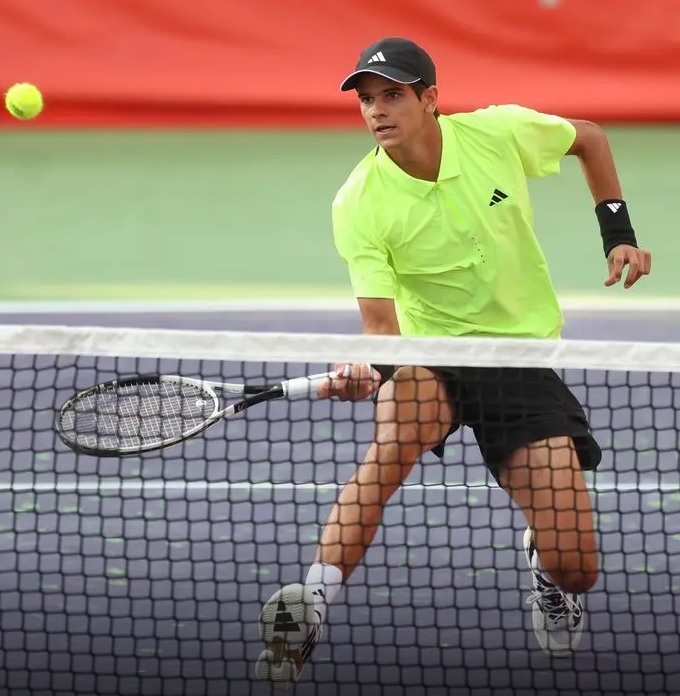
For one tense night in Madrid, the loudest crowd at the Caja Mágica wasn’t watching Jannik Sinner or Carlos Alcaraz. It was glued to the first meeting of two intoxicating young prospects, João Fonseca and Rafael Jódar.
Before a roaring Spanish majority and hearty Brazilian contingent, the two 19-year-olds played one of the most—if not the most—highly anticipated matches at the Madrid Open, despite neither having yet cracked the Top 20. The atmosphere betrayed something larger than mere ranking points or a Round of 32 berth. The tennis world watched with bated breath and wondered, for the first time in the New Two era, whether the long-awaited battle for a third gravitational body had finally begun to materialize.
There is a war going on in tennis, of which we are all well aware: Sinner and Alcaraz have split the last two calendar years of Grand Slams and counting, and have set themselves scarily far apart from the rest of the pack. But beneath their momentous, center-stage war, another is incubating.
The war is not between two players per se, but over the most sought-after asset in tennis: disruption. Under the Sinner-Alcaraz mold, the game finds itself in the early throes of dynastic stagnation. Tennis fandom has ebbed significantly, with non-fan interest settling back to virtually zero. Even within tennis fandom, the frenzy that began with Alcaraz’s ascent in 2022 and reached its peak at Roland-Garros 2025—Sinner-Alcaraz’s greatest match to date—has largely subsided.
The New Two’s rivalry is impressive and exhilarating, but it’s also predictable. Sinner will sharpen his game and win sixty straight sets across four continents, and then Alcaraz will break through him and go on his own tear. They simply pass the keys to the kingdom back and forth, evolving around the other’s game as they climb into uncharted greatness.
Of course, we are abundantly grateful to them. In the wake of Federer and Nadal, along came these two new exceptional ambassadors, each unimpeachably sportsmanlike and prodigiously talented. Their professionalism, athleticism, on-court creativity, and off-court charm have been like steroids for the sport’s brand appeal. Their rivalry has done to the global tennis audience what the deeper meaning of Christmas did to the Grinch’s heart, and then some.
As great as it is, the natural entropy of sport is pulling for something to upend the monotony. From peace comes, inevitably, an appetite for chaotic, aleatory, or otherwise disruptive agitation—a crack in the establishment, or a career-defining upset on the world’s biggest stage. Within tennis, that means a new Slam champion.
In the two-plus years since Sinner and Alcaraz began their unopposed reign, the ATP field has drifted into a psychological valley, more or less resigned to their order-of-magnitude inferiority. Tour veterans like Alexander Zverev and Taylor Fritz chase consistency and semifinal finishes, but none are actually viewed as threats to the emergent duopoly.
Zverev, the leader of the pack at a safely margined World No. 3, unabashedly acknowledges the skill gap in press conferences and on-court interviews. The rest of the top ten, a hodgepodge of underperforming phenoms and deteriorating warhorses, have quieted to a whisper.
Amid this depressing lull, Jódar’s arrival has landed with gripping force. Unpredictability, after all, is the principal attraction of sport. March Madness is such an engrossing and lucrative product in large part due to the frequency of its arena-shaking upsets. By this metric, the Sinner-Alcaraz symbiosis—if we’re being picky—is limited. It’s natural to ponder, how much greater might tennis be if someone else could reliably beat the New Two?
The fantasy of a new geometry—with all the compounding synergies it would unleash—is too compelling to shake. Sinner and Alcaraz are not indestructible, as they have already let show. In the trailing twelve months, Sinner has lost to Jakub Menšík, Novak Djokovic, and Alexander Bublik once each. Alcaraz has lost to Sebastian Korda, Daniil Medvedev, Cameron Norrie, and Taylor Fritz once each.
But even those underdogs’ victories, albeit well-earned, were not convincing challenges to power. They were chips off a mountain face; nips from krill floating beneath; benign reminders that the field can beat them, should an off-day collide with an opponent’s peak performance. The sport’s growing hunger for disruption won’t be satiated by occasional, excusable losses. The tennis world is seeking another legitimate obstacle—a new stream of symbiosis—to block the path to unfettered domination. (Quite possibly, some of this yearning is entangled with a rearview nostalgia for the Big Three.)
Looking back to historical precedent, Djokovic’s breakup of the Federer-Nadal duopoly reveals the conditions prerequisite to disruption. First, as a matter of course, a disruptor must be younger than the incumbents. Second, he must ambush them with a playing style that touts unique advantages over each of theirs. Federer’s clinical effortlessness and Nadal’s fiery acrobatics had adapted around one another, but remained vulnerable in different ways to Djokovic’s inimitable defense.
Djokovic turned tennis into an odd number, and in doing so, precipitated the greatest epoch in men’s tennis history. For nearly two decades, semifinals and finals permuted the three of them like pinballs into each other, requiring each to adapt nimbly to distinct threats from multiple directions. Now, in 2026, as Djokovic sings his swan song and leaves the tennis world in the hands of the New Two, the hope for a generational equivalent is irresistible.
Thus far, Brazil has offered the most credible candidate in João Fonseca. In roughly eight months, he shot up from World No. 130 to World No. 25, picking up two ATP titles en route. Statement victories over top-10 veterans Andrey Rublev, Karen Khachanov, and Tommy Paul galvanized a fierce Brazilian “home crowd”—comparable only to those of Alcaraz or 20-year-old Filipina sensation Alexandra Eala—that follows him wherever he goes. The velocity of his ascent, together with his youth, dynamism, and swelling popularity, has made him the de facto frontrunner in the disruption conversation.
Young João is still, of course, finding consistency and developing his game toward its ceiling, but that ceiling is generally regarded as the third-highest in men’s tennis (excluding Djokovic). His reputation has enjoyed a status of incumbency on the triumvirate podium and faced little meaningful pressure from contemporaries. That is, until now.
Following the emphatic arrival of Rafael Jódar, with whom Fonseca is naturally juxtaposed, the seedlings of rivalry have begun to sprout. Jódar is exactly 27 days younger than Fonseca, and in 2024, they both committed to play tennis at the University of Virginia. Fonseca, however, famously reneged, went pro, and immediately garnered a lofty reputation. Jódar played in the NCAA for a year and only recently left the Cavaliers to join the ATP Tour—to a comparably resounding uproar.
Interestingly, their playing styles—although less mature—can be neatly mapped onto those of the New Two. Like Alcaraz, Fonseca is an explosive power-hitter with a triple-digit forehand and a flair for theatrics. Like Sinner, Jódar is an inscrutable stoic with an iron fortress for a mind and lasers for ground strokes. (This is especially true of his up-the-line backhand redirect, which is jaw-droppingly accurate for how difficult it is to pull off.)
To further the Sinner comparison, even when Jódar’s body fails him—like it did in his most recent three-set loss to Luciano Darderi in Rome—he persists a graceful composure and an opaque mental state. His steely determination and precocious intuitions have already drawn glowing endorsements from Toni Nadal himself—perhaps the preeminent authority on Spanish teenage greatness, and a figure whose approval carries tectonic significance within tennis.
On account of Jódar’s youth, poise, raw talent, and similarly meteoric rise—soaring from World No. 686 to World No. 29 in one year, picking up an ATP title along the way—he has rapidly begun to challenge Fonseca’s status as the sport’s presumptive disruptor.
Even beyond Fonseca and Jódar, signs of a wider youth acceleration are beginning to emerge. 21-year-old Belgian wunderkind Alexander Blockx has also leapt from outside the Top 100 to World No. 36 in the last year. Much of that ascent came from his breakthrough semifinal run in Madrid, where he collected the scalps of Brandon Nakashima, Félix Auger-Aliassime, Francisco Cerúndolo, and defending champion Casper Ruud before finally falling to Zverev in a respectable struggle.
But more so than Blockx or any other spirited freshman — say, Martín Landaluce or Dino Prižmić — Jódar’s rise feels symbolic. For the tennis world, his prestigious candidacy yields a palpable and productive urgency. That is, he and Fonseca both know that if they do not defeat Sinner or Alcaraz first, the other will.
It is very unlikely that ten years—even two years—will pass before at least one Slam goes the way of a lucky outsider. This happened even during the Big Three era, when there were three gatekeepers instead of two. The odd Slam would slip to Andy Murray, Stan Wawrinka, or a one-hit wonder; such was statistically inevitable.
But this time around, as soon as the first Slam falls outside the Sinner-Alcaraz domain, the tennis world will ask whether it represents legitimate obstruction or a well-timed peak from a fundamentally innocuous player. If that breakthrough goes the way of Fonseca or Jódar, the assumption will likely be the former. As such, the race to reach it may matter as much as the milestone itself.
Going into their maiden encounter in Madrid, each understood the weight of the match and the precedent it would set. The pressure surfaced in behaviors uncharacteristic of each player, Fonseca violently retiring his racquet following an early break in the decider and Jódar addressing the crowd and his team with
conspicuous animation.
The thrilling three-setter substantiated the legitimacy of the young Spaniard’s threat. Jódar won the opening set in a tight breaker, Fonseca wrestled back the second, and Jódar dominated the third. For Fonseca, the loss meant abdicating “new kid on the block” status to his would-have-been classmate, who now overshadows him for the first time in the ATP rankings.
The bleak reality is: the field may be subjected to a decade or more of total asphyxiation unless someone can meaningfully counter the New Two. The present cohort have proven themselves incapable of the feat thus far, and are generally too old to pose the kind of sensational threat that might actually make an impact. But now, as the Fonseca-Jódar Cold War picks up steam beneath the surface, the ATP finally betrays a glimmer of hope in its earnest search for a third prince—perhaps even in time for Roland-Garros.