

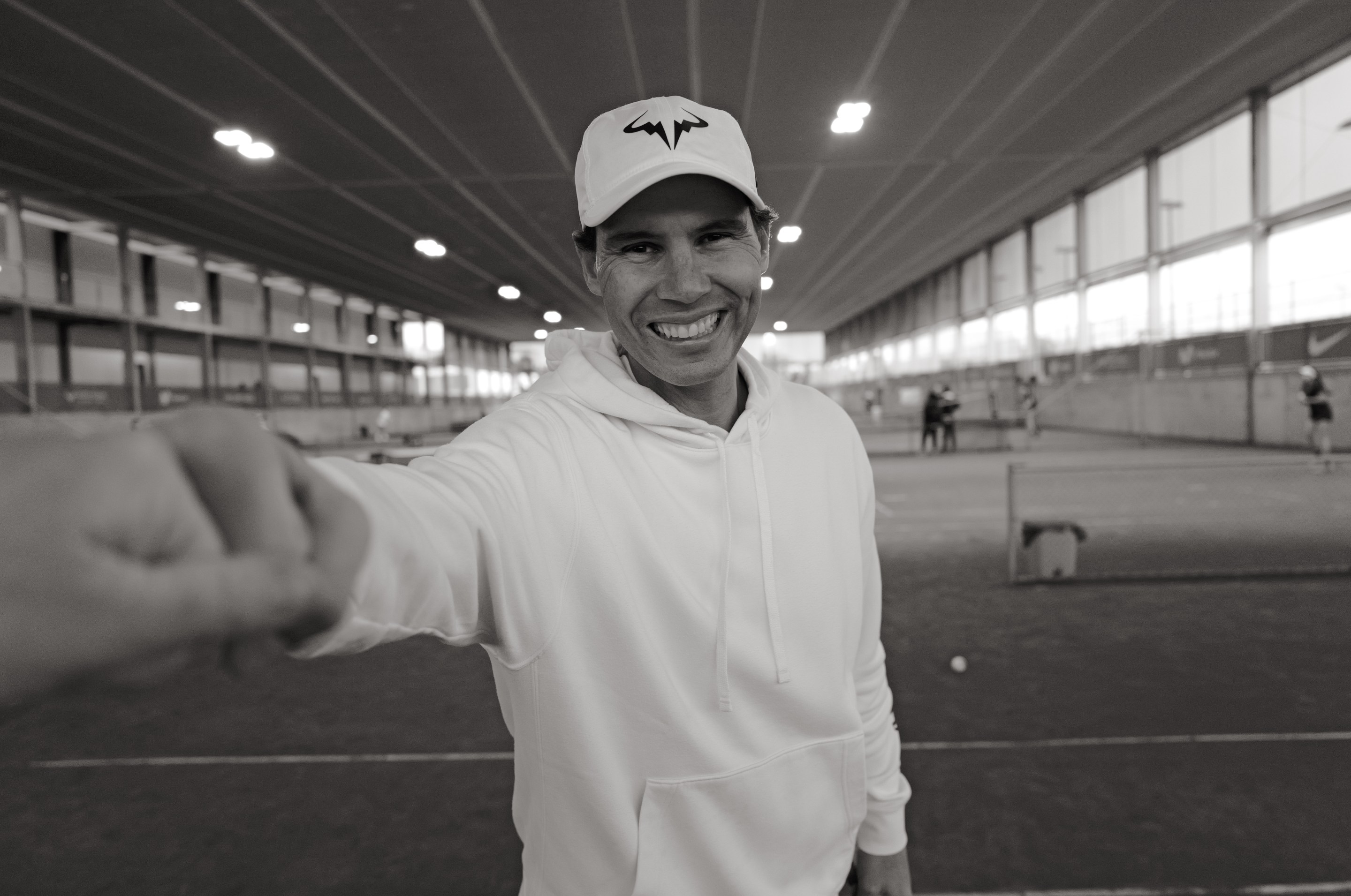
Racquet: Everyone knows Rafa Nadal the athlete. But when you first agreed to make a series about him, what was the version of Rafa you were actually looking for?
Zach Heinzerling: The first question was relatively simple: who is Rafa beyond all the achievements? He’s one of the most recognizable athletes in the world, but very little is actually known about his inner life. Who is he off the court? What motivates him?
Rafa is extremely private—he’s managed to avoid the media’s gaze for most of his career. There are almost no documentaries about him, and very little written about him in the last fifteen years. It became clear very quickly that if I wanted to understand him, I needed time. He’s not naturally transparent or trusting. He reveals himself slowly—through repetition, routine, behavior, and the way he moves through the world.

R: Rafa’s public image is so controlled—disciplined, modest, almost opaque. Was the challenge figuring out what existed underneath all of that?
ZH: Rafa’s actions speak volumes—his words less so. Publicly, he’s known for his restraint and modesty, almost as a form of self-protection. What interested me was understanding the psychology underneath that restraint.
That led us into his childhood, especially his relationship with his uncle, which became critical to understanding who he is emotionally.
In the end, many of the most revealing moments weren’t conversational at all. They were observational: the way he interacted with family, the struggle with his body, the emotion he carries both on and off the court. The real Rafa emerged in those quieter moments.
R: There are already statistics, trophies, endless archive footage. What did you feel was still missing from the story?
ZH: The statistics already exist. The titles already exist. What interested me was the emotional subtext.
What does it actually take to sustain that level of discipline, competitiveness, and pressure for twenty years? What happens once the body can no longer support the same intensity? And then what happens psychologically once that reality becomes impossible to ignore?

R: The series arrives at this strange moment where Rafa’s entire career suddenly exists in hindsight. How did retirement shape the structure of the story?
ZH: It allowed us to tell two stories simultaneously: Rafa trying to say goodbye in the present, and the story of how he became Rafa in the first place.
Retirement gave the series emotional gravity. The archival journey helped explain why walking away was so psychologically difficult for him.
R: His body almost feels mythological at this point—the injuries, the endurance, the pain threshold. How did you translate that physically onto the screen?
ZH: We wanted the audience to feel the accumulation of wear and tear, not just understand it intellectually. Tennis is an incredibly repetitive and punishing sport, and Rafa played it with extraordinary physical intensity for two decades.
Eventually, his body became almost a character in the series—something that carried him to greatness, but also something he was constantly negotiating with, fighting against, and ultimately forced to confront.

R: It feels like Federer and Djokovic have different philosophies, where ambition and competition are concerned. Did you think about those rivalries psychologically as much as athletically?
ZH: I tried to approach them less as sports rivalries and more as philosophical contrasts.
Rafa and Federer captured the public imagination because they seemed to represent opposite ideas of tennis: Federer as the effortless artist, Rafa as the relentless warrior. There’s truth in that, but the reality is more complicated, and the series tries to explore that nuance.
With Djokovic, the contrast became more psychological. Novak often projects certainty and supreme confidence, whereas Rafa approaches competition through doubt, caution, and constant pressure management. In many ways, understanding Rafa became easier when viewed in contrast to the players around him.
R: What’s more interesting: Rafa’s greatness, or the cost of that greatness?
ZH: The cost, definitely. Greatness without sacrifice isn’t dramatically interesting because it stops feeling human.
What moved me most about Rafa wasn’t simply his ability to win—it was the amount of suffering, discipline, repetition, and uncertainty that enabled those victories.
Even as one of the greatest athletes of all time, Rafa somehow still presents as the fighter, the underdog, the person pushing uphill. People are inspired by that mentality—the idea that through discipline and determination, you can overcome almost anything.
R: When you’re given extraordinary access to someone this famous, how do you avoid becoming protective of them?
ZH: Access is seductive. But access alone isn’t enough. It’s important to stay curious and avoid reverence.
My responsibility wasn’t to protect Rafa’s mythology or dismantle it—it was simply to observe him honestly. Fortunately, Rafa lives quite honestly, and his public image largely reflects who he is privately. That made it easier to tell the story truthfully.
R: Do you think someone who doesn’t care about tennis can still connect to this story?
ZH: I hope so. Fundamentally, this isn’t really a tennis story. It’s about identity, discipline, aging, and letting go.
It’s about a person whose entire life was built around an extraordinary ability—and the painful, confusing reality when that ability begins to disappear.
R: What was it actually like earning Rafa’s trust?
ZH: With Rafa, trust wasn’t built through big conversations. It was built through consistency and presence. He values discretion and normalcy.
Over time, I think he understood that I wasn’t trying to force moments or manufacture drama—and that allowed the relationship to develop naturally.
Zach Heinzerling is an Academy Award–nominated, Emmy Award–winning director whose work includes the Oscar-nominated feature documentary Cutie and the Boxer, the acclaimed Hulu series McCartney 3,2,1, and Stolen Youth: Inside the Cult at Sarah Lawrence. His latest project, RAFA, a four-part documentary series about tennis legend Rafael Nadal, premieres in May 2026.


