

Last summer, after 147 years of lawn tennis, Wimbledon finally decided to swap out their line judges for the electronic line calling (ELC) system, leaving Roland-Garros, which I will only be recognizing as the French Open, as the sole tournament among the majors (as well as all ATP/WTA events at the 500 level and up) to employ human referees.
This decision follows a long line of defiant acts associated with French tennis, going as far back as the Tennis Court Oath at the outset of the French Revolution. Much more recently, they ruffled feathers when they unilaterally moved the 2020 French Open—citing the pandemic—to late September, without consulting the other tournaments. This year, they haven’t increased prize money as much as other majors, angering players, with world #1 Aryna Sabalenka even threatening a future boycott of the French Open.
The tournament insists that the old-fashioned way of judging in-or-out calls by the naked eye is still the best and most accurate way to referee the red clay courts of Roland Garros. The most compelling reason for this is the fluid nature of the clay surface: although there are just two millimeters of red clay on the surface, the dust moves about the court throughout the match, groomed only between sets. The resulting irregularity can occasionally give ELC problems.
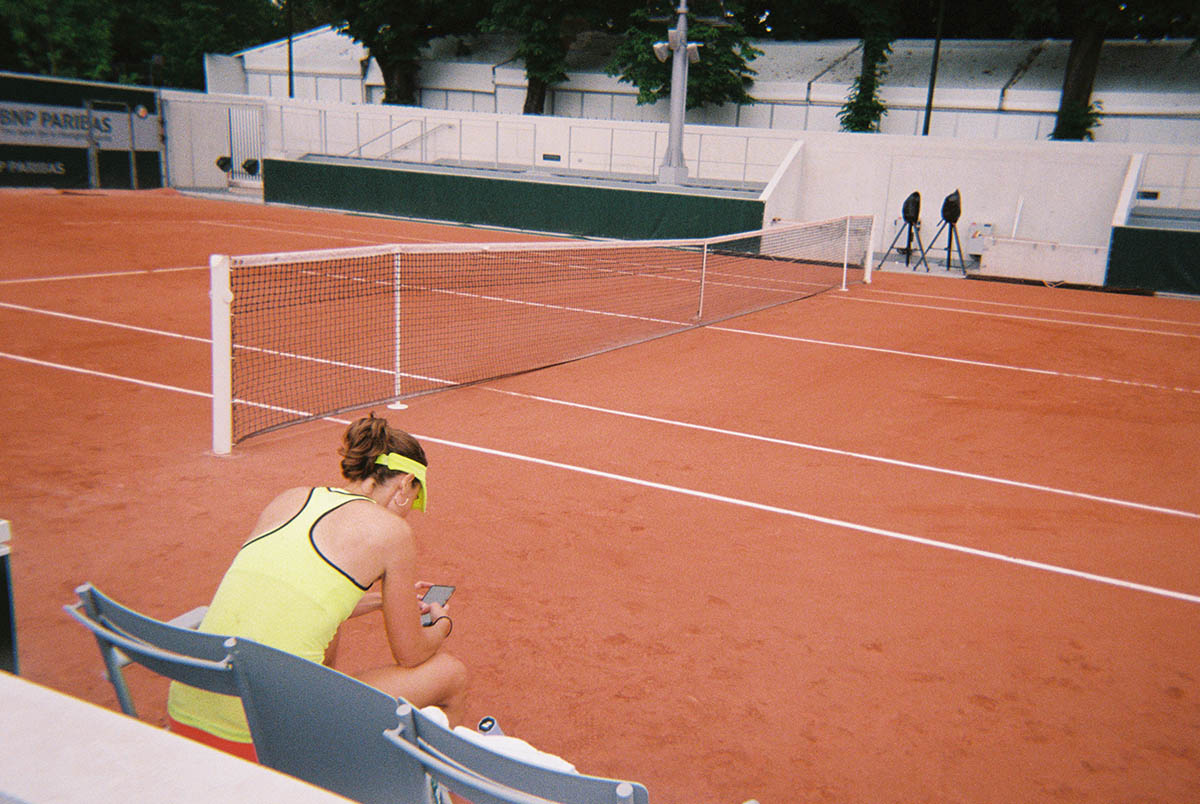
Players are also having a hard time reconciling what they’re seeing (pronounced ball marks left in the clay) with what they’re hearing from ELC—which leads sometimes to an amusing ritual of photographing the ball mark with their phones mid-match, earning code violations along the way.
The complexity of the clay surface is why many longtime clay-court referees describe their work as a craft, perfected through years of experience and wisdom. Thus, when explaining its decision to retain human referees for the 2026 French Open, the French Tennis Federation (FFT) boasted, “We are the best country for providing officials on tour. We take pride in this… We are a benchmark and we want to stay that way. The federation’s will is to keep line judges as long as possible.”
There is another explanation for why RG has decided to go its own way: because this is the way things have always been done, so this is the way things will continue to be done. And because France thinks it is the best at everything.
Fittingly, much of this can be traced back to the days of the Tennis Court Oath in the late 18th and early 19th centuries, when Enlightenment and Romantic thinkers in France were championing a new kind of humanism as the basis of a new, ideal society. With a commitment to principles that hold society together, and then later, a belief that emotion and feeling were the true lodestars of humanity.
What feels good? And what doesn’t? And once there’s a collective understanding of what it is that feels good, that becomes part of the way things are done. Forever.
This has basically been the litmus test the French have used to craft their modern society, and has resulted in the doubling down on the qualities that make France, well, France: a zealous devotion to tradition and to what works on an intuitive level, and enormous pride in Gallic culture.
These qualities make the French exceptional in many ways, but also, at times, a bit exhausting. France can often feel like stepping into a time machine—beyond just watching tennis with human referees. I’ve been going to the same village in the French Alps since I was a child, and it’s almost uncanny how little things have changed over the years.
Much of small-town France abides by the principle of “If it ain’t broke, don’t fix it.” There doesn’t seem to be the same reflexive urge to innovate and change the way there is in the US. In a word, rural France is quaint, in the best possible way: The way the town looks the same now as it did in the 1990s. The way people always greet each other with a “bonjour” or “bonsoir” when entering a shop before jumping into the business hand. The way the French take their time with a meal.
Is this always the most efficient way of doing things? No. But is it enjoyable? Definitely. There’s an emphasis on enjoying the little things in life.
But this antiquated rigidity occasionally gets under my skin, like when I want a café au lait as a little pick-me-up after lunch–I don’t care that it isn’t “du matin.” Or when I feel like having a nice, fruity glass of red wine with my branzino at dinner, when a white might technically be de rigueur.
Another part of this intuitive, feeling-based French ethos is a certain stubbornness; an unshaking belief that they have the right idea. Like when, in 2020, the FFT abruptly announced they would be moving the French Open from May to September, without consulting players, the ATP, or the WTA: this struck me as incredibly on-brand for a nation that relishes bucking international trends.
Most interesting to me is the French Open’s decision not to increase the tournament’s prize money to keep up with the other Grand Slams. On the one hand, this speaks to France’s contrarian, independent spirit. But beyond that, I’ve never thought of the French as being particularly cheap.
When I was working for a French production company in Hollywood, the price tags on certain expenses used to make my head spin. $10,000 on plane tickets, hotel rooms that cost more than $1000 a night, and restaurant tabs that exceeded my yearly grocery bill. But while there was a certain level of excess and wantonness to this spending, there was also a strong emphasis on spending on nice things. Things that make you feel good. A delicious meal with friends. A comfy seat on a plane. A beautiful suite with a view.
So perhaps part of their thinking with the French Open purse is: we put on an exceptional tournament, and it’s a privilege to compete in such a beautiful and historic place. You shouldn’t need extra prize money as an incentive to compete at Roland Garros.
I get why players are upset about the prize money, but from my point of view as a fan, the French are ideal custodians of an uber luxurious tennis tournament like Roland Garros in a lot of ways. Sure, the other majors like the US Open have just as many resources as the French Open, but they don’t always seem to understand that bigger, faster, stronger isn’t always better. Sometimes turning back the clock feels right, especially at the older, more historic European majors. Good taste goes a long way.
I left the film industry a few years ago, and now write about the heart and soul of sports, the human stories that live outside the lines of play. Of course, players like Coco Gauff and Jannik Sinner deserve the lion’s share of the attention around tennis. But so do the people raking the clay, or serving the perfect slice of cured ham to fans, or scurrying across the court to fetch an errant shot. And certainly the referees determining if a 130 mph serve was in or out.
Which is why I was so disappointed when Wimbledon got rid of their line judges for last year’s tournament; it cheapened the majesty and history of tennis’ premiere tournament. What’s next—loosening up their all-white dress code?
I’m sure Roland Garros was thrilled however—since another fundamental characteristic of the French is one-upping the English as much as possible.
Will the judges screw up a couple calls now and then at this year’s French Open? Almost certainly. But would I rather ELC complete its takeover of professional tennis? No way.
It’s great theatre, watching the chair umpire hop out of their seat to inspect a ball mark, peering down to the millimeter, and the inevitable disagreement that ensues with whichever player is on the wrong side of the call. To me, that’s real. That’s interesting. That’s French.
The great 18th century humanist Jean Jacques Rousseau—who spent a majority of his life living and writing in France—preached that true virtue is derived from self-assuredness and authenticity, often in resistance to exterior social pressure. And that to me exemplifies the Roland Garros’ iconoclastic approach to international tennis, and why I respect it so much.
Because as we hurtle towards a future in sports that embraces any and all technology—from advanced analytics to live gambling lines and probabilities on the TV broadcast to automation in officiating—sometimes I feel like the motivating question in modern tennis is: What can we change? Instead of: what should we change?
This makes the French the perfect champions for preserving the past in tennis. They understand what’s worth preserving. And relish resisting the flavor du jour, digging in their heels to fight for what matters, even if it isn’t popular. Some might call this conservative. But I call it humanist.
So I’ll be excited to see the judges marching out in their collared shirts and cardigans onto the red clay of Roland Garros next week. And hopefully for years to come.
Trinquons à ça!
James McClellan is a multimedia journalist based in New York City who writes about the intersection between sports and culture.


