

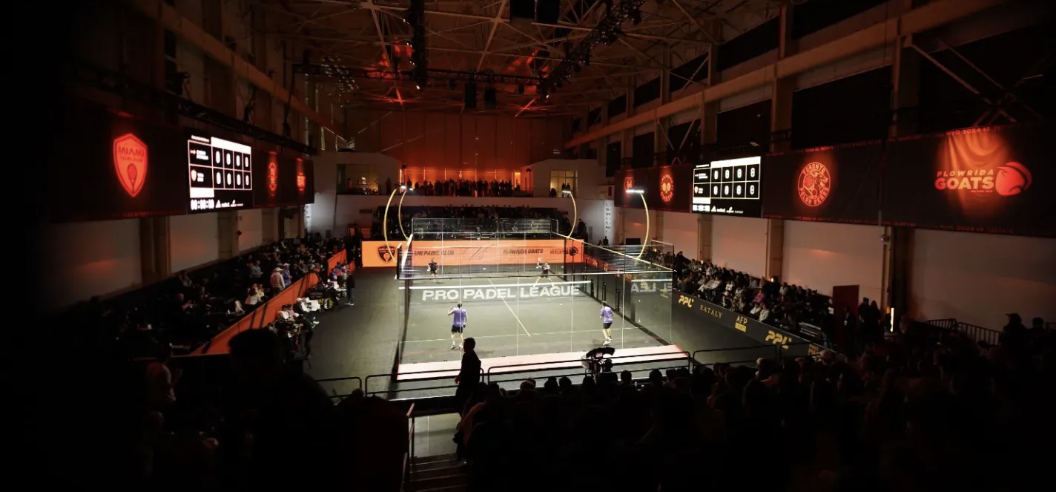
Like its less-athletic, distant cousin pickleball, it’s a relatively new sport, so there’s lots of potential for growth; and like tennis, pàdel’s outdoor courts and social nature caused its popularity to skyrocket during the COVID-19 pandemic. Pàdel is sitting comfortably in the sweet-spot of racquet sports.
Pàdel has come full-circle in the decades since its origins on a concrete court in 1960s Acapulco. From Mexico, it moved south to Argentina, then over to Europe, where it took a firm hold in the 90s. Along the way, the concrete walls and primitive wooden paddles gave way to the technical carbon-fiber racquets and sleek glass courts that we know today.

Europe has been a proving-ground, ironing out the kinks and providing a strong proof-of-concept for decades, but— despite its obvious appeal as a pastime, a sport, a workout and a social activity— pàdel never really gained a foothold in the US the way it did throughout the rest of the world. Until now.
Enter the Pro Padel League (PPL). Started in 2023 by founder and CEO Mike Dorfman, the North America-based league seeks to harness the sport’s extreme upward trajectory and maintain it for a very long time.
“As a serial entrepreneur, I quickly saw that there was a huge business opportunity behind the Pro Padel League,” Dorfman said. “Between the number of clubs being built, and the amount of capital players invest in court time, memberships, and gear, the sport demonstrated all of the characteristics of other aspirational luxury sports properties. I was excited to help usher in the new wave of growth in the sport, initially from a casual player, to the Atlantics team owner, to CEO of the league.
“Pàdel is one of the fastest-growing sports globally, as evidenced by its explosive growth over the past decade. Since 2014, Getting a Rise Out of Pàdel over 13,000 courts have been built, an increase of 467 percent. The sport is undeniably social and addictive, and we are in the early stages of growth in North America. PPL has an opportunity to capitalize on this momentum.”
Working in tandem with other facets of the pàdel universe in this country and elsewhere, PPL is working to build a stage for elite competition, the infrastructure necessary for high-level play, the revenues to pay for it all, and the fan base to support and bring the sport forward.
“The role that we play really is as a platform for the professional sport to get enough attention,” said Diane Gotua, PPL’s Chief Commercial Officer. “We’re focused on getting the right partners that are co-creating this sport with us. We are working with our athletes, our team owners, and our brand partners to really grow the sport. Especially here in the US where it's still somewhat nascent, but I feel like it's at that tipping point of really breaking through a very crowded US sports landscape.”
Launched with seven teams, the PPL has grown to 10, with another two joining in 2026. The goal is to field a full league of 20 pro franchises.
Gender balance is a founding principle at PPL, with teams split evenly between men and women. Tournaments feature men’s and women’s brackets, and often mixed doubles as well. The league also recently executed a historic world first: a female-for-male pro player trade (Miami’s Ariana Sanchez for New York’s Fede Chingotto).

“The PPL offers the world of pàdel a different format than what we're used to seeing on the professional pàdel circuit,” said Diego Salazar, New York Atlantics General Manager and Coach. “It's a format where we can see different types of pairings, which adds interesting variety to the matchups. This team competition format is very fun; it creates a unique atmosphere among players, team members, spectators, and pàdel fans that is different from other events in Argentina or Spain.”
Alex Ruiz of the Cancun Waves agrees: “We are used to playing all over the world. Perhaps the USA has a special charm because of the country it is and the profile it has. In addition, the team format of the league makes the tournaments more special, as you share many things with players you don't usually interact with and also with the team staff. I represent Cancun Waves and I feel like family there, so I have nothing but words of gratitude.”
This year, PPL’s event schedule began in June with a tournament in Miami, the spiritual home of pádel in America, followed in July by a tournament in San Sebastián, Spain, its first outside of North America. In August, Guadalajara hosted the third round; then it was on to the Hamptons on Long Island. The 2025 season wraps up in October with the City’s Cup Finals among the top eight teams in each bracket. The total prize money for this year’s PPL events is $4M.
The increasing fan base can follow the action on television (PPL has agreements with a number of broadcasters around the world) and on its own YouTube channel. It’s a sport that’s tailor-made for watching on a screen.
“Pàdel is an extremely athletic sport,” said Dorfman. “I think that athleticism shines through in the TV production. One of the biggest advantages of pàdel versus, say, tennis even, is the amount of downtime.
“You never double-fault on a serve; 80-plus percent of first serves are going in. And because the balls are staying within the court, there’s about five seconds between the vast majority of the points,” he continued. “We've experimented with trying to play music in between points, but it just restarts so fast that there's no opportunity. It’s quite an engaging viewing experience because you're not getting a bunch of commercial breaks, you're not getting a bunch of ads, or in-game entertainment, or timeouts.”
For PPL pros and owners, the financial support provides a viable way to play the sport they love on a professional level, while helping to foster a burgeoning amateur following. For the New York Atlantics’ Salazar, the league is an opportunity to start something from the ground up.
“We know that we're all working together and doing a good job together to become one of the most important places in the world of pàdel,” he said. “It’s true that pàdel is still a very young sport in the United States, but the PPL is doing a very good job, taking the competition to another level and giving it a lot of exposure in the world of pàdel. That said, today, all pàdel lovers and fanatics around the world are paying close attention to the events organized by the PPL. Little by little, the league is advancing with top-level pàdel events.”
For Ruiz, it’s nice to be a part of the upsurge: “We have seen this happen in other countries such as Italy and Portugal, but I think the fact that it is growing the way it is in the United States is incredible. As far as I am concerned, being one of the first professional players to play here and raise awareness of the sport is both a responsibility and a source of pride.”
The league is focused primarily on promoting the professional side of pàdel, but widening the fan base, and encouraging amateur play, is an important aspect of growing the sport.
“Right now, we have roughly 500 courts for pàdel in the entirety of the US,” Dorfman said. “That's going to change very fast. But I think we can play a role in helping public courts get built in parks, and just help with accessibility for schools and universities. So there's a large role for us to play across the spectrum.”
In some ways, it’s an easy lift: Americans have shown definitively that they are ready to embrace a new racquet sport—as long as it’s social, easy to learn, and more challenging than pickleball.
“The U.S. has become open to accepting more internationally popular sports in recent years,” says Dorfman. “Formula One and the MLS are two examples of sports that have recently caught fire in the US, with the popularity of the Drive to Survive documentary series, and Lionel Messi joining Miami.
“There’s an appetite for new sports that have global appeal, especially as we're changing our consumption habits with how we watch and engage with sports. Pàdel is new, and it's something that a lot of people here have never seen before.”


