Skip to Content
Newsletter

No Miracles Left for Delpo

[vc_empty_space height="5px"]

By Sebastian Fest

[vc_empty_space height="15px"]When a tennis match ends with the spectators giving life advice to one of the contenders, there can be little doubt that something extraordinary has taken place.


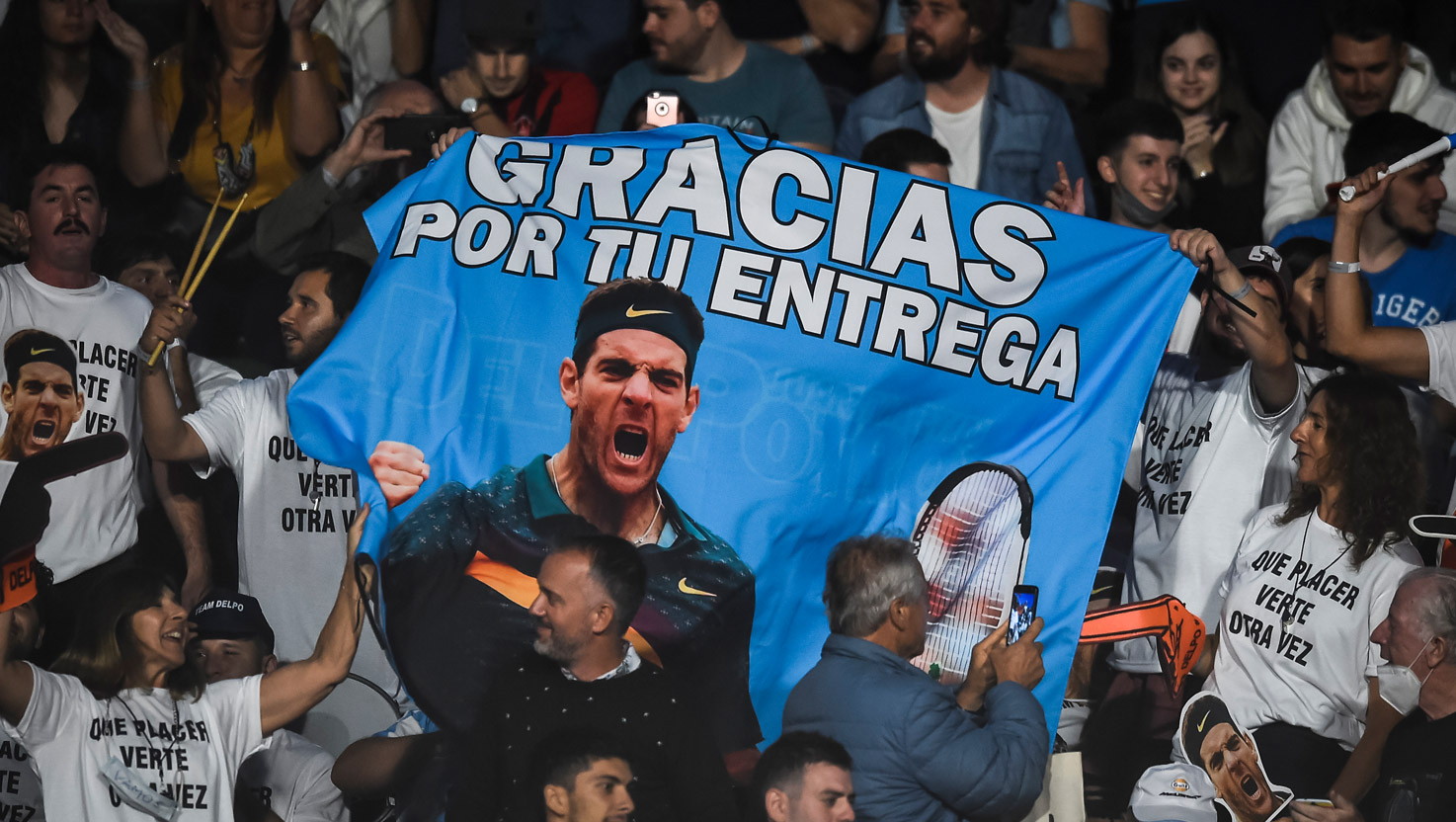
That was the case Tuesday night in Buenos Aires, as Juan Martin del Potro closed out his career on day 2 of the Argentina Open with a resounding 6–1, 6–3 loss to countryman Frederico Delbonis.

Two phrases I overheard multiple times amidst the heartbreak of a nation were some version of “Life goes on, Juan!” and “Be happy, Juan!”

There was very little high-quality tennis and nobody seemed to care on this splendid summer night in the packed Guillermo Vilas Center Court of the Buenos Aires Lawn Tennis Club.

What was expected to be a party to mark the return of “Delpo,” as his legions of fans call him, after myriad injuries, ended up being the night of his retirement. Really, though, it was much more than that: What del Potro, Delbonis, the 5,000 spectators, and countless fans watching on television experienced was a mass, collective catharsis. An open-air psychological therapy session with the excuse of a tennis match.

To understand the emotional outpouring, one must first understand the relationship between Argentines and tennis. It is not only a sport of the upper classes here, but has been enthusiastically embraced by the vast middle class since Guillermo Vilas burst onto the scene in the 1970s.

Yes, Argentina goes beyond soccer, tango, and meat. There is a lot of tennis in the eighth-largest country in the world, and in homes, bars, and offices, it is common for screens to show hours upon hours of tennis.

The elite Buenos Aires Lawn Tennis Club was founded in 1892 and is typical of British-style clubs worldwide. Every February, tens of thousands of people make a pilgrimage to the club, located in the Bosques de Palermo (Palermo Forest), to watch tennis. It doesn’t matter who is playing: They want tennis.

delpo3
The end. (Getty)

[vc_empty_space height="15px"]But this year was different. Del Potro was coming back after 965 days without playing and his fourth operation on his right knee (in addition to three previous operations on the left wrist and one on the right wrist). The 2009 US Open champion is, in Toni Nadal’s words, one of the unluckiest players on the circuit. Haunted by injuries, he was sidelined for a total of 1,984 days—five and a half of the 16 years he has been a professional tennis player.

Delbonis easily won what was, if I’m honest, a non-match that lasted just over an hour. Many in the stands were sick to their stomachs. Was it necessary for del Potro to expose himself to that? Was it necessary to see him unable to run, fearful that his right knee would give out again? Was it necessary for Delbonis to throw so many drop shots—two in a row in the last game—against an unresponsive opponent?

Others saw it differently: What a pleasure to see once again that forehand that flies and sounds like no other! What a delight to see that lovely, thunderous serve one more time!

Many came to the match thinking that del Potro would once again perform a miracle at the age of 33, not unlike the one that, after returning from yet another injury, saw him through to the Olympic final in Rio de Janeiro in 2016, defeating Novak Djokovic and Rafael Nadal along the way.

But no, there was no miracle, only waves of love from the stands for the best Argentine tennis player since Vilas himself—love from the likes of the great Gabriela Sabatini and, for the first time in a professional match, by his own mother, both of whom came to pay homage. Waves of encouragement and love for a broken and stooped man who stared at the orange dust he fell in love with as a child.

delpo4
Delpo Don't Give Up. (Getty)

[vc_empty_space height="15px"]“I spent my whole salary to come and see you!” shouted a fan as del Potro was already overcome by tears. In the final game, aware that it was all coming to an end, he wept as he wandered around the back of the court covering his face with a towel.

“This is a moment I never wanted to come,” he admitted a few minutes later. “I achieved all the dreams I set out to achieve; I was left with the thorn of the number one, which I came very close to achieving.”

Del Potro won 22 singles titles, including the 2009 US Open, and peaked at No. 3 in the world in 2018. Still, the injuries prevented him from the kind of career he was capable of. No matter how long he’d been sidelined, del Potro never seemed to need to shake off any rust when he returned—he always seemed capable of dazzling performances, no matter how long he’d been away from the game, at least until 2018, when he was forced to alter his backhand to protect his wrists.

Amidst the emotions it was difficult to get del Potro to answer a specific question: Had he just retired, was this his farewell to tennis?

“Today I dream of being happy and of being able to leave behind all this nightmare I’m living with [in] my leg. It makes it impossible for me to play tennis, which is my job, my life. That affects my state of mind. I dream of being happy, of being able to use my body to do what I want, and not what I can. If I achieve that, I will be very calm, very happy. And if it happens, I’m up for anything—that’s why I can't close the window of a miracle with tennis.”

It’s clear that, deep inside him, he doesn’t want to give up tennis. But life goes on. Are you going to be happy, Juan?

“I need to find some peace in my leg to enjoy so many beautiful things I have. I have to learn other things in life,” he said after the match.[vc_empty_space height="10px"]Above:  Thank you, Delpo. (Getty) 

Sebastian Fest is a former sports Editor of DPA and La Nación. He is the author of “Rafael Nadal and Roger Federer, the lives and careers of two tennis legends”.[vc_column width="1/6"][vc_tweetmeme share_via="racqetmagazine"][vc_column width="1/6"][vc_facebook type="button_count"][vc_column width="1/6"][vc_column width="1/6"][vc_column width="1/6"][vc_column width="1/6"][vc_empty_space height="45px"][vc_column width="1/4"][vc_column width="1/2"]

NOW AVAILABLE
Issue No. 18

racquet_issue-18

[vc_btn title="BUY NOW" style="outline" shape="square" color="success" size="lg" align="center" button_block="true" link="url:https%3A%2F%2Fracquetmag.com%2Fproduct%2Fissue-no-18%2F|title:GET%20IT%20NOW||"][vc_column width="1/4"]

Stay in touch

Sign up for our free newsletter

More from Racquet

Rafa Returns, in Four Parts

RAFA, a four-part documentary on the most reserved member of the Big Three, is out on Netflix. By director Zach Heinzerling, the series airs a side of Rafael Nadal that he rarely showed during his 24 years on the pro tour, but that many of us suspected, or hoped, was there all along. Racquet sat down with Heinzerling to talk about his unprecedented access, and how he was able to tease out the Rafa we now find on the screen.

May 29, 2026

ACE: Form and Function of Tennis Wear

In her new book, ACE: the times & style of tennis, creative director Sunita Kumar Nair delves into the history of tennis clothing, and what makes the court a de facto runway.

May 28, 2026

My Love-Hate Relationship with the French (Open)

There is a simple explanation for why Roland-Garros has so often decided to go its own way: because France thinks it is the best at everything. 

May 22, 2026

Rafael Jódar Isn’t Waiting for Anyone

Sinner and Alcaraz have split the last two calendar years of Grand Slams and counting, and have set themselves scarily far apart from the rest of the pack. But beneath their momentous, center-stage war, another is incubating.

May 18, 2026

Only the Most Tenacious Thrive on the Terre Battue

Rolex Testimonees Garbiñe Muguruza, and last year's women's singles champion Coco Gauff reflect on what it takes to lift the Suzanne-Lenglen trophy at Stade Roland-Garros in Paris.

May 18, 2026

Murder on a Roman Tennis Court

Renaissance painter Caravaggio killed a man at Campo Marzio, surrounded by pimps and pallacorda.

May 15, 2026
See all posts