

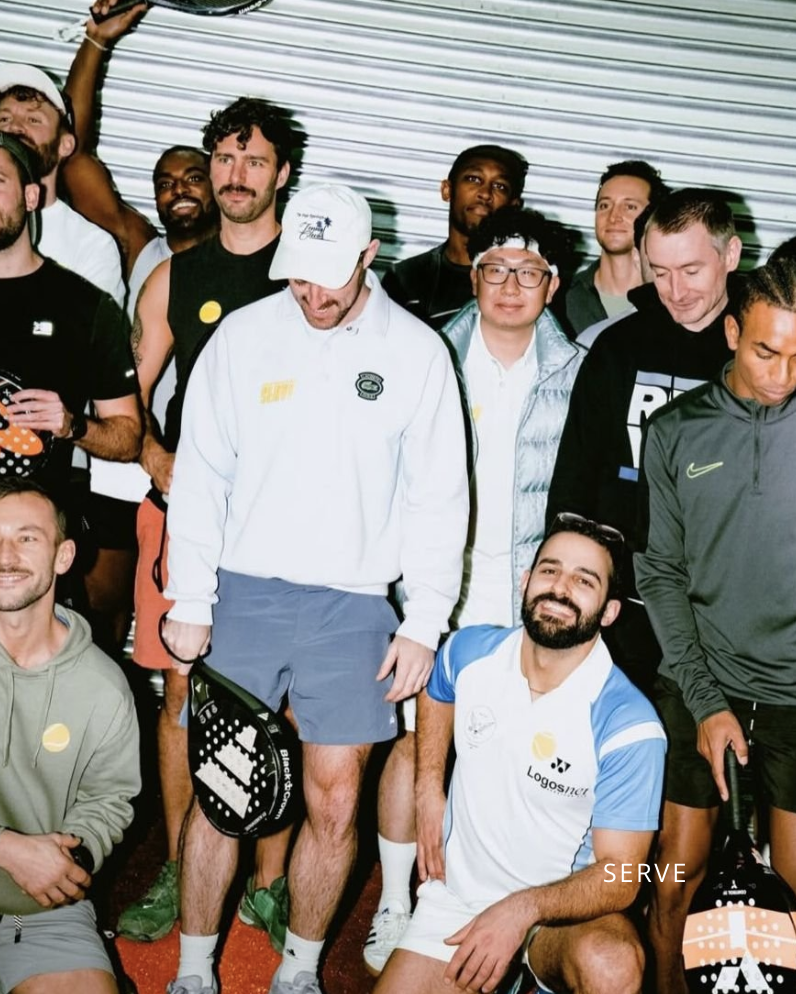
It’s Sunday morning and my head is racing with thoughts of everything I have to do that day. I often find myself anxious before hosting my monthly pàdel social, even when tickets are all sold out: ‘Will anyone actually turn up? What if there’s an odd number? What if everyone has an awful time!?’
There’s zero evidence of any of these worries of course, and every time I’ve hosted SERVE (for the last eight months), it always ends in people wanting more—and me feeling absolutely humbled and full of joy in its success.
SERVE started as a one-off event idea for the run club community I lead, but since the first event, it has become a monthly staple in a wider wellness offering. It’s one I’m very proud I created, host, and continue to develop.
I choose to see my anxiety as a sign that I really care; if I didn’t, I’d probably question why I was bothering altogether. But there’s something about pàdel that feels familiar to its big brother, tennis: once you’re in it, it’ll never leave you.

Since the pandemic and the rise of a social media-fueled self-first era, we’ve all been longing for connection, and this subsequent rise of community is now powering run clubs. Loads of them, catering to enthusiasts, brand fans, identities and abilities. You can’t move in London on a weekend morning without seeing a group pacing through the park, water bottles in hand, running vests on, wraparound sunglasses and the neon blur of sneakers accompanied by official pacers in branded tops yelling encouragement from the front. Just make sure you get in the cafe queue before they finish.
Last year, in an effort to try something I hadn’t, I joined the masses and attended my first run club with Gayns, a central London based LGBTQ+ club. We ran 7k from Tower Bridge to Borough Market, taking in the beautiful cityscape along the Thames and ending in a mass of sweaty gays and theys all guzzling water, comparing pace times and connecting with each other; no sign of a pint, drugs or the silent judgement from the meerkats looking for their next mate.
IT WORKS BECAUSE PÀDEL IS INHERENTLY SOCIAL.
It felt good. The endorphins opened people up to be more approachable—to make genuine social connections. Run club quickly became my church, a routine activity for every weekend that I didn’t have plans.

I started playing pàdel last year while working a short contract for the LTA, England’s governing body for tennis. Lunchtime games with colleagues soon became addictive, and the business was also exciting: Discussions on how the LTA was starting to govern the sport in the UK, and creating potential assets for sponsorship, just as the city was about to be hit with pàdel fever.
That summer, I enjoyed watching a lot of tennis—Roland Garros, Queens and Wimbledon—and played in some local leagues myself. With the approach of autumn, I switched my focus to indoors. I still wanted my racquet sports fix, without the risk of British weather.
So I dropped a note in the run-club group chat and asked who fancied playing pàdel. Forty guys responded. An idea clicked: ‘Let’s do a pàdel social!’
I met with Connor Minney, the founder of Gayns, to discuss how it would work, and if he’d be interested in promoting it. The community had already done a couple of non-running events, so I knew it was feasible. SERVE was born. A new type of Sunday Social.
It works because pàdel is inherently social. Come with a friend or solo, you’ll leave knowing someone a little better, feeling confident holding a racquet and most likely with a story of a fumble from trying to use the glass tactfully or that winner you patiently waited to smash.
It’s also accessible. Guys arrive having never stepped on a court, and quickly get to grips with it, whereas confident tennis players are humbled in minutes, swinging hard before understanding it’s a game of patience as much as strategic power plays. It’s a sport that levels out, but offers the option to play slow or fast—even in the same rally—each player acting like a bumper inside a pinball machine.
The somewhat-ironic flipside to the sport’s popularity, particularly in London and other major cities, is that this accessibility is challenged by high prices and the race to build the best club offering. In the rush to become a leading name in pàdel, some brands have aimed for super-clean minimal aesthetics, whereas apparel in particular has adopted the vintage tennis look: familiar and trusted visuals, far from the less formalised roots of the sport’s colourful graphic appearance.
Stratford Padel Club align more to the latter; when I spoke to them, they were most supportive of the idea of SERVE, understanding that this was about community above all else. A converted car dealership, the club was set up by four friends, featuring nine courts, a couple of bars, a gym and a courtyard for hosting summer barbecues. It’s less polished than the chains, and I often hear more Spanish than English at the club.

Aesthetics are important, however. With the support from Gayns—with its own distinct 90s look and feel—I immediately took SERVE’s branding inspiration from an old Nintendo game I used to play with my sisters: SUPER TENNIS. I can still hear the theme of the start screen in my head, the umpire announcing ‘PLAY!’ and the frustrated ‘that’s not fair!’s of my siblings when losing a point. I channelled this through not only the logo and graphics, but also a ‘how to play’ instruction manual that looks like it might fall out of an old board game.
Obviously after that, it was only right to design stickers (who doesn’t love a sticker?). Using 90s tennis fashion and typography, tournament score sheets, and social graphics, combined with some stunning photography by Sam Hooper, SERVE’s aesthetics come together to create an excitement and energy that players want to be a part of.
SERVE is about getting people into the sport; to encourage new players to come and try it, without committing to paying over a hundred pounds for an hour when they aren’t sure how to even start. There’s guaranteed court time every last Sunday of the month; two hours and plenty of players to challenge all abilities.
As the social has evolved, I have been careful to make sure players get more out of it every time. Drills to practice serving accuracy are now part of new player introductions, and we educate players on building a solid net game as the ultimate strategy. Meanwhile more experienced players contend for king-of-the-court to warm up, ahead of 10-minute rounds of Pàdel Americano-style play. We use linear scoring and a simple serving pattern to keep everyone engaged. The format sees court time mixed with social club and healthy competition.
I’ve had the privilege of seeing people turn up solo and partnered with strangers that they’re friends with by the end of the session. Seen players connecting between socials to get on court in their own time to play. Regulars investing in their own racquets, and many disagreements between line calls that end in laughter as they argue SERVE the point, before ultimately playing a let. We’ve had pints between court times, prizes for winning teams, and even rounds of tequilas after playtime is over. Even the Wimbledon Men’s final didn’t stop the monthly tournament being taken seriously by some. Pàdel matters, and that means SERVE does too.
With the thirst for more SERVE sessions per month, I have now launched SERVE Pro. A mid-month tournament, a more competitive and traditional game, and a knockout challenger I lovingly named ‘Bash one out’ to keep things tongue-in-cheek.
We now have a decent pattern of regulars and fresh faces coming to play twice monthly, whether it’s to improve and increase their court time, step on court for the first time, or meet up with friends and new faces. As we plan for the future, I want to take SERVE across the city to other clubs, and open up the accessible format to new clubs, players and even partners to make pàdel even more inclusive and accessible.
Marcus Lange was born with a racquet in hand into a family of tennis playing sisters. Now a creative consultant, he’s worked across huge campaigns and events in tennis, pàdel, lifestyle and fashion.


