


Skip to Content
Features

Tennis Heaven Among the Dunes

I’ve been to Wisconsin exactly two times. The first visit was during graduate school, when a fellow journalism student who, like me, was missing skiing something fierce, planned a trip for the two of us up to Wisconsin. There’s good skiing up there, we were told by Chicagoans who didn’t know any better. So we of the Cascades and the Rockies drove two hours north from Evanston, IL to ski a “mountain” with a 200-foot elevation.

I’ve been to Wisconsin exactly two times. The first visit was during graduate school, when a fellow journalism student who, like me, was missing skiing something fierce, planned a trip for the two of us up to Wisconsin. There’s good skiing up there, we were told by Chicagoans who didn’t know any better. So we of the Cascades and the Rockies drove two hours north from Evanston, IL to ski a “mountain” with a 200-foot elevation.

And yet there I was in July—ever the optimist—driving to another geological anomaly in Wisconsin, once again with no real concept of what lay ahead.

I was headed to Sand Valley for the opening of the new 13,000 square-foot Tennis Center. If you’re a golfer, you probably just went “ooh!” because that’s what every golfer says when I mention SV. Sand Valley was developed by the people who brought you Bandon Dunes, and it lives up to the hype, I’m told. I can’t vouch for it myself because of course I was there for the tennis.

I’m so glad I was.

Upon arrival, I threw my tennis bag over my shoulder and walked past the well-kept farm-to-table vegetable garden and chicken coop, past goldfinches on bending blades of native sedge, and over dunes of soft white sand to the area around The Gallery, which stands sentry on a hill overlooking the grass courts.

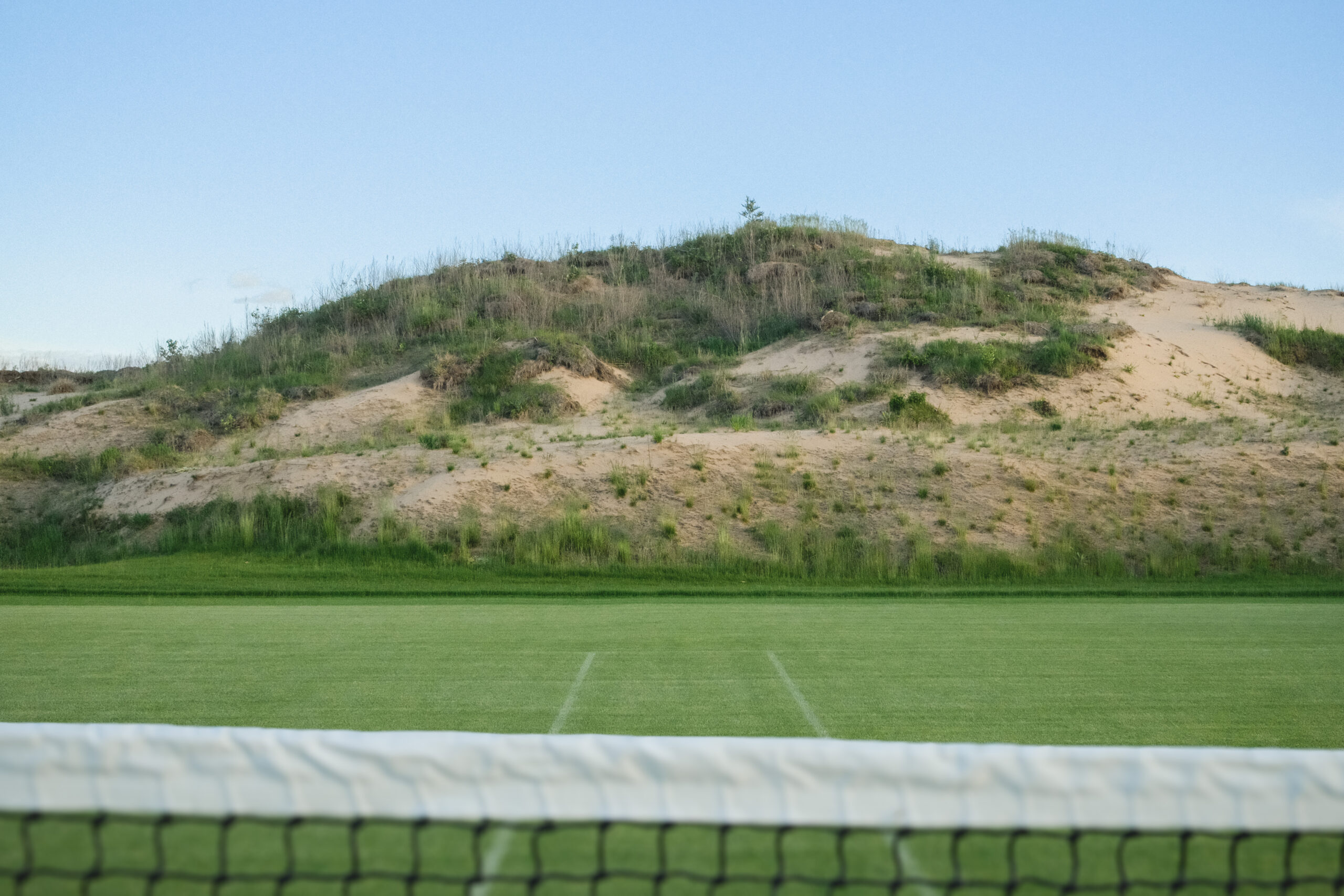
The courts—sixteen spectacular, Wimbledon-level grass courts (eight are playable at any one time)—are immaculate. They’re either rolled or mown most days, with a robot named Ace to paint the lines. Tubs of ice-cold water beckon from all sides. There’s a pro to help you navigate the vagaries of grass, which, at the Sand Valley level, does provide a decent bounce but doesn’t grab the ball like a hard court (pro tip: bend your knees). And all of this is nestled within 12,000 acres of sand barren in the center of the state, with waving grasses and windswept Scottish dunescapes and sandpipers on stilt legs. You can almost—almost—hear the North Sea.

[vc_video link="https://youtube.com/watch?v=FVD_33aUXUQ"]

A luxurious weekend of lawn tennis here would have been enough to soften any residual animus I’d been harboring in re: Wisconsin. But it was done away with entirely by the opening, that weekend, of the new building. Silhouetted against a wide Midwest sky, the cathedral-like structure houses a restaurant and bar, some locker rooms, and a little tennis pro shop. But the pièce de résistance sits on the ground floor, with clerestory windows above and a little whites-clad cartoon mammoth on the wall: the court tennis hall.

Your brain just did what mine did originally: you read “tennis court,” not “court tennis.” Well switch those words back the way you found them and hang around: Sand Valley’s new court-tennis court is the newest—and farthest west—among only 12 in the entire country.

As with the other 11 (there are only 45 worldwide), this court conforms to a centuries-old standard: it’s an asymmetrical indoor hall, with doors and windows and awnings meant to mimic the medieval streets where the game began more than 900 years ago.

I’ll be honest: the 950-year-old precursor to modern tennis does have a fusty, old, patina that’s accreted over the centuries, due in part to the fact that most remaining courts are cloistered inside the walls of clubs or literal palaces. But this new court—in the middle of Wisconsin, recall—shrugs all that off: anyone can play; no club-member, school-tie, Brahmin-ness necessary.

So I did. And I can report that, fusty or no, there’s a very good reason court tennis has lasted this long: It’s gorgeous. It’s old-school. It’s esoteric. It’s also a rollicking good time. You swing a long, heavy racquet—as hard as you can—at a handmade ball (that’s right; the pro must HAND-MAKE EACH BALL, sewing wool melton around a cork center), and it feels really good. Balls bounce off walls and penthouses and into windows with little bells that alert you to a score. Balls that hit the center net gather in what I have to assume is every tennis player’s dream: a runnel that corrals all the balls and encourages them to roll down to a basket at one end.

The sport’s current upsurge is partly thanks to people like Sand Valley co-owner and court tennis player Michael Keiser. In an “if you build it they will come” moment, he brought in niche expert after niche expert to create the cavernous, bespoke arena required to play the game. And come they did: in July, the US National Open was played here.

Real_Tennis_Court
real_tennis_gallery

Keiser’s goal is to field a traveling team from among local high school kids. For now, it’s free to guests of the resort, and court time is available for a fee to anyone else who wants to explore the deep roots of tennis in one of this country’s most dramatic settings.

With five world-class courses and more on the way, golf is Sand Valley’s raison d’être. But mine, and yours if you seek to play tennis the way it was meant to be played, should be a visit to Wisconsin. Maybe don’t bring your skis.

Wendy Laird is Racquet’s Features Editor and a frequent contributor. She intends to become an insufferable expert on arcane racquet sports, and, to that end, will gladly accept honorary memberships to fusty clubs.

Stay in touch

Sign up for our free newsletter

More from Racquet

A Riot of Colour with Agnès Ricart

Agnès Ricart is a multimedia artist from Spain who—close Racquet readers will confirm—has been a staple in our visual vocabulary for the better part of a decade. Alongside classic Racquet illustrations such as Medvedev flipping the bird at the collected crowd at the US Open, Naomi Osaka's masked protest during COVID and even a protester using a tennis racquet to clear a cannister of tear gas. Her work is vivid and cheeky, and can be seen across the world from The Guardian to Die Ziet to the Economist. We asked her to bring to life an ode to the tennis ball in our latest issue, and to sit down for a Q&A about her artistic practice.

April 24, 2026

From the Trenches of the World’s Most Obscure Racquet Sport

Stické tennis was invented in the 1870s in England, i’s a hodge-podge of tennis, squash, and real tennis. The game disappeared after the First World War. Just two courts are still playable. Yes, stické is the world’s most obscure racquet sport.

April 17, 2026

Racquet Retreat at Sensei Had us Breathing Easier

During this year's Indian Wells tournament, we launched a first-ever restorative trip for our nearest and dearest at the exclusive Porupine Creek property, and the results were... relaxing.

April 17, 2026

Jannik Sinner Can’t Lose (Except at Content)

When Aryna Sabalenka’s on-court intensity translates into campy, self-congratulatory TikToks, harmony is felt and sense is made. But Jannik’s on-court persona, tightly controlled like an unseasoned chicken breast, respectfully, need not be repackaged for YouTube. Because where is the flavor?!?

April 13, 2026

Issue No. 28: Tennis is the Blueprint

“To create one’s own world takes courage.” —Georgia O’Keefe

April 13, 2026

The Disappearing American College Tennis Player

These days, American college tennis is barely that: American

April 3, 2026
See all posts