

Skip to Content
Features

The Elegant Order of the Court

Sure, game-play conditions may vary, and a maintained court is more enticing for actual play, but as purely aesthetic fascinations, the inherently satisfying rationality of court design endures. 

By Rachel Davies

9:31 AM EDT on April 3, 2026

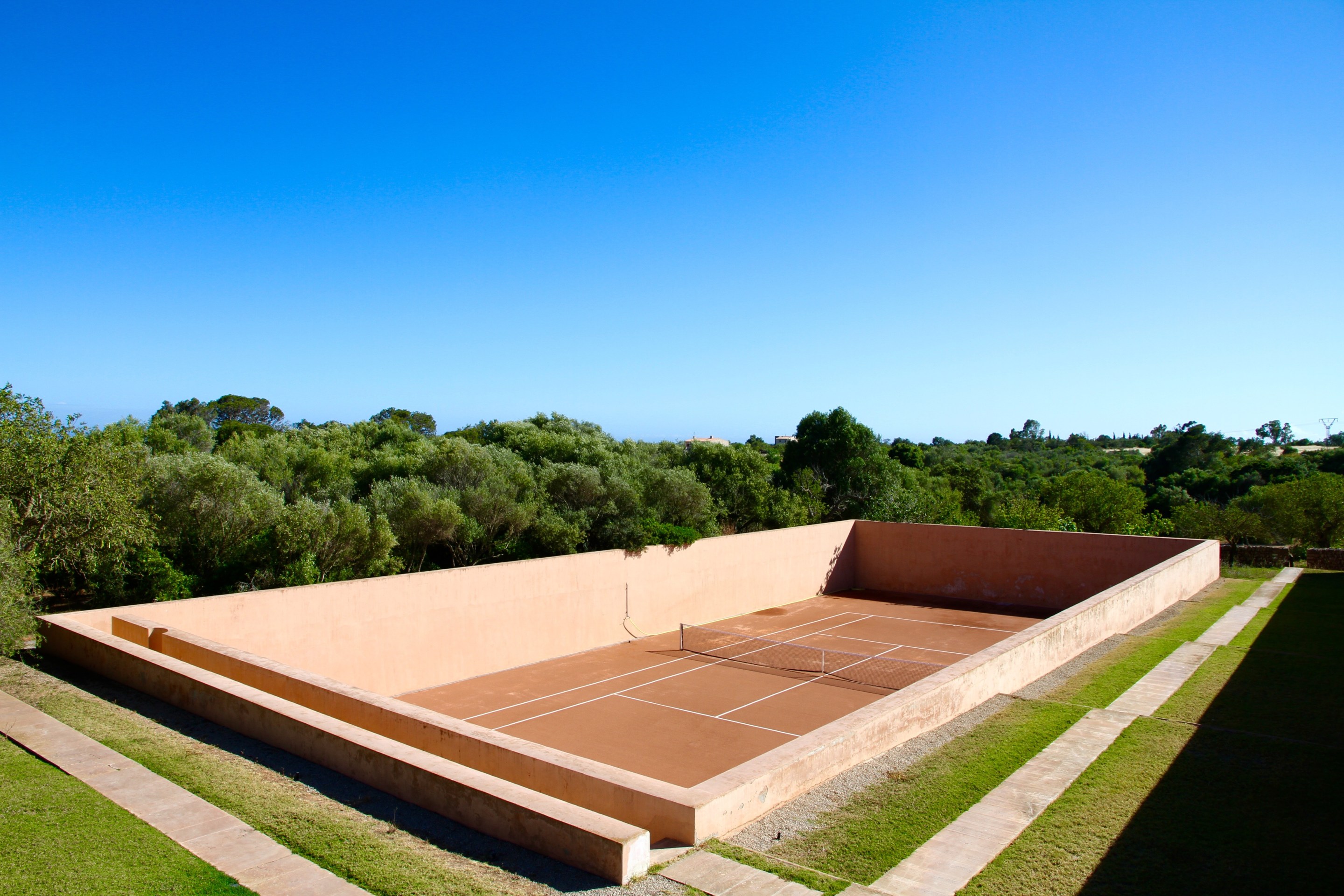
The sunken tennis court at the Neuendorf House, a residential property in Southern Mallorca designed by Claudio Silvestrin and John Pawson in the ’80s, takes its cue from the austerity of standardized dimensions.

The simplicity of the standard tennis court allows even the most rudimentary of spaces to feel orderly. Even if you’re looking at a public court you have to wake up at 6 am to queue for, or a worse-for-the-wear home court that’s been neglected for far too long, the elegance of those 11 simple lines remains.

Using rammed earth, Hector Barroso's design for a Baja tennis facility mimics the landscape of its region.

Some architects prefer a design that's in harmony with the orderliness of the court, not an antidote to it. Hector Barroso is one such architect, having designed the grounds for a private tennis club in Los Cabos, Mexico in 2018. Using rammed earth, the design mimics the landscape of its region, the fact that it is literally crafted from the earth allowing for a natural alignment. The overall design hasn’t yet been fully realized, but several of Barroso’s elements are completed at the property, including a sunken stadium with a court at its center, one of the property’s centerpieces. “What I’m interested in is empty spaces, the ‘calzadas’ as we call them, and how the position of the architecture around it gives scale and sense to those negative spaces,” Barroso tells Racquet. In one stroke, the sense of quiet borrowed from the surrounding landscape offers a sense of momentary tranquility to players before they pick up their racquets. 

Paul Le Quernec’s effervescent design for a tennis club in Strasbourg, France was intended to mirror the energy of the players.

For some, the rationality of a tennis court is an invitation to provide a counterpoint. While Wimbledon may be known for its strong sense of tradition, the structure of the Hopkins Architecture-designed All England Lawn Tennis Club is rather playful, with a wavy timber roof that’s supported by steel beams and raking props. If those props seem to evoke the prongs of a racquet’s shaft, that’s by design. "The very original concept was to make the roof from timber like an architectural version of a Dunlop Maxply racquet,” Hopkins Architects principal architect Mike Taylor told Dezeen in 2023, the year the building was completed. 

In Indonesia, Fffaaarrr found the middle ground when they designed a space that is half coffee shop, half tennis club homebase. Terracotta walls enclose the plum-colored court on three sides, with the other side lined by stands that are nestled under a building overhang. While relatively simple, it has a level of conviviality not immediately implied by the more minimalist designs. 

Paul Le Quernec’s effervescent design for a tennis club in Strasbourg, France was intended to mirror the energy of the players. The halfway-deconstructivist structure features broad curves, pushing people through the public areas and over to the courts, with the parachute-like ceiling presiding over a gradient yellow floor being one particularly memorable section. In this context, the arrival at the tennis courts feels like a sigh of relief—delivered from the funky shapeliness (and relative low ceiling) of the communal zones and into the double-height breathability of the courts.   

The sunken tennis court at the Neuendorf House, a residential property in Southern Mallorca designed by Claudio Silvestrin and John Pawson in the ’80s, takes its cue from the austerity of standardized dimensions. After following a dusty pink concrete pathway—the same tone and material as the rest of the property—players are ushered down to a court that’s been inserted into the earth. Here, the surrounding world is barely visible; there’s nothing to focus on but the clay court.

The Indonesian architecture firm Fffaaarrr designed a space in Bali that is half coffee shop, half tennis club.

And in Accra, Ghana, the Backyard Community Club by Glenn DeRoche uses a simple material palette of prefabricated rammed-earth panels for the structure and clay for the court itself. This is given a sense of ornamentation, though, by the subtle manipulation of sunlight: triangular cutouts in the rammed-earth walls surrounding the court usher daylight in and create a sense of connectedness with the broader community, rather than simply being a walled garden. “I'm obsessed with light and darkness, and how darkness allows us to appreciate light,” Deroche told Racquet in 2025. “So we designed this panel that was moving in two directions; it tapers in one plane and then it angles in another.” 

In every case, constraint begets expansiveness; right angles widen and narrow; lines extend and curve. The final touch: players and their watchers round out the space, genuflecting in these 36x78 foot cathedrals to sport. 

Rachel Davies is the author of the design newsletter Personal Space and the Contributing Editor at Dwell. Their work has appeared in Architectural Digest, Curbed, and Prune, among other publications.

Stay in touch

Sign up for our free newsletter

More from Racquet

A Riot of Colour with Agnès Ricart

Agnès Ricart is a multimedia artist from Spain who—close Racquet readers will confirm—has been a staple in our visual vocabulary for the better part of a decade. Alongside classic Racquet illustrations such as Medvedev flipping the bird at the collected crowd at the US Open, Naomi Osaka's masked protest during COVID and even a protester using a tennis racquet to clear a cannister of tear gas. Her work is vivid and cheeky, and can be seen across the world from The Guardian to Die Ziet to the Economist. We asked her to bring to life an ode to the tennis ball in our latest issue, and to sit down for a Q&A about her artistic practice.

April 24, 2026

From the Trenches of the World’s Most Obscure Racquet Sport

Stické tennis was invented in the 1870s in England, i’s a hodge-podge of tennis, squash, and real tennis. The game disappeared after the First World War. Just two courts are still playable. Yes, stické is the world’s most obscure racquet sport.

April 17, 2026

Racquet Retreat at Sensei Had us Breathing Easier

During this year's Indian Wells tournament, we launched a first-ever restorative trip for our nearest and dearest at the exclusive Porupine Creek property, and the results were... relaxing.

April 17, 2026

Jannik Sinner Can’t Lose (Except at Content)

When Aryna Sabalenka’s on-court intensity translates into campy, self-congratulatory TikToks, harmony is felt and sense is made. But Jannik’s on-court persona, tightly controlled like an unseasoned chicken breast, respectfully, need not be repackaged for YouTube. Because where is the flavor?!?

April 13, 2026

Issue No. 28: Tennis is the Blueprint

“To create one’s own world takes courage.” —Georgia O’Keefe

April 13, 2026

The Disappearing American College Tennis Player

These days, American college tennis is barely that: American

April 3, 2026
See all posts