

Skip to Content
Features

Postcard from SoHo: The Wall Always Wins

At Wilson’s SoHo flagship, …Anyone for Tennis? hosted Off the Wall, a panel bringing together fashion, media, and music to reframe tennis as a shared language of culture and play.

By Christobelle Rudes and Photos by Costanza Damiani

11:16 AM EDT on April 27, 2026

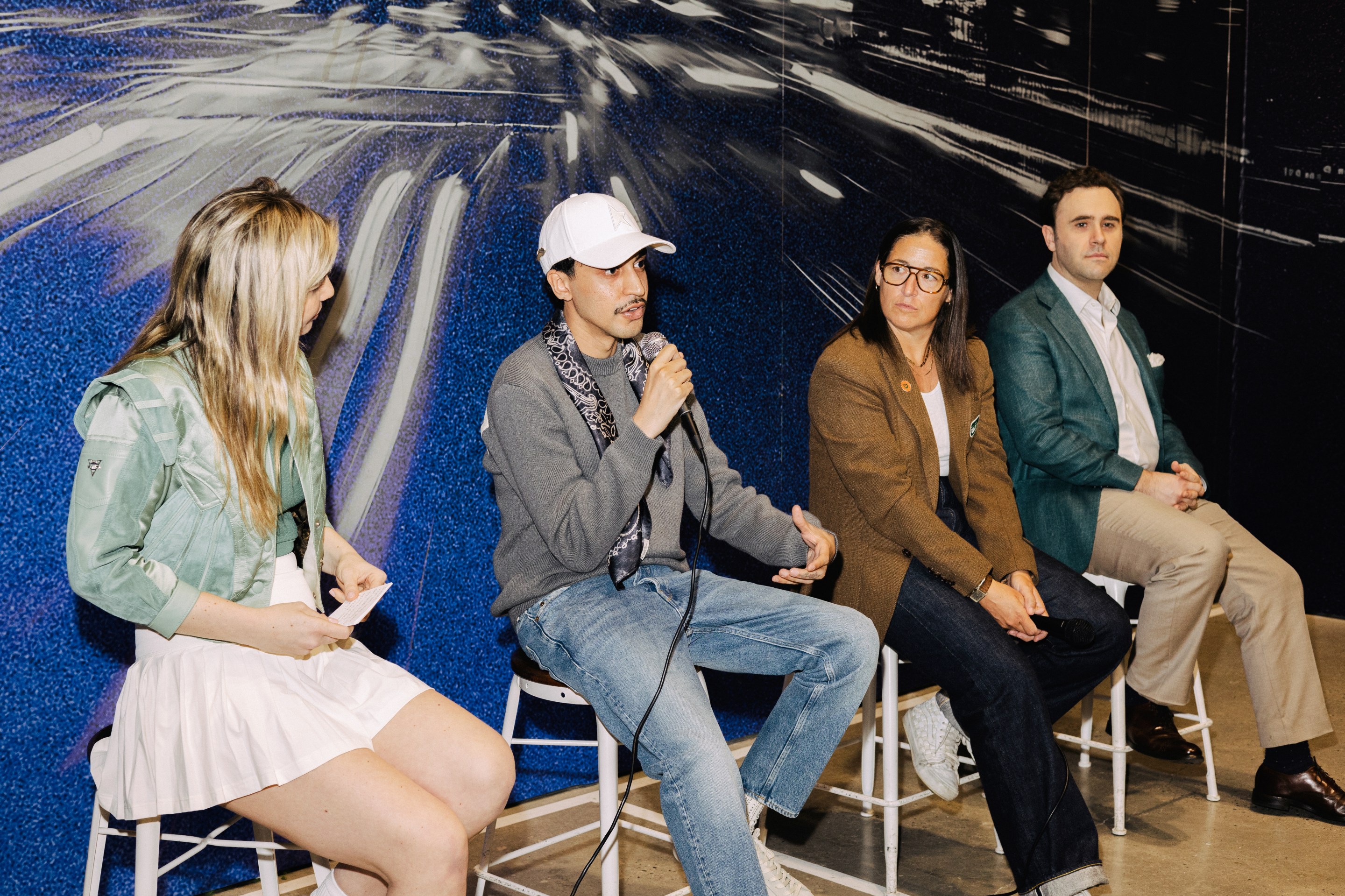
On a spring evening in SoHo, New York, the Wilson flagship store closed for a private event. The newest Blade racquets, lined in rows of dark green, and Clashes in matte black framed the space, while folding chairs filled Thomas E. Wilson Park, an indoor atrium tucked behind the store’s typical floor of mannequins and clothing racks. Conversations moved over Brazilian sparkling wine from Bom Dia and a near regulation-size tennis-court matcha brownie, backed by sounds from Philly natives Astro 8000 and Zappa, who made the trip to New York for the Wednesday night party.

The event, Off the Wall, was organized by Sara Morano, known for her monthly “…Anyone For Tennis?” series that draws a New York crowd to the courts in Old Greenwich, Connecticut. The evening carried the same underlying energy: tennis as conversation and culture.

Morano moderated the panel, bringing together three voices who approach tennis from different disciplines but share a common fluency in the game: Musa Fayyaz, New York-based creative director of AMN; Caitlin Thompson, founder of Racquet; and Andrew Bevan, a classically trained vocalist, performer, and longtime tennis player.

Fayyaz approached tennis through design, though not in the conventional sense of sportswear. For him, the game operates as a structured system of thought, balancing control with emotional intensity. He arrived in a full Golden Goose look that reflected the evening’s blend of sport and style.

“Every day there’s a new design, a new brand — I look at it as a psychological game,” he said. “When I hit a shot, I want it to land on the far side of the court, catching the industry off guard. When I design a piece, I’m thinking about disruption and unpredictability.”

In both the court and the studio, small intentions can shift outcomes entirely.

Thompson, whose magazine Racquet has spent the last decade tracing tennis through culture, described the game as an environment that absorbs you completely.

“Regardless of how new to tennis you are or where you are in your journey, it’s totally immersive,” she said. “You feel like you’re in the most important moment of your life.”

Bevan, who understands performance both on stage and on court, spoke to the rhythm the game lends.

“The more you practice, the more you focus on specific things that you can do,” he said. “It’s like muscle memory.”

For Bevan, the logic of tennis mirrors music: repetition becomes instinct. What begins as physical skill is shaped over time by an internal discipline—focus, timing, and control layered onto the body.

As the panel came to a close, Thompson offered a line that carried into the next phase of the evening, when the atrium was reconfigured as a practice space and guests moved into drills against the wall.

“The wall always wins,” she said, half-joking.

Guests lingered between conversation and play.

“There was a moment in the transition when people were more interested in taking photographs in front of the Wilson logo than using the wall to hit, which I didn’t totally expect but loved, even as I was nudging them towards the racquets,” Morano said. “What I want to do with ‘…anyone for tennis?’ is rig that social energy back into the game, so that people come for the atmosphere and discover that playing tennis is even better than it looks.”

In the end, the wall won. Even those from the fashion crowd who had never picked up a racquet stayed to play.

“Courts are all the same,” Thompson said during the panel, “but the ways that they show up—and the people who bring them to life—are different everywhere.”

Just shy of a full court, on an early spring night in downtown Manhattan, something distinct took shape: a space where tennis moved fluidly between image and action, and where the line between watching and playing began to dissolve.

Stay in touch

Sign up for our free newsletter

More from Racquet

A Riot of Colour with Agnès Ricart

Agnès Ricart is a multimedia artist from Spain who—close Racquet readers will confirm—has been a staple in our visual vocabulary for the better part of a decade. Alongside classic Racquet illustrations such as Medvedev flipping the bird at the collected crowd at the US Open, Naomi Osaka's masked protest during COVID and even a protester using a tennis racquet to clear a cannister of tear gas. Her work is vivid and cheeky, and can be seen across the world from The Guardian to Die Ziet to the Economist. We asked her to bring to life an ode to the tennis ball in our latest issue, and to sit down for a Q&A about her artistic practice.

April 24, 2026

From the Trenches of the World’s Most Obscure Racquet Sport

Stické tennis was invented in the 1870s in England, i’s a hodge-podge of tennis, squash, and real tennis. The game disappeared after the First World War. Just two courts are still playable. Yes, stické is the world’s most obscure racquet sport.

April 17, 2026

Racquet Retreat at Sensei Had us Breathing Easier

During this year's Indian Wells tournament, we launched a first-ever restorative trip for our nearest and dearest at the exclusive Porupine Creek property, and the results were... relaxing.

April 17, 2026

Jannik Sinner Can’t Lose (Except at Content)

When Aryna Sabalenka’s on-court intensity translates into campy, self-congratulatory TikToks, harmony is felt and sense is made. But Jannik’s on-court persona, tightly controlled like an unseasoned chicken breast, respectfully, need not be repackaged for YouTube. Because where is the flavor?!?

April 13, 2026

Issue No. 28: Tennis is the Blueprint

“To create one’s own world takes courage.” —Georgia O’Keefe

April 13, 2026

The Disappearing American College Tennis Player

These days, American college tennis is barely that: American

April 3, 2026
See all posts