

Skip to Content
Newsletter

Aryna Sabalenka Finds Her Footing

[vc_empty_space height="5px"]

By Giri Nathan

[vc_empty_space height="15px"]A tennis player goes on a tear. It’s pretty much always a delight to watch, but they are not all made equal. Here’s a theory: The most entertaining tear in tennis is when a power hitter sees the tennis ball like a cantaloupe for a week, and hits through the clay as if it were not clay at all. Roland-Garros has given us many iconic examples: Robin Soderling delivering conclusive evidence that Rafa could actually lose, Jelena Ostapenko exploding in an orb of pure light, Stan Wawrinka growing the fangs of the Stanimal. These aren’t the players canonically thought of as good on clay—that honor goes to all those lean masters of topspin and stamina and artful slides. But if conditions and form align, there is no touching them. If their timing is perfect and their legs hold up and they can see the slowness of the surface as a means to offset their subpar foot speed, then these players can load up and do awful damage with every stroke. Which is exactly what Aryna Sabalenka has been up to lately. It’s not just her killer 23–6 record this season; it’s what’s under her soles.

Sabalenka is no one’s idea of a classic dirtballer. Consistency is not her bag. Her natural habitat is the hard court, where she has piled up an elite 180–77 record over her career, per Tennis Abstract, and before this year’s clay swing, Sabalenka was actually under .500 on clay in her career, a splotch on the résumé of the world’s No. 7 player. This year, however, she has managed to keep her momentum even as the ground below her crumbled. The hitting that carried her into the final on the muggy courts of Miami in March has carried right over onto the dirt in April—first the indoor courts of Stuttgart, and then this week in the high altitude of Madrid. The less dense the air, the lower the air resistance on the ball, and the faster her shots speed across the net and onto the shoestrings of an unhappy opponent. In Madrid, Sabalenka has lost just 18 games over 10 sets. On average, she has wrapped up her matches in a tidy 1:04. Opponents have been deleted from the baseline opposite.

After her match against her close friend Elise Mertens, which saw Mertens retire with a thigh injury down 6–1, 4–0, Sabalenka remarked: “I think after first few games I would say I kind of destroyed her a little bit.” I would say that too. When I settled in to watch Sabalenka play her semifinal against Anastasia Pavlyuchenkova, I let my attention drift from the scoreboard for a few minutes to answer some emails. By the time I opened a fresh document to take notes, she was demolishing forehands to set up a set point. She stayed at a dead sprint until 5–0 in the fifth and, if not for a slight stumble there, would have closed out the match in well under an hour instead of a sluggish 1:04. Sabalenka, as usual, generates unplayable pace of her own, and, perhaps even more important on clay, looked great redirecting an opponent’s pace to find unretrievable angles. “I’m really happy that I don’t feel anymore that I cannot play on the clay court, and I start to really like it,” she said. Her adaptation should encourage other clay-challenged but -curious big hitters like Naomi Osaka.

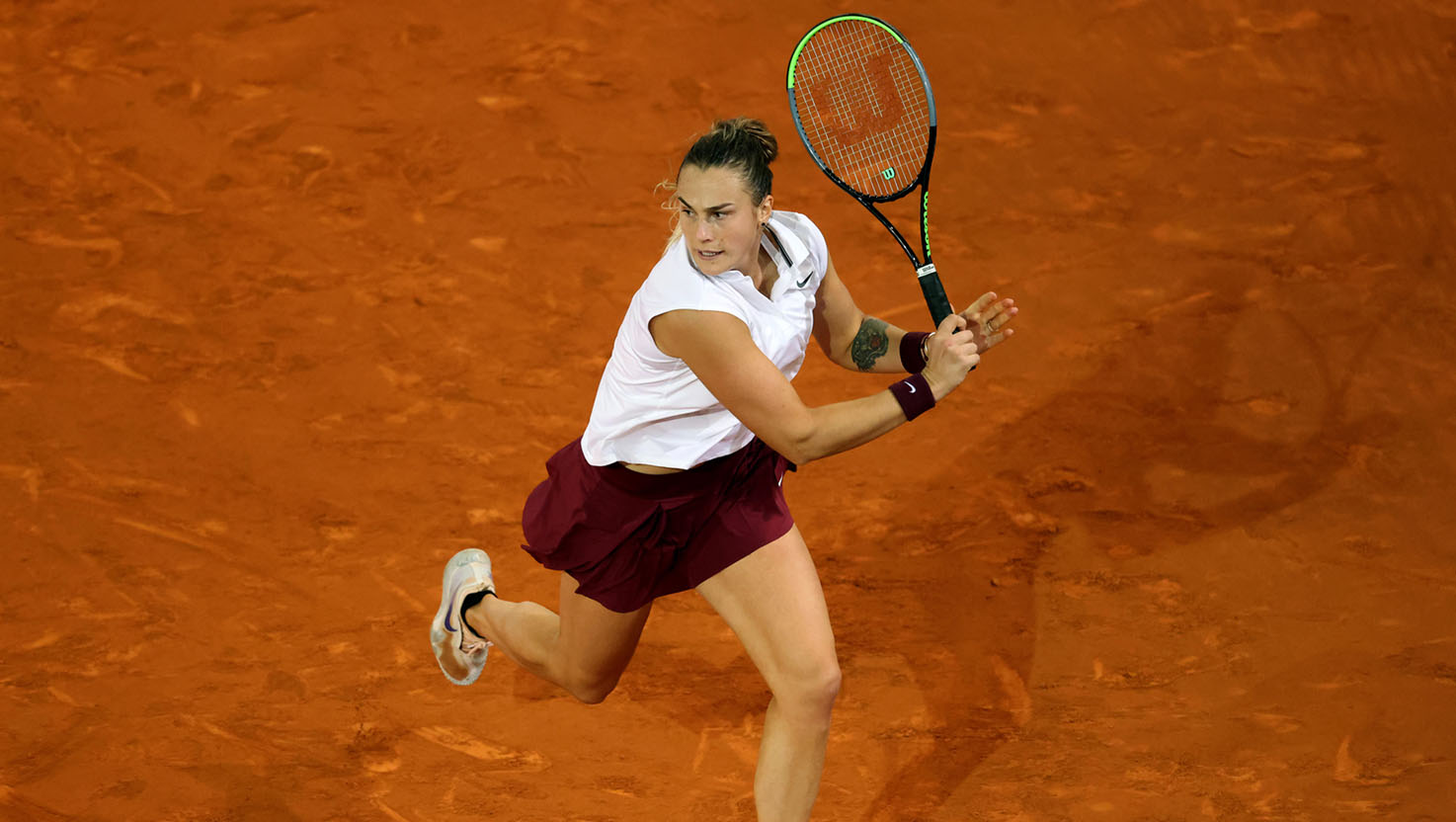
Now Sabalenka is about to play her third final in as many events. Her opponent in all of them: Ashleigh Barty, who has more than justified her No. 1 ranking this season with a 25-3 record and titles in Melbourne, Miami, and Stuttgart. The only thing better than watching a player go on a tear is seeing another player go on their own, in parallel. If they played three-set finals all summer, I wouldn’t complain.[vc_empty_space height="10px"]Above: Aryna Sabalenka has mastered the clay in Madrid. (Getty Images)[vc_column width="1/6"][vc_tweetmeme share_via="racqetmagazine"][vc_column width="1/6"][vc_facebook type="button_count"][vc_column width="1/6"][vc_column width="1/6"][vc_column width="1/6"][vc_column width="1/6"][vc_empty_space height="45px"][vc_column width="1/4"][vc_column width="1/2"]

GET ISSUE 16 NOW

racquet_issue-16

[vc_btn title="GET IT NOW" style="outline" shape="square" color="success" size="lg" align="center" button_block="true" link="url:https%3A%2F%2Fracquetmag.com%2Fproduct%2Fissue-no-16%2F|title:GET%20IT%20NOW||"][vc_column width="1/4"]

Stay in touch

Sign up for our free newsletter

More from Racquet

Saying Goodbye to the Stan We All Stan

We contemplate an ATP tour without Stan Wawrinka, who lifted trophies and bared it all in a memorable Body Issue spread: In a room full of Pat Rafters, our See You in Court columnist Mel Kenny would still stan Stan.

February 6, 2026

Postcard from Melbourne

Photographer Hritika Chaturvedi was on the ground in Melbourne capturing the biggest moments from the Australian Open and she shares her experience trying to capture the world's greatest amid shadow, light, foibles and fanfare.

February 3, 2026

Tennis Gets its Heated Rivalry Moment

The Open Era, an upcoming novel by debut author Edward Schmit, follows Austin Hardy, an openly gay tennis player, as he navigates two weeks playing in the US Open. We sat down with Schmit to talk tennis, books, and… the gay sports genre that is suddenly everywhere.

February 2, 2026

Where Has All the Good Merch Gone?

They just don’t make tennis merch like they used to, so we asked our favorite indie brands, resellers and stylish tennis friends (and fiends) where they find the best tennis apparel.

January 16, 2026

Daniel Yaw-Miller & Mel Kenny on Substack (and in Satin)

Melissa and Daniel—the authors of Hard Hitting and Sportsverse, two of the best newsletters around—are friends, neighbors, hitting partners, and for one magical afternoon at our new Clubhouse location, muses of style.

January 16, 2026
See all posts