

Skip to Content
Newsletter

Lorenzo Sonego And The Italian Renaissance

[vc_empty_space height="5px"]

By Giri Nathan

[vc_empty_space height="15px"]Monte Carlo might produce the best postcards, but clay-court tennis looks perfect in Rome. This is just where the dirt belongs, encircled by the statues and the big stone pines and the broad variety of ambitious sunglasses. Seeing the players tussle in a gladiatorial bowl and hearing the faraway sirens bleat (somehow) in an Italian accent, I can almost taste the zucchine alla scapece and feel the humidity defeat my linen shirt. But as much vicarious fun as I am having from the comfort of an unfurnished apartment, the locals at the Foro Italico are having way, way more fun. Perhaps this is because of the abundance of ATP talent they abruptly find themselves celebrating. Last year the young Italians were confidently hurling themselves into the tour, and they’ve done nothing but thrive ever since. Italy no longer needs to pin its hopes on the mood that Fabio Fognini woke up in on any given morning, because it can now claim the only two teenagers ranked in the top 100. One of them, world No. 82 Lorenzo Musetti, has backed up his incredible feel with grown-up fitness and posted several wins over folks like Diego Schwartzman and Grigor Dimitrov this season. His elder by some seven months, world No. 18 Jannik Sinner, just made his first Masters final in Miami and has a technically airtight game that screams major titles. Making his own first Masters final in Madrid last weekend was Matteo Berrettini, No. 9 in the world and a credible contender for its scariest forehand. Everything’s looking up for the ragazzi.

But none of those three would be the last Italian man standing in Rome. The teens lost in round 2—Musetti served off the court by Reilly Opelka and Sinner unable to stave off the inevitable against Rafa Nadal. In the third round, Berrettini fell to Stefanos Tsitsipas. So the hero this week was world No. 33 Lorenzo Sonego, the man with the Karate Kid headband now rounding into form at age 26. Last fall Sonego made the fourth round at Roland-Garros and obliterated a spotty Novak Djokovic in Vienna; last month at the Sardegna Open he grabbed both the singles and doubles titles. He cuts an unusual figure for a dirtballer: 6 foot 3 and lanky, with a springiness and coordination that seems like it could have been directed toward the sport of his choosing, he racks up clay wins with massive serves and resilience. He looks similarly at ease hammering 126 mph out wide as he does sprinting all out to dig up a drop shot, and he needed plenty of both to defeat Dominic Thiem in a three-hour, 24-minute bout in Rome. Their second set, studded with 38 winners and 19 unforced errors, might have been the best passage of shotmaking of this clay season. Sonego lost that set in a tiebreak. Then he saw a stadium full of adoring and vocal fans get booted out of the premises due to curfew.

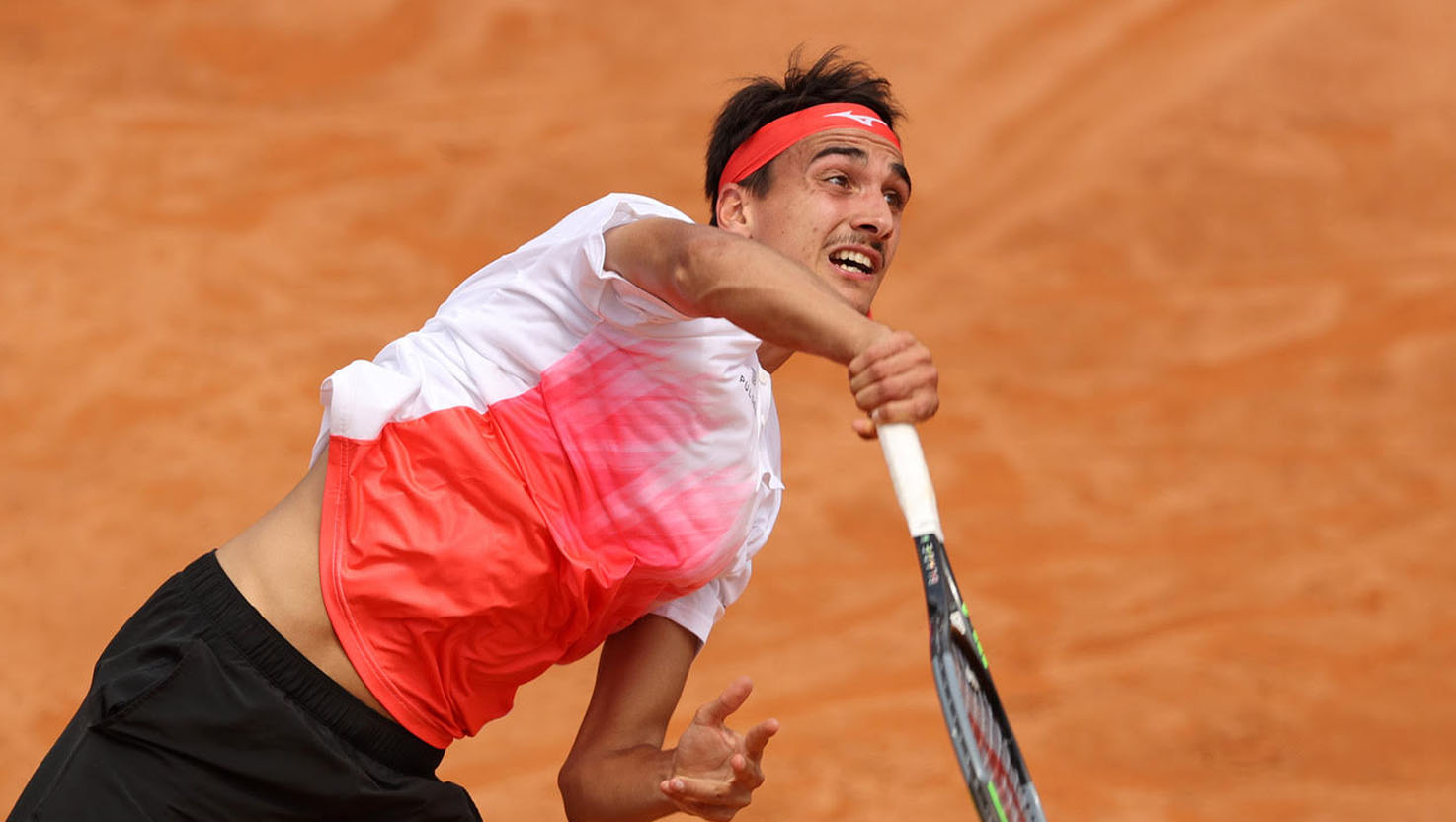
The players returned to finish the match in a near-empty stadium, with all emotional home-court advantage wiped clean. Sonego broke immediately, was broken back, and held on tight for a deciding breaker, where, a pair of Thiem backhand lasers notwithstanding, he outclassed the prince of clay and notched the second top 10 win of his life. “It’s amazing, an unbelievably emotional moment for me because I’m in Rome, in my Italy with fans for two sets," he said afterward. At a particularly emotional juncture of the match, the commentator on my Tennis TV feed declared that Lorenzo was “more Italian than Jannik in terms of character and personality,” and while I feel pretty uncomfortable (and unqualified) delivering verdicts on the relative Italianness of elite tennis players, I will simply observe that Sonego, shaking his hips on the court after his victory, looked awfully happy to be winning in Rome on home clay.[vc_empty_space height="10px"]Above: Lorenzo Sonego serves big in Rome. (Getty Images)[vc_column width="1/6"][vc_tweetmeme share_via="racqetmagazine"][vc_column width="1/6"][vc_facebook type="button_count"][vc_column width="1/6"][vc_column width="1/6"][vc_column width="1/6"][vc_column width="1/6"][vc_empty_space height="45px"][vc_column width="1/4"][vc_column width="1/2"]

GET ISSUE 16 NOW

racquet_issue-16

[vc_btn title="GET IT NOW" style="outline" shape="square" color="success" size="lg" align="center" button_block="true" link="url:https%3A%2F%2Fracquetmag.com%2Fproduct%2Fissue-no-16%2F|title:GET%20IT%20NOW||"][vc_column width="1/4"]

Stay in touch

Sign up for our free newsletter

More from Racquet

The Disappearing American College Tennis Player

These days, American college tennis is barely that: American

April 3, 2026

The Elegant Order of the Court

Sure, game-play conditions may vary, and a maintained court is more enticing for actual play, but as purely aesthetic fascinations, the inherently satisfying rationality of court design endures. 

April 3, 2026

The Morte d’Arthur Was Greatly Exaggerated

Frenchman Arthur Fils—the charisma bomb—is back and looking better than ever.

March 30, 2026

An Open Letter To Daniil Medvedev: Are You “So Back?”

Racquet’s See You In Court is a regular column in which Melissa Kenny, a famously mediocre lifelong player, opines on pro tennis. She also writes Hard Hitting, a Substack about the thrills and frustrations of recreational tennis.

March 20, 2026

Dispatches from the Desert

Our Managing Editor Wendy Laird is on the grounds and has Dispatches from the Desert coming in on a regular basis: Today the BNP Paribas Open is over. Long live the BNP Paribas Open.

March 6, 2026

A Playable Feast

There’s something wonderful about seeing “closed for the season” on a hotel’s website. They’re just four words, but they say so much: we don’t wring every penny from this property; this location has a “season;” this hotel values your experience far too much to stay open during sub-par weather. “Closed for the season” has a lot of sexy indifference to it; it makes you want to visit even more.

March 2, 2026
See all posts