

Skip to Content
Newsletter

Stefanos Tsitsipas Is Hanging in There

By Giri Nathan

Let us be frank: Things could have gotten funky with Stefanos Tsitsipas during a suspended tennis season. Life in a pandemic had plenty of us reconsidering routines, as the sudden departure from the everyday made stark what we liked and disliked about that everyday. Many will emerge from the other side with priorities reshuffled, a fresh worldview. For a tennis player, the burdens of international travel and grueling matches were lifted. For a tennis player of means, this meant unusual stretches of free time, which might allow them to entertain other flights of fancy—and for Tsitsipas in particular, there are many, many fancies. Just as a certain Australian pro could have (and may still) emerged from lockdown as a full-time videogame streamer specializing in first-person shooters, the young Greek could have emerged a full-time YouTube personality and travel photographer. He had once told me that his mind occasionally drifted off to his filmmaking while he was on the court. What would happen when this vivid mind was left to wander for months at a time?

And yet, here he is, back on the courts. For all his hobbies, the reality is that Stef wants so badly to do the biggest things in tennis that no version of Final Cut could divert his attention for long, no matter how many bonus features. Which is not to say there weren’t some hiccups. There was that third-round US Open loss to Borna Coric, an implosion for the ages, which he later referred to as the “saddest and funniest at the same time thing that has ever happened in my career!” But then he recovered from that. There was the rocky transition to clay, of which he said tersely, “In all honesty, it hasn’t been the best so far. So, yep,” and went on to lose his first match in Rome. But then he recovered from that, and made a final at Hamburg, followed by the second major semifinal of his life, this time at Roland-Garros. After the restart he racked up a 15–7 record heading into London. “I don’t want to be a kid anymore. I want to be treated as a man,” he told The Guardian in a recent interview. Last year it was here, in London, where the kid emphatically broke out into tennis adulthood, winning the ATP Finals on his first try.

He will not reprise that performance in this strange 2020. He was eliminated after a loss to Rafael Nadal on Thursday, in a lurching, exhausting match that probably should not have been as close as it appeared on paper. Nadal won a tight first set, and looked well on his way to closing out the second. Rafa was cruising through service games in the second set, winning his first 11 points. He hadn’t lost any points on second serve, either, and then came the 4–5 game...where he proceeded to double-fault on break point. That tiny lapse in quality opened the match up to a whole third set, which itself was of dubious quality, opening with three straight breaks. Nadal put it away to win 6–4, 4–6, 6–2 and advance to the semifinal. The easiest flaw to identify in Tsitsipas’ game is his return, and he will struggle to regularly compete with players of this caliber until he figures out a way to hang around in those games. That lesson was repeated in this match, which ended his season. Nadal, meanwhile, will look to win this tournament for this first time, with much fresher legs than he would otherwise be sporting in late November.

stef3
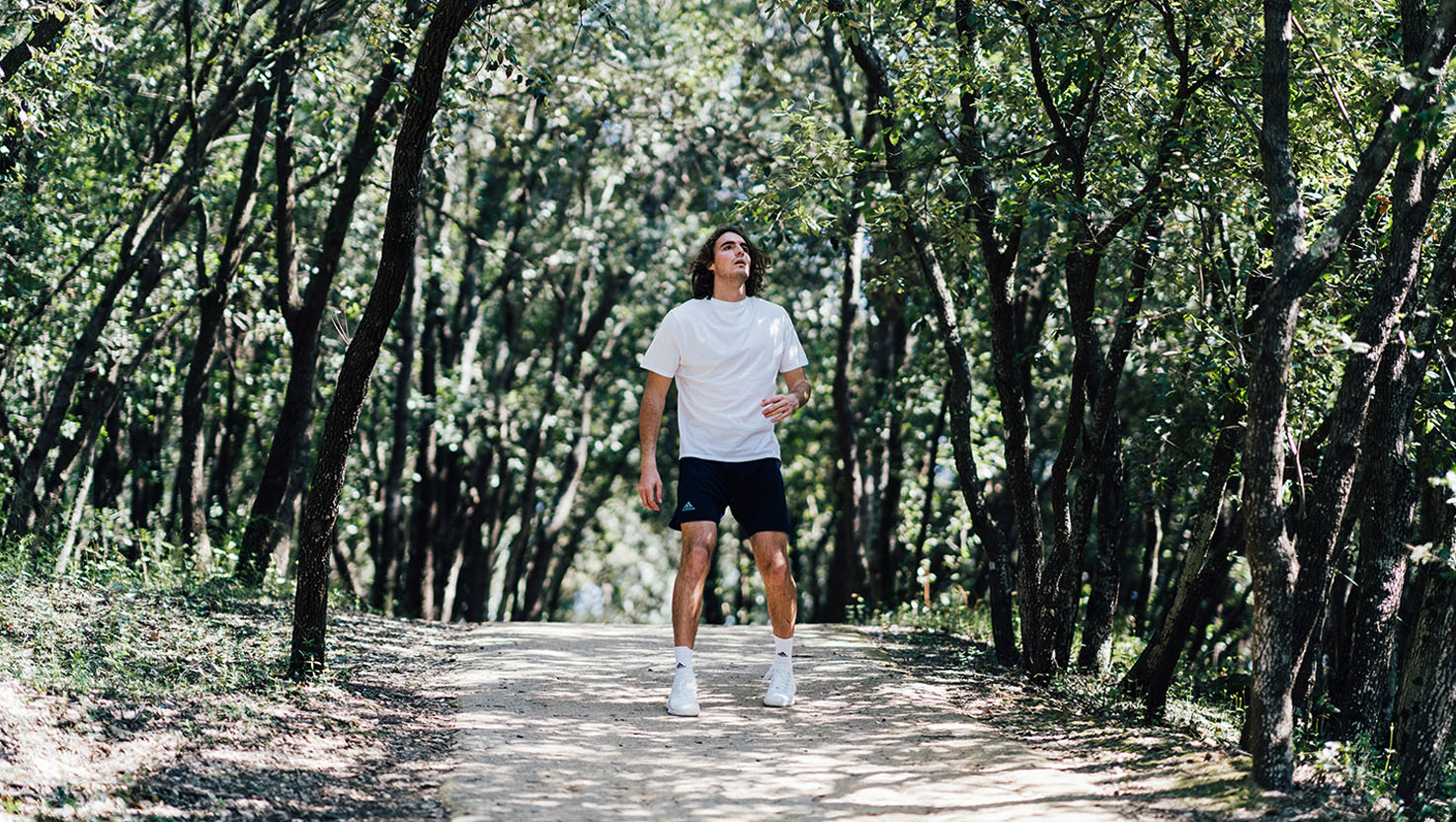
More mood, as seen in Issue No. 14.

But Tsitsipas is probably dwelling on bigger things than his return quality at the moment. At the presser after his loss, he was asked about the difficulties of this year spent migrating from bubble to bubble, playing in vacant stadiums. “It feels very—to me, it feels very dark, and honestly, I’m not a person who sees the dark side of things. But the whole thing was very difficult to handle, to be honest with you,” he said. “I’m very happy that I didn’t break down, and I’m sure if you ask other players they are going to respond the same way.” This is the singular joy of following him: an almost awkwardly sincere, unfiltered view of the inner life of a top young athlete, with all its ups and downs. He is not one for self-consciousness or playing it cool. He tells it like it is, and, for him and so much of the world, it sucks, so he says as much: “It’s a different world, I would say. I will describe it as a different world and we are very lonely.” No disagreement there, Stef.

Shop Now
adidas x Racquet
Dominant Jacket

racquet_adidas-dominantjacket

[vc_btn title="SHOP NOW" style="outline" shape="square" color="success" size="lg" align="center" button_block="true" link="url:https%3A%2F%2Fracquetmag.com%2Fproduct%2Fadidas-x-racquet-dominant-jacket%2F|title:SHOP%20THE%20COLLECTION||"][vc_column width="1/4"]

Stay in touch

Sign up for our free newsletter

More from Racquet

From the Trenches of the World’s Most Obscure Racquet Sport

Stické tennis was invented in the 1870s in England, i’s a hodge-podge of tennis, squash, and real tennis. The game disappeared after the First World War. Just two courts are still playable. Yes, stické is the world’s most obscure racquet sport.

April 17, 2026

Racquet Retreat at Sensei Had us Breathing Easier

During this year's Indian Wells tournament, we launched a first-ever restorative trip for our nearest and dearest at the exclusive Porupine Creek property, and the results were... relaxing.

April 17, 2026

Jannik Sinner Can’t Lose (Except at Content)

When Aryna Sabalenka’s on-court intensity translates into campy, self-congratulatory TikToks, harmony is felt and sense is made. But Jannik’s on-court persona, tightly controlled like an unseasoned chicken breast, respectfully, need not be repackaged for YouTube. Because where is the flavor?!?

April 13, 2026

Issue No. 28: Tennis is the Blueprint

“To create one’s own world takes courage.” —Georgia O’Keefe

April 13, 2026

The Disappearing American College Tennis Player

These days, American college tennis is barely that: American

April 3, 2026

The Elegant Order of the Court

Sure, game-play conditions may vary, and a maintained court is more enticing for actual play, but as purely aesthetic fascinations, the inherently satisfying rationality of court design endures. 

April 3, 2026
See all posts