

Skip to Content
Features

The Disappearing American College Tennis Player

These days, American college tennis is barely that: American

By Mikkel Bjerch-Andresen

11:55 AM EDT on April 3, 2026

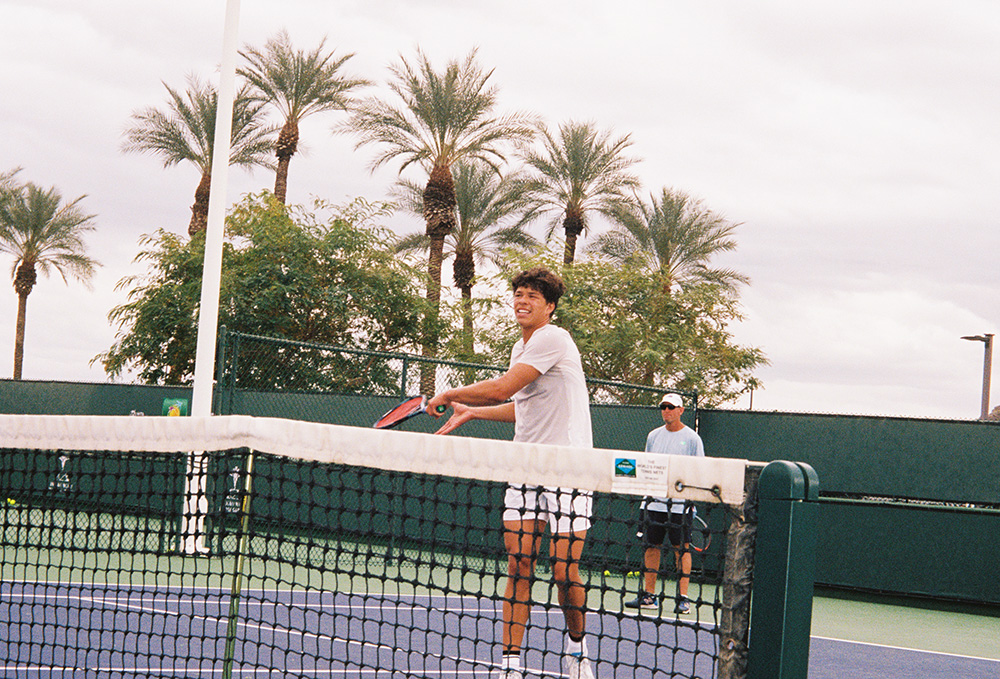
American Ben Shelton played two seasons of NCAA D1 tennis at the University of Florida before turning pro.

If lately it seems like college tennis has become more ‘international showcase’ and less ‘home-grown proving ground,’ that’s because it has. In 2005, roughly seven out of every ten incoming Division I tennis freshmen were born in the United States. Two decades later, that number sits below four in ten.

I've scraped and organized every publicly available DI tennis roster I could find from the past 20 years. The database covers more than 73,000 unique player-year entries from men's and women's programs across the country. I built it to answer a question that had been nagging me: how much has international recruiting actually changed the composition of college tennis? The answer turned out to be more dramatic than I expected.

I've done the same analysis on college golf rosters, where internationalization is well-documented; when I dug into tennis, the magnitude of change I encountered was double that of golf. In 2005, 69% of incoming women's tennis players and 71% of incoming men's players were U.S.-born. By 2025, those figures sat at 44% and 41%, a 30-percentage-point drop for both genders. College tennis has completely flipped.

The casual tennis fan has likely noticed the shift. Walk into any college match and you'll hear accents from across Europe, South America, and Asia. But most people who follow college tennis, even closely, likely wouldn’t guess international recruiting has doubled.

The Math

The percentages matter because they translate into real roster spots. According to NCAA participation reports, Division I tennis has maintained relatively stable roster sizes throughout this period, roughly 5,000 to 5,200 total players between men's and women's programs combined. Men's tennis saw a slight decline in total spots over 20 years. Women's stayed more stable.

When compared to the participation report, my database captures between 65% and 80% of all Division I tennis players in any given year. The coverage is strong enough to estimate what the U.S. decline means in absolute terms: Take the NCAA's total participation numbers, apply the observed U.S.-born rates, and a 30-percentage-point decline across roughly 5,000 spots works out to approximately 1,500 fewer American players on DI tennis rosters today compared to 2005.

That's 1,500 American high school juniors who would have had college tennis opportunities twenty years ago who don't have them today. Because those spots went to someone from another country, not because the total number of roster spots shrank dramatically.

It's Happening Everywhere

You might assume this is a Power-4 phenomenon. Elite programs recruiting globally to compete for national championships, mid-tier and lower-tier schools picking up the American talent the big programs passed over.

The data says otherwise.

Power-4 programs in the dataset (the SEC, Big Ten, ACC, and Big 12 as traditionally configured) have seen their U.S.-born freshman share drop from roughly 65% to 45% over twenty years. The decline is steady and consistent. Women's tennis at Power-4 schools shows more year-to-year volatility, but the trend points the same direction as men's.

Power-4

Non-Power-4 programs—the roughly 200 Division I schools outside the four wealthiest conferences (SEC, Big Ten, ACC, Big 12), often called 'mid-majors’—tell a sharper story. These schools—the ones that used to be landing spots for strong regional players or late bloomers—have watched their U.S.-born share drop from around 70% to below 40%. The decline is steeper and more uniform than at Power-4 schools; the mid-tier programs—once the backbone of American college tennis—have embraced international recruiting with the same intensity as the Power-4 schools.

Non-Power-4 U.S.-born freshman share, 2005-2025

I've done this same analysis on men's and women's college golf, drawing on a database of 75,000 players across 21 seasons. Internationalization shows up there too. D1 men's golf went from 86% American to 71% over the same period, and women's golf from 83% to 65%. That's significant, but it's roughly half the magnitude of what's happened in tennis. And the gap widens at the mid-major level. Non-Power-4 golf programs have internationalized more slowly than their tennis counterparts. The difference comes down to the global talent pool. Tennis is one of the most popular sports in the world, and countries like Spain, France, and Serbia produce elite junior tennis players at a rate that golf-playing nations simply don't match. 

An American junior gunning for a mid-major roster spot now faces the same global talent pool flooding rosters at blue-blood programs. The pathway that used to exist— play well regionally, land a scholarship at a solid mid-tier school, develop during your college years—has narrowed significantly.

In 2005, being a strong state-level player gave you a legitimate shot at a DI roster spot. Most programs recruited heavily within their region. By 2025, that's no longer enough. You're competing against players who've been training full-time at European academies since age 12.

Why Coaches Recruit Internationally

The shift didn't happen by accident. Coaches at every level made deliberate choices, driven by a changing marketplace and a simple calculation: who gives me the best chance to win right now?

A Division I women's tennis head coach, who asked not to be named, explained it to me this way: "In many countries outside of the United States, tennis is a top sport in terms of popularity. These countries are attracting the best athletes to play tennis. In the United States, tennis has really fallen behind other sports, so it is not attracting the best athletes, and there are fewer players to compete with the top internationals."

His point resonated with what I've seen on the golf side. In the U.S., the best young athletes get pulled toward football, basketball, baseball, soccer, lacrosse. A 6'2" kid with fast hands and good footwork might be steered toward basketball or wide receiver before anyone hands him a racquet. In countries like Spain, France, Croatia, and Serbia, that same kid grows up watching tennis on prime-time television. The international player pool runs deeper because the sport sits higher in the cultural hierarchy.

Budgets and salaries have grown across college athletics, but the pressure to produce results has outpaced both. Coaches at every level feel it. A mid-major head coach has the same job security concerns as a Power-4 coach, often with a fraction of the budget. Most turn over every stone to field the strongest roster they can. International players, even at the mid-major level, have often trained at academies, competed in ITF junior tournaments, and come from tennis cultures with deeper competitive infrastructure. They arrive on campus ready to contribute.

The pull works in both directions. Stanford sophomore Max Basing, from Oxshott in Surrey, England, explained to The Stanford Daily why international players are drawn to U.S. college tennis. Asked what college athletics looks like in the United Kingdom, his answer was blunt: "It doesn't really exist." He added, "They don't have that level of college sports, of funding, of facilities just all around the country where people can go and still take their sports seriously and pursue an education."

College tennis scholarships represent extraordinary value for families in Eastern Europe, Latin America, and parts of Asia. A U.S. degree combined with four years of high-level tennis training, world-class facilities, and competitive match play against top opponents is a package that doesn't exist anywhere else in the world. The willingness to grind through the demands of a college season, to juggle academics and athletics in a way that American students sometimes resist, runs high among international recruits. For many international families, the decision is obvious.

The Consequences

The consequences show up in places you might not expect. Tennis consistently ranks among the highest-transferring NCAA Division I sports. Around one in seven men's players and one in nine women's players switch schools each year, most moving to a different college tennis program. International students transfer at higher rates than U.S. players, according to Parenting Aces.

Some programs don't survive at all. When Southern Utah's tennis programs were cut in 2020, women’s head coach Michael Mucci connected the dots. "If we had more Americans from the Mountain region like Nevada, Utah, Arizona over the course of the last five to 10 years," he told Tennis.com, "then the support may have been better so maybe we'd have more donors, fundraising opportunities for facilities and maybe this wouldn't have happened." Mucci also added "But there are so many programs that got cut even with a ton of Americans, so I believe it really depends on the situation."

Mucci's program isn't an isolated case. Men's tennis has been hit harder by program cuts than almost any other college sport. Dick Gould, who won 17 NCAA titles coaching at Stanford, identified the vulnerability years earlier. "If you're a state school that gets state and public funding, and your team is 70% international players," he said, "I think that makes your sport an obvious target."

Wayne Bryan, whose sons Bob and Mike played at Stanford before becoming the most successful men's doubles team in tennis history, has been vocal about this for two decades. In a 2020 piece for Merion West, he wrote that he'd "been fighting against the foreign player glut in American college tennis for the past 20 years, but have been spectacularly unsuccessful in reducing the size of this giant elephant in our midst."

I see Bryan's point. The data validates the speed of change he was flagging all those years ago. But what concerns me most is the feedback loop: Fewer American players on rosters means less local connection to college tennis. Less local connection makes programs easier targets when athletic departments need to trim budgets. Fewer programs means fewer opportunities for American juniors, which leads to more international recruiting to fill the remaining spots. The cycle could potentially reinforce itself.

For American junior tennis development, the trend raises uncomfortable questions. College tennis has long been the centerpiece of the American player development pathway. If those rosters are increasingly filled by international players, what happens to the pipeline that feeds American professional tennis? Does it push American athletic talent toward other sports even faster? The data can't answer those questions directly. But it provides the foundation for asking them seriously.

The Stabilization Question

One detail in the data stands out: The decline appears to have slowed in recent years. The 2024 and 2025 freshman classes show U.S. rates hovering around 41-44%, with less dramatic year-over-year drops than the 2010s showed.

It's too early to call this a genuine plateau. Sample sizes for the most recent years are still small, and rosters continue to get updated. The transfer portal and NIL rules add new variables that could push the numbers in either direction. But if the stabilization is real, it would suggest we've hit a natural equilibrium somewhere around 40%. Even in a globalized market, there are practical limits on how international a roster can become; visa restrictions, cultural adjustment, recruiting logistics across time zones, and institutional pressure at public universities to maintain domestic players all create a floor.

A floor at 40% is still a different world than 70%, however. For American juniors, college tennis is no longer a presumed destination for strong regional players; rather, it's a competitive outcome that demands serious credentials. And for parents investing years and thousands of dollars in junior tennis development, those odds matter.

For an American junior today, what used to get you recruited at a solid mid-major program might now only be good enough for Division II. What used to land you at a Power-4 school requires credentials that most American juniors can’t access.

The era of American-dominated college tennis rosters is over. The 2005 model, where seven out of ten spots went to U.S.-born players, isn't coming back. The shift happened steadily, over two decades, across every conference and every tier. And it happened because the incentives for coaches and international players lined up perfectly, while American junior tennis didn't adapt fast enough to compete. What remains is a smaller, more competitive share of a sport that long sat at the heart of the American college athletic experience.

[Data note: This analysis is based on publicly available Division I tennis rosters from 2005-2025, representing approximately 73,000 player-year observations. Coverage rates range from 65-80% of total NCAA-reported participants in any given year. U.S.-born rates are calculated from freshman classes where origin data is available, then applied to total NCAA participation figures to estimate absolute numbers.]

Mikkel Bjerch-Andresen is a sports data analyst and former NCAA Division I golf coach based in Oslo, Norway. When he's not scraping college rosters into spreadsheets, he's coaching junior golfers or running half-marathons with a double stroller.

Stay in touch

Sign up for our free newsletter

More from Racquet

The Elegant Order of the Court

Sure, game-play conditions may vary, and a maintained court is more enticing for actual play, but as purely aesthetic fascinations, the inherently satisfying rationality of court design endures. 

April 3, 2026

The Morte d’Arthur Was Greatly Exaggerated

Frenchman Arthur Fils—the charisma bomb—is back and looking better than ever.

March 30, 2026

An Open Letter To Daniil Medvedev: Are You “So Back?”

Racquet’s See You In Court is a regular column in which Melissa Kenny, a famously mediocre lifelong player, opines on pro tennis. She also writes Hard Hitting, a Substack about the thrills and frustrations of recreational tennis.

March 20, 2026

Dispatches from the Desert

Our Managing Editor Wendy Laird is on the grounds and has Dispatches from the Desert coming in on a regular basis: Today the BNP Paribas Open is over. Long live the BNP Paribas Open.

March 6, 2026

A Playable Feast

There’s something wonderful about seeing “closed for the season” on a hotel’s website. They’re just four words, but they say so much: we don’t wring every penny from this property; this location has a “season;” this hotel values your experience far too much to stay open during sub-par weather. “Closed for the season” has a lot of sexy indifference to it; it makes you want to visit even more.

March 2, 2026

In Dubai, Uncertainty on Court and in the Skies

By the end of the week, it was hard to tell what felt more fragile: the schedule, the draw, the final, or the belief that sport can stay separate from the world around it.

February 28, 2026
See all posts