

Skip to Content

[vc_empty_space height="5px"]

By Giri Nathan

[vc_empty_space height="15px"]Once you’re done appreciating how convincingly Iga Swiatek claimed the No. 1 slot in the WTA, you might then turn to the analogous situation on the men’s tour, as queasy as Iga’s is satisfying. How often do you see a perfectly healthy world No. 1 who, by mid-April, has only this scribbled on the season résumé: a fired coach, two wins, and two losses? That’s where we are right now with Novak Djokovic, scarcely playing tennis, but firmly on top of it.

There’s no reason to believe that he wouldn’t still be the best player on tour, if he were only playing a normal schedule. I have cheese in my fridge old enough to remember when this guy was closing in on the Calendar Slam. As inspired as we all were by the near-perfect hard-court swing of Rafael Nadal, and as shaken as I am by the existence of Carlos Alcaraz, I know that the former has a stress fracture in his rib that needs healing, and the latter is a mere babe too young to know the hurt of full-strength Djoker. Were he touring normally, I’d be picking Novak to take any tournament of consequence. But you can’t ignore the burps and bumps of the past few months.

He started the year with some international humiliation, courtesy of the Australian government. It was his fault he wound up at the whims of these bureaucrats, and it was their fault it played out so grotesquely, and it’s everyone’s fault that I cannot spend another sentence lingering on this stupid debacle. The next challenge for Novak was finding a tennis tournament that would have him. If you’re looking for places that aren’t terribly scrupulous about the überwealthy and powerful people allowed in, you could always do worse than Dubai. Djokovic, who’s won the title there five times, showed up and beat Lorenzo Musetti and Karen Khachanov, only to lose to qualifier Jiri Vesely. Not long after, he fired his forever coach, pal, and countryman, Marian Vajda.

Novak Djokovic’s career could be split into two parts. There’s the big part where he employed Marian Vajda and won 20 Slams and 37 Masters. And there’s the little slice where he did not employ Marian Vajda and lost to Nick Kyrgios twice in two weeks. That stretch in 2017–2018 was the least fruitful patch of his prime, and he was drifting around in search of radical solutions. When he booted Vajda and the rest of his team during the 2017 clay swing, he said he was looking for “shock therapy.” (Was it shock therapy he needed, or just a sorely needed elbow surgery, delayed because he wanted his body to repair itself with “natural” methods? I leave it to the reader to decide.) This time, at least, instead of ditching the whole camp, he’s keeping the continuity with his other coach, Goran Ivanisevic.

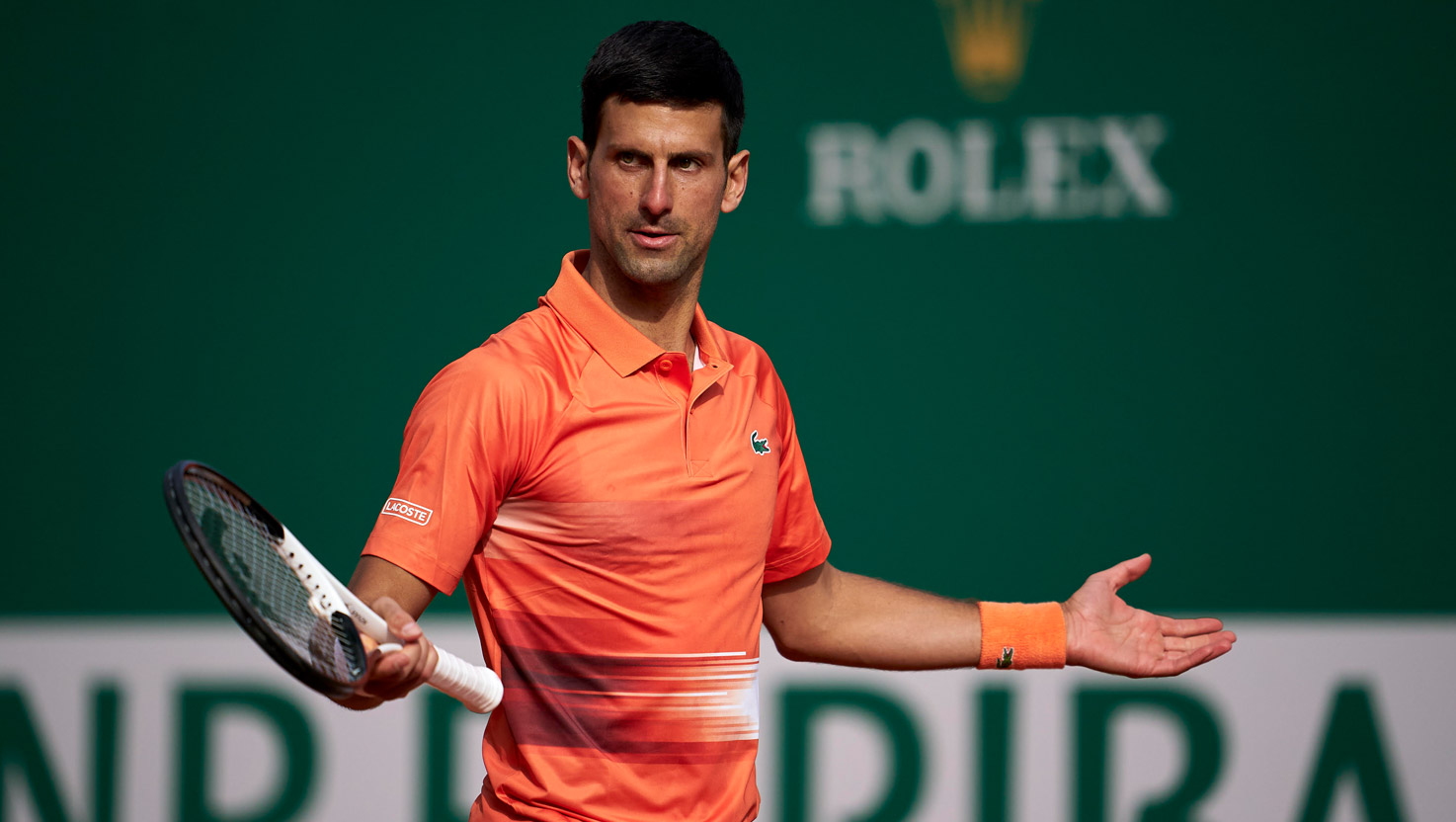
An unvaxxed Djokovic couldn’t get into the U.S. to play in Indian Wells or Miami. Daniil Medvedev became world No. 1 in his absence, but his reign was short-lived, as he didn’t make a dent at either tournament. Later he’d reveal that he’d been playing through a “small hernia,” which now needs repairing. (Medvedev’s love affair with clay will have to wait another year to be rekindled.) Djokovic came back to Monte Carlo this week, only to lose to the spunky Alejandro Davidovich Fokina, vanishing in the third set. “I just ran out of gas completely. Just couldn’t really stay in the rally with him. I mean, if you can’t stay in the rally, not feeling your legs on the clay, it’s mission impossible,” he said afterward. He remains 10 points ahead of Medvedev. For a man wandering the wilderness, refuge doesn’t get much sweeter than next week’s tournament plans: the home courts in Belgrade, bearing his name.[vc_empty_space height="10px"]Above: Novak looks for answers in Monte Carlo. (Getty)

[vc_column width="1/6"][vc_tweetmeme share_via="racqetmagazine"][vc_column width="1/6"][vc_facebook type="button_count"][vc_column width="1/6"][vc_column width="1/6"][vc_column width="1/6"][vc_column width="1/6"][vc_empty_space height="45px"][vc_column width="1/4"][vc_column width="1/2"]

NOW AVAILABLE
Issue No. 18

racquet_issue-18

[vc_btn title="BUY NOW" style="outline" shape="square" color="success" size="lg" align="center" button_block="true" link="url:https%3A%2F%2Fracquetmag.com%2Fproduct%2Fissue-no-18%2F|title:GET%20IT%20NOW||"][vc_column width="1/4"]

Stay in touch

Sign up for our free newsletter

More from Racquet

Postcard from Egypt: I Turned a Vacation into an ITF

One 37-year old former D3 player trying to stay fit while traveling with her husband and toddler gets carried away and enters a pro tournament at the encouragement of her hotel pro. What could go wrong?

May 1, 2026

Michael McGregor’s Tennis Love Story

The vibrant and idiosyncratic still lifes—often composed on hotel stationary—are the work of artist Michael McGregor, whose roots in a “huge tennis family” inform one of his favorite themes.

April 28, 2026

Pàdel Shots: a Lexicon

A by-no-means-exhaustive list of the names and neologisms that define a new(ish) sport

April 27, 2026

Why Everyone You Know is Playing Padel

Many sports like to claim that they’re the fastest-growing, and they often have a legitimate claim to the title, depending on how you measure it. But, by almost any yardstick, pàdel really is the world’s fastest-growing sport.

April 27, 2026

Have Pàdel Will Travel

The hottest clubs around the world don’t feature EDM dance floors or after-hours speakeasies. They’re racquet-centric, they’re wellness-affiliated, and they’re taking advantage of the fastest-growing sport on the planet. Welcome to the global network of pàdel.

April 27, 2026

Pàdel Party in the U.S.A.

Pàdel is about people. Whether you play competitively and want to win, or play socially and need a reason to wear that outfit, it revolves around coming together as a team to make all the different reasons come to life.

April 27, 2026
See all posts